George Perkins Marsh Boyhood Home
Boyhood home of conservationist George Perkins Marsh.
Last updated
Where it is
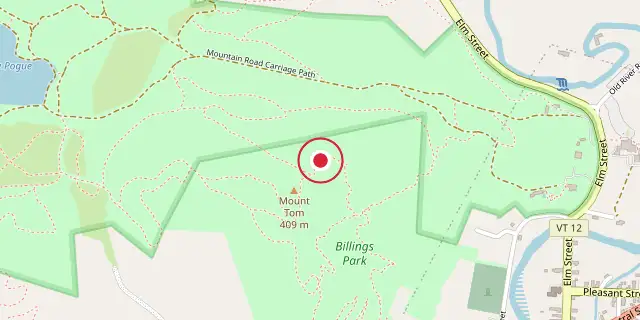
Coordinates: 43°37′52″N 72°31′44″W (43.6310, -72.5290) · Open in OpenStreetMap
Coordinates and connected clubs: the infobox of Wikipedia: George Perkins Marsh Boyhood Home (CC BY-SA 4.0). Map: drawn by Codexery from OpenStreetMap tiles.
The George Perkins Marsh Boyhood Home, also called the Marsh-Billings House or Marsh-Billings-Rockefeller Mansion, is the central building of Marsh-Billings-Rockefeller National Historical Park in Woodstock, Vermont. It was the childhood residence of George Perkins Marsh, an early conservationist, and later the home of Frederick H. Billings, a railroad executive and philanthropist. The house is a National Historic Landmark and a notable example of Queen Anne architecture.
History
Charles Marsh, a prominent Vermont lawyer, built the core of the main house in 1805 as a two-story five-bay Federal style residence and raised his family there. His son George Perkins Marsh, born elsewhere in Woodstock in 1801, grew up in this house before leaving for Dartmouth College at age sixteen. George followed his father into law and politics, serving in Congress as a Whig from 1834 and later in diplomatic posts under Presidents John Tyler and Abraham Lincoln.
Between the 1830s and 1860s he developed a philosophy of land stewardship, publishing Man and Nature in 1864, which assessed historical societal decline due to poor stewardship and called for environmental preservation. He died in 1882. In 1869 Frederick H. Billings, a Vermont native who made his fortune in California land claims and co-founded the Northern Pacific Railroad, bought the 246-acre Marsh estate. Between 1869 and 1881 he commissioned two major house enlargements, the second by Henry Hudson Holley transforming it into a Queen Anne Victorian.
Billings established a model farm on the property, now the Billings Farm & Museum, and built 14 miles of carriage roads through the upland estate.
Features and facilities
The park sits just northwest of Woodstock village on the west side of Vermont Route 12. Across the road is Billings Farm & Museum, a working farm and heritage museum on former Billings land. Parking for both sites is on the east side of VT 12, with National Park Service staff at both the farm's visitor center and a visitor center on park property. The area near the road is landscaped and contains the George Perkins Marsh Boyhood Home, a National Historic Landmark.
Though built in 1805, the house was greatly altered under Frederick Billings to its Late Victorian appearance. Guided tours are available by reservation and include displays of landscape paintings, notably a collection of Hudson River School works, showing the influence of painting and photography on the conservation movement.
The gardens have been restored. Westward, carriage roads and trails cross over 600 acres of conservation landscape, passing a pond and several scenic viewpoints. Trailhead access is also provided on Prosper Road.
Did You Know?
- The park was the first U.S. national park to receive Forest Stewardship Council certification for sustainable forest management, awarded in August 2005.
- The park was honored in 2020 by being placed on Vermont's America the Beautiful quarter.
- The property was given to the United States by Mary French Rockefeller and Laurance Rockefeller in 1992.
More in National Historical Parks of the United States
Sources
Compiled from Wikipedia and the sources listed below. Text from Wikipedia is available under CC BY-SA 4.0; this entry is adapted from it.
- Wikipedia: George Perkins Marsh Boyhood Home (CC BY-SA 4.0).
Spotted an error? Know more?
Reader corrections go straight into our review queue. Suggest an edit · How this site is sourced