Lyndon B. Johnson National Historical Park
Preserves the Texas White House and Johnson family ranch.
Last updated
Where it is
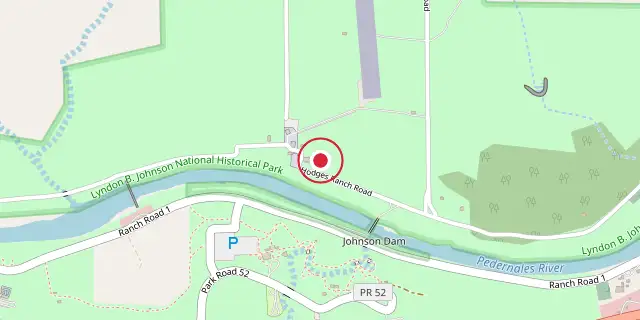
Coordinates: 30°14′28″N 98°37′26″W (30.2410, -98.6240) · Open in OpenStreetMap
Coordinates and connected clubs: the infobox of Wikipedia: Lyndon B. Johnson National Historical Park (CC BY-SA 4.0). Map: drawn by Codexery from OpenStreetMap tiles.
Deep in the Texas Hill Country, about fifty miles west of Austin, lies the Lyndon B. Johnson National Historical Park. This site preserves the 36th president’s birthplace, home, working ranch, and final resting place.
Johnson’s ranch, known as the Texas White House, was outfitted with full communications gear so he could govern from there about a fifth of his time in office. He donated the ranch to the public in his will, insisting it remain a living, working ranch rather than a lifeless museum. After his death, Lady Bird Johnson also lived there until 2007.
Districts and features
The park is split into two separate sections: the Johnson City District and the LBJ Ranch District. In Johnson City, the Johnson City District holds the president’s childhood home, his grandparents’ log cabin settlement, and the National Park Visitor Center. About 14 miles west, the LBJ Ranch District sits on the north side of the Pedernales River in Gillespie County. This ranch served as the Johnson family’s getaway during his most powerful years and includes the family cemetery, offering a window into his time in office.
Johnson City
The Johnson City Unit lies on the town’s south side, with parking at the visitor center on Lady Bird Lane and at the intersection of U.S. Route 290 and N Street. Housed in a former hospital, the visitor center offers exhibits, films, and an overview of the park, focusing on President Johnson and his wife Lady Bird. A short walk north stands the Johnson Boyhood Home, an 1880s Victorian house where he lived from age five. Johnson restored this home while president, and it became a National Historic Landmark in 1965. West of the visitor center is the Johnson Settlement, a restored prairie featuring his grandfather’s dogtrot house and other 19th-century farm buildings.
LBJ Ranch
The ranch sits on the north side of U.S. Route 290, about 14 miles west of Johnson City. Access is through the Lyndon B. Johnson State Park and Historic Site, which sits between the highway and the Pedernales River’s south bank. National Park Service land lies north of the river. Preserved sites at the ranch include the president’s first school, his reconstructed birthplace, the Texas White House, and the Johnson Family Cemetery, where both President and Lady Bird Johnson are buried.
Visitors take a self-guided driving tour from the State Park visitor center, requiring a permit. Unusually for a presidential home, and by Johnson’s own request, the ranch keeps a herd of Hereford cattle descended from his own stock. On August 2, 2018, the National Park Service closed the Texas White House and Pool House to visitors due to structural problems, and as of 2026, these buildings remain closed for tours.
Frequently Asked Questions
Where is Lyndon B. Johnson National Historical Park?
Lyndon B. Johnson National Historical Park is located in Blanco and Gillespie County, Texas, U.S.
When was Lyndon B. Johnson National Historical Park founded?
Lyndon B. Johnson National Historical Park was founded on December 2, 1969.
More in National Historical Parks of the United States
Sources
Compiled from Wikipedia and the sources listed below. Text from Wikipedia is available under CC BY-SA 4.0; this entry is adapted from it.
- Wikipedia: Lyndon B. Johnson National Historical Park (CC BY-SA 4.0).
Spotted an error? Know more?
Reader corrections go straight into our review queue. Suggest an edit · How this site is sourced