Abraham Lincoln Birthplace National Historical Park
Two Kentucky farm sites from Lincoln's early life.
Last updated
Where it is
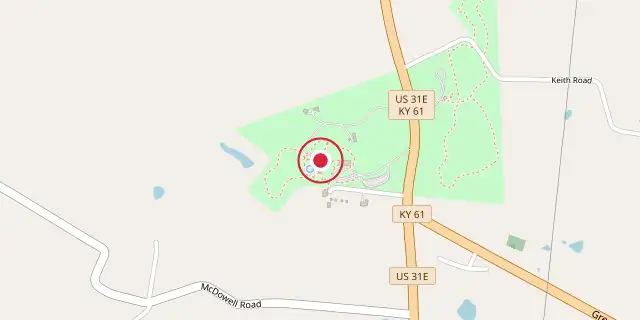
Coordinates: 37°31′52″N 85°44′13″W (37.5310, -85.7370) · Open in OpenStreetMap
Coordinates and connected clubs: the infobox of Wikipedia: Abraham Lincoln Birthplace National Historical Park (CC BY-SA 4.0). Map: drawn by Codexery from OpenStreetMap tiles.
Abraham Lincoln Birthplace National Historical Park preserves two farm sites in LaRue County, Kentucky, associated with Abraham Lincoln's birth and early childhood. Lincoln was born at the Sinking Spring site and later lived at the Knob Creek Farm until age seven. The park's visitor center is located at the Sinking Spring site.
Sinking Spring
Thomas and Nancy Lincoln settled on Sinking Spring Farm in late 1808, and Abraham Lincoln was born there on February 12, 1809, in a one-room log cabin. A neoclassical memorial building designed by John Russell Pope now encloses a symbolic cabin representing the one in which Lincoln was born. The cornerstone was laid on February 12, 1909, by President Theodore Roosevelt, and the building was dedicated on November 9, 1911, by President William Howard Taft.
The memorial features 16 windows, 16 ceiling rosettes, and 16 fence poles to signify Lincoln as the 16th president, and 56 steps leading to the entrance represent his age at death. The original cabin was dismantled before 1865, and logs from a nearby house were later used by Alfred W. Dennett to construct a similar cabin that toured many cities. The Lincoln Farm Association acquired logs from multiple sources, including some incorrectly attributed to Jefferson Davis's birthplace, and eventually placed a reduced-size cabin inside the memorial. The logs in the current cabin mostly date to the 1840s and depict a typical mid-19th-century cabin.
Knob Creek
Lincoln moved with his family to Knob Creek Farm northeast of Hodgenville when he was two years old and lived there until age seven in 1816. The farm comprises 228 acres, with the Lincolns occupying 30 acres leased by Thomas Lincoln along the Old Cumberland Trail. At this farm, Lincoln's brother Thomas was born and died, and Lincoln nearly drowned in the creek before being rescued by neighbor Austin Gollaher. The family moved to Indiana in December 1816.
The Lincoln cabin was later taken down by Gollaher and used to build a horse stable, which was washed away by a flood. Two historical buildings remain: the Lincoln Tavern, built in 1933 as a dance hall that later became a museum and gift shop, and the Gollaher Cabin, likely built around 1800 and moved to the site to represent the Lincoln cabin. The farm was listed on the National Register of Historic Places on November 16, 1988, and was added to the national park in November 2001 after purchase by the Larue County Fiscal Court.
Administrative history
The Lincoln Farm Association constructed the memorial building at Sinking Spring between 1909 and 1911 and donated it to the federal government in 1916, establishing Abraham Lincoln National Park on July 17, 1916. The War Department administered the site until August 10, 1933, when it transferred to the National Park Service. It became Abraham Lincoln National Historical Park on August 11, 1939, and was renamed Abraham Lincoln Birthplace National Historic Site on September 8, 1959. The Knob Creek site was added on November 6, 1998, and the two sites were redesignated a National Historical Park on March 30, 2009.
More in National Historical Parks of the United States
Sources
Compiled from Wikipedia and the sources listed below. Text from Wikipedia is available under CC BY-SA 4.0; this entry is adapted from it.
- Wikipedia: Abraham Lincoln Birthplace National Historical Park (CC BY-SA 4.0).
Spotted an error? Know more?
Reader corrections go straight into our review queue. Suggest an edit · How this site is sourced