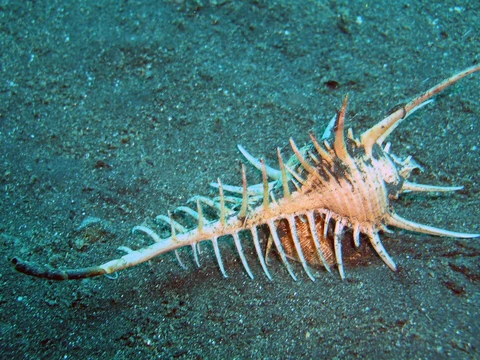
Vitularia salebrosa
An ectoparasitic murex snail that bores into host molluscs.

Vitularia salebrosa is a marine gastropod mollusk belonging to the Muricidae family, commonly known as murex or rock snails. Its shell ranges from 24 mm to 80 mm in length and is white or yellowish-brown, sometimes with bands. Thickened varices, when present, consist of several parallel, closely set laminae. The outer lip and columella have a yellow tint, and the operculum is diamond-shaped with two short upper sides, two longer lower sides, and rounded corners.
This species lives under rocks in intertidal and subtidal zones along the tropical Pacific coast of the Americas, from Baja California to Peru. It is an ectoparasite of other mollusks, drilling a hole through the host’s shell and feeding on its blood or digestive organs over several months. To support this suctorial feeding, it has a long proboscis, a reduced buccal mass, and a simplified digestive system compared to other muricids. Prey include the oyster *Ostrea* cf. *fisheri*, the limpet-like slipper shell *Crucibulum spinosum*, and the vermetid gastropod *Tripsycha (Eualetes) tulipa*.
Quick Facts
- Taxon
- Vitularia salebrosa
Facts from the source article.
Lore & Background
The shell of Vitularia salebrosa is white or yellowish-brown, sometimes banded, with occasional varices that are much thickened and composed of numerous parallel, close laminae. The outer lip and columella are tinged with yellow, and the operculum is diamond-shaped with rounded angles. The species ranges from Baja California to Peru on the tropical Pacific coast of America, living under rocks in intertidal and subtidal zones.
This snail is an ectoparasite of other molluscs. It bores a hole through the host's shell and sucks its blood or digestive organ (depending on the prey) over a period of months. Consistent with this suctorial feeding habit, it has a long proboscis, reduced buccal mass, and simplified digestive system compared to other Muricids. Prey include the oyster Ostrea cf. fisheri, the limpet-like slipper shell Crucibulum spinosum, and the vermetid gastropod Tripsycha (Eualetes) tulipa.
A related ectoparasite, Genkaimurex varicosus, is known from Japanese waters, where it parasitizes scallops.
Reader's Guide
Vitularia salebrosa represents a specialized feeding strategy within the Muricidae, being an ectoparasite that drills into the shells of other molluscs and feeds over months. Its long proboscis, reduced buccal mass, and simplified digestive system are adaptations to this suctorial lifestyle, distinguishing it from typical predatory murex snails. The species' prey includes the oyster Ostrea cf. fisheri, the slipper shell Crucibulum spinosum, and the vermetid gastropod Tripsycha (Eualetes) tulipa, indicating a broad host range among shelled molluscs. Its distribution along the tropical Pacific coast of America, from Baja California to Peru, places it in intertidal and subtidal rocky habitats. The shell morphology—with thickened varices composed of parallel laminae and a diamond-shaped operculum—aids in identification. The existence of a similar ectoparasite, Genkaimurex varicosus, in Japanese waters suggests that this feeding mode has evolved independently in different muricid lineages. The species was described in 1845 by Reeve with illustrations by G. B. Sowerby, and later discussed by Smith in 1947.
Did You Know?
- Vitularia salebrosa is an ectoparasite that bores a hole through its host's shell and feeds over months.
- Its shell length varies between 24 mm and 80 mm.
More in Murex Snails, Part 2 1-24
Spotted an error? Know more?
Reader corrections go straight into our review queue. Suggest an edit · How this site is sourced