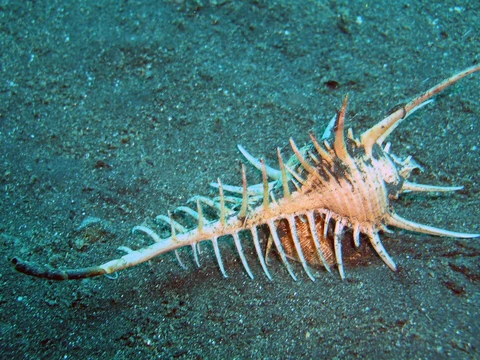
Chicomurex rosadoi
A marine gastropod mollusk from the Indian Ocean off Mozambique.

Chicomurex rosadoi is a marine gastropod mollusk belonging to the family Muricidae, commonly known as murex or rock snails. Its shell, a yellowish-brown color, grows to 49 mm in length and features a heavy, scaly spire that is biconical in shape. The protoconch consists of 1.5 whorls, while the teleoconch has 6.5 broad, convex whorls that are weakly shouldered and have adpressed sutures.
Axial sculpture on the body whorl includes 12 nodose, rounded ribs; the second whorl has 15 such ribs, and the third has 16. Other whorls bear three rounded, webbed varices with short, open spines, and high ribs sit between these varices. Spiral sculpture on the body whorl consists of five rather high, rounded cords. The second and third whorls have six or seven cords, the fourth has six to eight cords with one shallow thread between each pair, the fifth whorl has 17 to 19 cords and threads, and the last teleoconch whorl has nine or ten cords with shallow threads.
The large, round to ovate aperture is white and can be closed by a brown, round to ovate operculum. The narrow, smooth inner lip has a shallow, broad anal sinus at its posterior end. The erect outer lip is denticulate and weakly sculpted with 9 or 10 lirae. The siphonal canal is short and broad, weakly bent at the tip, and carries two webbed spines.
This species is found in the Indian Ocean off the coast of Mozambique.
Quick Facts
- Genus
- Chicomurex
- Species
- rosadoi
Facts from the source article.
Lore & Background
The shell of Chicomurex rosadoi is yellowish-brown and reaches a length of 49 mm. Its spire is heavy, squamous, and biconical in shape. The protoconch contains 1.5 whorls, while the teleoconch contains 6.5 broad and convex whorls that are weakly shouldered with adpressed sutures. The body whorl is axially sculptured with 12 nodose and rounded ribs, the second whorl with 15, and the third whorl with 16. Other whorls contain three rounded, webbed varices with short, open spines and high ribs between the varices.
Spiral sculpture on the body whorl consists of five rather high, rounded cords; the second and third whorls have six or seven cords, the fourth has six to eight cords with one shallow thread between each pair, the fifth whorl has 17–19 cords and threads, and the last teleoconch whorl has nine or ten cords and shallow threads. The large, round to ovate white aperture can be closed by a brown round to ovate operculum. The narrow and smooth inner lip shows a shallow and broad anal sinus at its posterior end. The erect outer lip is denticulate with a weak sculpture of 9 or 10 lirae. The short and broad siphonal canal is weakly bent at the tip and contains two webbed spines.
Reader's Guide
Chicomurex rosadoi is documented as occurring in the Indian Ocean off Mozambique, with its description based on material examined by Houart in 1999 and later included in the comprehensive work 'Fossil and Recent Muricidae of the world' by Merle, Garrigues, and Pointier in 2011. The species is placed within the genus Chicomurex, part of the family Muricidae, which encompasses the murex snails or rock snails. Its shell morphology—featuring a biconical spire, nodose axial ribs, webbed varices, and a denticulate outer lip with lirae—places it among the more sculpturally complex members of the group. The species' significance lies in its contribution to the known diversity of muricid gastropods from the East African coast, particularly Mozambique, an area that continues to yield new taxa. The detailed description of its whorl counts, cord patterns, and operculum provides a basis for distinguishing it from related species. Its inclusion in the 2011 reference work underscores its acceptance within the taxonomic literature, though no further ecological or behavioral data are recorded in the available notes.
Did You Know?
- The shell reaches a length of 49 mm.
- The protoconch contains 1.5 whorls and the teleoconch contains 6.5 whorls.
- The body whorl has 12 nodose and rounded axial ribs.
- This species occurs in the Indian Ocean off Mozambique.
Taxonomic Placement & Original Description
Chicomurex rosadoi is a species of sea snail classified as a marine gastropod mollusk within the family Muricidae, the group widely recognized as murex snails or rock snails. The species was formally described by R. Houart in 1999 in the journal Iberus (volume 17, issue 2, pages 123–130), where it was introduced alongside a second new Muricidae species, both collected from Mozambique in east Africa. The same paper also documented a range extension for Chicoreus (Triplex) elisae Bozzetti, 1991. The shell of C. rosadoi is yellowish-brown in coloration and attains a maximum length of 49 millimeters. The species was subsequently incorporated into the major reference work by Merle, Garrigues, and Pointier (2011), "Fossil and Recent Muricidae of the world, Part Muricinae," published by Conchbooks in Hackenheim, appearing on page 110 of that 648-page volume. It is also catalogued in the Sociedad Española de Malacología publication, volumes 16–17 (1998–99), 1981, page 128 7.
Spire Architecture & Axial Sculpture
The shell of C. rosadoi presents a heavy, squamous spire with a distinctly biconical overall shape. The earliest developmental stage, the protoconch, comprises one and a half whorls. Following this, the teleoconch is built from six and a half broad, convex whorls that are only weakly shouldered and separated by adpressed sutures. The axial sculpture varies considerably across the whorls: the body whorl carries twelve nodose, rounded ribs; the second whorl bears fifteen; and the third whorl displays sixteen. The remaining whorls are sculpted with three rounded, webbed varices, each tipped with short, open spines, with high ribs running between successive varices. This progressive change in rib count and the transition to varice-bearing whorls give the spire a textured, layered appearance that is characteristic of many muricid shells, helping to distinguish C. rosadoi within its family.
Spiral Sculpture & Aperture Morphology
The spiral sculpture of C. rosadoi is equally intricate and shifts from whorl to whorl. The body whorl is adorned with five rather high, rounded cords. The second and third whorls each carry six or seven cords, while the fourth whorl displays six to eight cords with one shallow thread nestled between each pair. The fifth whorl is the most densely sculpted, bearing seventeen to nineteen cords and threads. The last teleoconch whorl returns to nine or ten cords accompanied by shallow threads. The aperture itself is large, round to ovate in outline, and white in color, capable of being sealed by a brown, round to ovate operculum. The narrow, smooth inner lip terminates posteriorly in a shallow, broad anal sinus. The erect outer lip is denticulate and bears a weak sculpture of nine or ten lirae. The short, broad siphonal canal curves weakly at its tip and contains two webbed spines.
Geographic Range & Biogeographic Context
C. rosadoi is known exclusively from the Indian Ocean waters off the coast of Mozambique, in east Africa. This single locality represents the entire known distribution of the species, making it a geographically restricted muricid. The species was described by Houart in 1999 as part of a broader taxonomic effort to document new Muricidae from this region, a paper that also introduced a second new species and extended the known range of Chicoreus (Triplex) elisae Bozzetti, 1991. The Mozambican coast, situated along the eastern African margin of the Indian Ocean, has historically been a source of numerous muricid discoveries, and C. rosadoi adds to the diversity documented from these waters. Its restricted range and the detailed morphological description provided at the time of its original publication underscore the importance of continued malacological survey work in understudied tropical marine environments.
Frequently Asked Questions
Who is Chicomurex rosadoi?
Chicomurex rosadoi is a marine gastropod mollusk placed in the Muricidae family, the same lineage that includes the familiar murex and rock snails. Its yellowish-brown shell reaches a maximum of 49 mm and is crowned by a heavy, scaly, biconical spire.
What are Chicomurex rosadoi's powers/role?
The body whorl bears 12 nodose, rounded axial ribs, while the second and third whorls carry 15 and 16 of the same rib type. The remaining whorls are decorated with three rounded, webbed varices tipped by short, open spines, giving the shell a heavily armored look.
Where does Chicomurex rosadoi call home?
This species is documented from the Indian Ocean off the coast of Mozambique, inhabiting the kind of marine substrate typical of Muricidae snails.
Why is Chicomurex rosadoi important?
Its protoconch spans 1.5 whorls and the teleoconch extends over 6.5 broad, convex whorls with weakly shouldered, adpressed sutures—traits that help specialists separate it from look-alike Muricidae. As a documented element of Mozambique's marine fauna, it adds a data point to our picture of Indian Ocean gastropod diversity.
More in Murex Snails, Part 2 1-24
Spotted an error? Know more?
Reader corrections go straight into our review queue. Suggest an edit · How this site is sourced