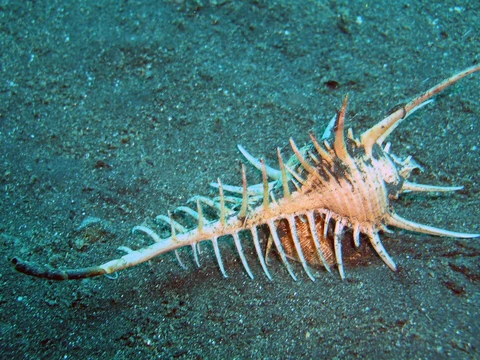
Ecphora gardnerae
Extinct Miocene predatory murex snail from Maryland and Virginia.

Ecphora gardnerae is an extinct predatory sea snail, a type of ocenebrinid murex gastropod. Its fossil shells occur in Miocene-aged marine rock layers in Maryland and Virginia. This large carnivorous snail lived during the Miocene epoch and died out more than five million years ago.
The species includes two subspecies: the nominate form, Ecphora gardnerae gardnerae, and Ecphora gardnerae germonae. These snails were once classified as Ecphora quadricostata, but that name now applies only to a species found in Pliocene strata from Virginia to Florida. The Miocene specimens from Maryland belong to a different taxon, Ecphora gardnerae.
Like most muricids, Ecphora snails drilled holes through the hard shells of other mollusks—usually bivalves, but sometimes other snails, including smaller Ecphoras—to feed on their soft tissues using a toothed, ribbonlike radula, a structure common to nearly all gastropods.
In March 1994, Dr. Eric Seifter testified before the Maryland Legislature that the classification of the state fossil, Ecphora quadricostata, was invalid because that species does not actually occur in Maryland. The designation was changed to Ecphora gardnerae gardnerae. The species was named in honor of geologist Julia Anna Gardner.
Quick Facts
- Genus
- Ecphora
- Species
- gardnerae
Facts from the source article.
Lore & Background
Ecphora gardnerae was previously known as Ecphora quadricostata, but that name is now restricted to a species found from Pliocene strata in Virginia to Florida. The Miocene-aged specimens found in Maryland have been assigned to a different taxon, Ecphora gardnerae. Subspecies include the nominate Ecphora gardnerae gardnerae and Ecphora gardnerae germonae.
As with most other muricids, Ecphora sea snails bored holes through the hard shells of other mollusks, usually bivalves, or sometimes other snails, including other, smaller Ecphoras, in order to feed on their soft insides using a toothed, ribbonlike appendage known as a radula.
In March 1994, Dr. Eric Seifter testified before the Maryland Legislature that the classification of the Maryland State Fossil, Ecphora quadricostata, was invalid (quadricostata is not actually found in Maryland) and needed to be changed to Ecphora gardnerae gardnerae. The fossil was named for geologist Julia Anna Gardner.
Reader's Guide
Ecphora gardnerae holds significance as a Miocene fossil of the Maryland and Virginia region, representing a large carnivorous sea snail that preyed on other mollusks by boring through their shells. Its taxonomic history reflects a shift in understanding: formerly identified as Ecphora quadricostata, that name is now reserved for a Pliocene species from Virginia to Florida, while the Miocene Maryland specimens were reassigned to Ecphora gardnerae. This distinction led to a 1994 testimony before the Maryland Legislature by Dr. Eric Seifter, who argued that the state fossil designation needed correction because quadricostata does not occur in Maryland. The fossil was subsequently recognized under the name Ecphora gardnerae gardnerae, honoring geologist Julia Anna Gardner. The species' legacy is tied to its role as a state fossil and its illustration of muricid predatory behavior, preserved in Miocene marine strata. Its extinction more than five million years ago marks the end of a lineage that once inhabited ancient seas of the Atlantic coastal plain.
Did You Know?
- Ecphora gardnerae is an extinct predatory ocenebrinid murex gastropod.
- Its shells are found in Miocene-aged marine strata of Maryland and Virginia.
Identity and Statehood
Ecphora gardnerae gardnerae occupies a singular place in both paleontology and American civic identity. Classified as a murex snail from the Miocene epoch, this marine gastropod carries the distinction of being the official state fossil of Maryland. Among the many prehistoric organisms that once inhabited the waters over what is now the Chesapeake Bay region, this particular species earned a permanent place in the state's symbolic landscape. The full trinomial designation reflects the taxonomic precision applied to a creature that lived tens of millions of years before human civilization. Its selection as a state fossil underscores Maryland's deep commitment to its paleontological heritage, a commitment stretching back to the 1850s when formal scientific investigation of local fossils first commenced. In a state whose fossil record spans from the Cambrian through the Pleistocene, the Miocene murex stands as a small but emblematic representative of the rich marine life that once thrived in these waters.
Pioneering Scientific Legacy
Ecphora gardnerae holds a place of considerable weight in the history of North American paleontology. It was among the very first fossils to be formally described on the continent, a distinction that places it at the dawn of systematic fossil science in what would become the United States. This early recognition came at a time when the broader scientific community was still assembling the framework for understanding deep time and the ancient inhabitants of the Western Hemisphere. The fact that a relatively small marine snail from the Miocene of Maryland could claim such a pioneering role speaks to the richness of the region's fossil-bearing strata. In the decades following its initial description, Maryland's paleontological record would grow to include landmark finds such as Astrodon johnstoni, the first scientifically described sauropod from North America, and the extraordinary Pleistocene cave assemblage in Allegany County. Yet the Miocene murex remains a foundational touchstone, a reminder that the state's fossil story began with creatures small enough to fit in a palm.
Physical Character and Protein Remnants
The physical qualities of Ecphora gardnerae set it apart from many other fossilized marine invertebrates. The shell is noted for its fragility, a characteristic that makes both collection and preservation a delicate affair for researchers and enthusiasts alike. Equally distinctive is its coloration, which gives the specimen a visual identity that sets it apart from the surrounding matrix and other fossils in the same strata. Perhaps most remarkably, recent scientific investigation has revealed that the fossil retains remnants of the original proteins that once belonged to the living animal. This discovery is extraordinary because protein preservation in fossils is rare and typically requires exceptional conditions of burial and mineralization. For a Miocene murex snail to still carry molecular echoes of its biological past pushes the boundaries of what paleontologists thought possible for this type of organism. It transforms the specimen from a purely structural record into a partial biochemical archive, offering a window into the molecular biology of an animal that perished long before the first dinosaurs walked the Earth.
The Miocene Seaworld of Calvert County
Ecphora gardnerae did not live in isolation. Its fossils are found within the Chesapeake group, a sequence of sedimentary rocks that exposes along the coast of Calvert County in Maryland. This geological formation is renowned for its extraordinarily diverse marine mammal fauna, a testament to the productive and biodiverse seas that covered the region during the Miocene. The same waters that cradled the murex snail also hosted an array of sharks, including the colossal Otodus megalodon, the largest shark ever to exist. The presence of numerous juvenile specimens among the shark fossils has led researchers to speculate that the area may have served as a breeding or nursing ground. The Miocene seas of Maryland also supported the sea turtle Bothremys, which may have fed in part by crushing snails, placing it in direct ecological interaction with murex species like Ecphora gardnerae. During the broader early Cenozoic era, Maryland alternated between submersion under seawater and exposure as dry land, creating a dynamic and shifting environment in which these organisms evolved and perished.
Frequently Asked Questions
What is Ecphora gardnerae?
Ecphora gardnerae is an extinct carnivorous sea snail belonging to the ocenebrinid murex family. It lived during the Miocene epoch, and its fossil shells are preserved in marine rock layers in Maryland and Virginia.
What subspecies of Ecphora gardnerae are recognized?
Two subspecies are identified: the nominate form, Ecphora gardnerae gardnerae, and Ecphora gardnerae germonae. Both are known from Miocene-aged deposits in the Mid-Atlantic region.
Why was Ecphora gardnerae separated from the name Ecphora quadricostata?
Earlier Maryland Miocene specimens were lumped under the name Ecphora quadricostata. That name is now reserved exclusively for a distinct species occurring in Pliocene strata from Virginia through Florida, leaving the older Maryland material under the gardnerae name.
When did Ecphora gardnerae go extinct?
This predatory snail disappeared more than five million years ago, at the close of the Miocene epoch. No living representatives of the species survive today.
What kind of predator was Ecphora gardnerae?
Ecphora gardnerae was a large carnivorous gastropod that hunted other marine animals in Miocene seas. Its robust shell and predatory lifestyle are typical of the ocenebrinid murex group.
More in Murex Snails, Part 2 1-24
Spotted an error? Know more?
Reader corrections go straight into our review queue. Suggest an edit · How this site is sourced