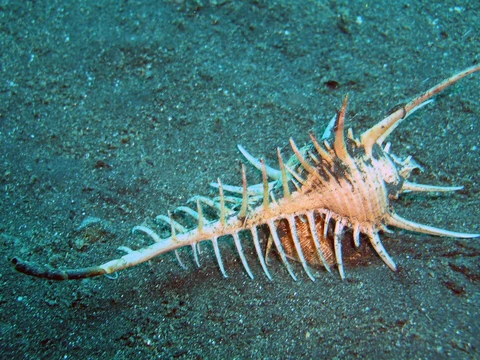
Timbellus
A genus of murex snails with both living and fossil species.

Timbellus is a genus of sea snails, specifically marine gastropod mollusks that belong to the Muricidae family—commonly known as murex snails or rock snails. This genus contains both living and fossil species. The following is a list of species within Timbellus: † *Timbellus arenarius*, *Timbellus atlantideus*, † *Timbellus barattus*, *Timbellus bednalli*, *Timbellus bilobatus*, † *Timbellus brevicauda*, † *Timbellus calvus*, † *Timbellus capitaneus*, *Timbellus corbariae*, *Timbellus crauroptera*, † *Timbellus crenulatus*, † *Timbellus danapris*, † *Timbellus detritus*, *Timbellus emilyae*, *Timbellus fernandezi*, *Timbellus flemingi*, *Timbellus fulgens*, *Timbellus goniodes*, *Timbellus guesti*, *Timbellus havanensis*, † *Timbellus kaiparaensis*, † *Timbellus laetificus*, † *Timbellus latifolius*, *Timbellus leucas*, *Timbellus levii*, *Timbellus lightbourni*, *Timbellus marshalli*, † *Timbellus micropterus*, † *Timbellus moguntiacus*, *Timbellus pannuceus*, † *Timbellus perlongus*, *Timbellus phaneus*, *Timbellus phyllopterus*, *Timbellus priabonicus*, *Timbellus radwini*, *Timbellus richeri*, *Timbellus rubidus*, *Timbellus stenostoma*, *Timbellus sublimis*, † *Timbellus swainsoni*, † *Timbellus tripteroides*, *Timbellus vespertilio*, † *Timbellus waiareka*, and *Timbellus xenos*. Two species once considered part of this genus have been moved into synonymy: *Timbellus concavopterus* is now *Favartia concavoptera*, and *Timbellus miyokoae* is now *Chicoreus miyokoae*.
Quick Facts
- Taxon
- Timbellus
- Type Species
- † Murex latifolius / Bellardi, 1872
Facts from the source article.
Lore & Background
The genus Timbellus encompasses a diverse array of species, many of which were described in the 19th and 20th centuries. Fossil species such as Timbellus arenarius, Timbellus barattus, and Timbellus brevicauda indicate a long evolutionary history, with remains found in strata from various periods. Extant species like Timbellus atlantideus and Timbellus bednalli are known from modern marine environments. The genus has been revised by authors including Houart, who described several new species in 2012 and 2015, and Pacaud, who contributed fossil taxa in 2017 and 2018. Some species originally placed in Timbellus have since been moved to other genera, such as Favartia and Chicoreus, reflecting ongoing taxonomic refinement.
Reader's Guide
Timbellus holds significance within the Muricidae as a genus that bridges fossil and modern faunas. Its species are studied for their morphological diversity, particularly in shell sculpture and spine development, which are characteristic of murex snails. The fossil record of Timbellus provides insights into the evolutionary history of the family, with species like Timbellus tripteroides and Timbellus swainsoni appearing in Paleogene deposits. The genus also contributes to biogeographic understanding, as species are recorded from regions including the Atlantic, Pacific, and Mediterranean. Taxonomically, Timbellus has been subject to revision, with some species reassigned to other genera, highlighting the dynamic nature of muricid classification. The work of researchers such as Houart, Bouchet, and Warén has been instrumental in clarifying the boundaries of the genus. Overall, Timbellus represents a notable component of the murex snail radiation, with both living and extinct forms enriching the study of gastropod evolution.
Did You Know?
- Timbellus includes both extant and fossil species.
- Some species originally placed in Timbellus have been moved to the genera Favartia and Chicoreus.
- Fossil species such as Timbellus arenarius and Timbellus brevicauda are known from the 19th and early 20th centuries.
- The genus was revised by Houart, who described new species in 2012 and 2015.
Taxonomic Place Among the Murex Snails
Timbellus leucas occupies a defined position within the broader taxonomy of marine invertebrates. It is classified as a species of sea snail, placing it among the gastropod mollusks that live in saltwater environments. At the family level, it belongs to Muricidae, a group that carries the common names murex snails or rock snails. This family-level affiliation connects Timbellus leucas to a wider assemblage of marine gastropods that have been formally recognized and catalogued across oceanic regions. The binomial name itself, pairing the genus Timbellus with the specific epithet leucas, distinguishes this particular species from its close relatives within the Muricidae family. As a marine gastropod mollusk, it shares the fundamental biological framework of other sea snails, including a protective coiled shell and a soft body adapted to oceanic life. Its placement within the Muricidae family signals particular morphological and ecological traits that set it apart from other gastropod families, anchoring its identity firmly within the rock snail or murex lineage recognized by malacologists worldwide.
Shell Dimensions and Physical Scale
The adult shell of Timbellus leucas presents a measurable range in size, spanning from 25 millimeters to 47 millimeters. This span of roughly 22 millimeters indicates that individuals of this species do not all reach identical final dimensions, pointing to natural variation within the population. At the smaller end, a 25-millimeter shell is modest in scale, while the upper boundary of 47 millimeters represents the maximum recorded size for a fully grown adult. These measurements describe the shell of a mature specimen, meaning that younger or immature individuals would present even smaller profiles. The shell, as the hard external structure of this sea snail, serves as the primary visible feature by which the species is identified and catalogued in scientific collections and field studies. Within the context of the Muricidae family, the rock snails, this size range gives researchers a concrete physical parameter for distinguishing Timbellus leucas specimens and assessing their growth. The defined minimum and maximum values provide a clear quantitative framework for describing this species' physical presence in its marine habitat, anchoring identification efforts in measurable, reproducible data.
Geographic Range Across the Eastern Atlantic
Timbellus leucas is documented in waters stretching from the European region to the western coast of Africa, all within the broader Atlantic Ocean. Specifically, its known distribution includes European waters along the island of Madeira, as well as the Atlantic Ocean off Southern Morocco and the coast of Senegal. This range places the species in the eastern Atlantic, spanning a considerable stretch from the mid-Atlantic island of Madeira southward along the African coastline. The inclusion of both a European territory (Madeira) and two African nations (Morocco and Senegal) in its range highlights the species' presence in a transitional oceanic zone where European and African marine biogeographies overlap. As a member of the Muricidae family, Timbellus leucas shares this eastern Atlantic habitat with other rock snail species, contributing to the molluscan diversity recorded in these coastal waters. The distribution pattern, stretching from island waters to continental coastal regions, maps a species whose known range bridges the gap between European and West African marine environments, all within the Atlantic basin.
Scientific Documentation and Historical Study
The scientific record for Timbellus leucas spans more than a century of malacological research. The species appears in the European Register of Marine Species, a comprehensive checklist compiled by Gofas, Le Renard, and Bouchet in 2001, which catalogued marine species found in European waters and provided a bibliography of identification guides. It is also documented in the extensive 648-page work by Merle, Garrigues, and Pointier (2011), which covered both fossil and recent Muricidae of the world, with Timbellus leucas specifically addressed on page 133 within the Muricinae section. Perhaps most historically significant, the species was part of the collections gathered during the scientific expeditions of the Travailleur and the Talisman, which operated between 1880 and 1883. The molluscan specimens from these voyages were later described by Locard in a two-volume publication issued in Paris by Masson in 1897 and 1898, which included extensive plates and detailed descriptions of shelled mollusks. This layered documentation, from 19th-century expedition work to modern taxonomic checklists, reflects the enduring scientific interest in this small Atlantic sea snail.
Frequently Asked Questions
What is Timbellus?
Timbellus is a genus of marine gastropod mollusks, meaning it comprises sea snails. It is classified within the Muricidae family, the group commonly referred to as murex or rock snails.
Does Timbellus include only fossil species or are some still alive today?
The genus contains both living and extinct (fossil) species, so it is not purely a prehistoric group. Numerous extant and numerous fossil species have been described under this name.
How many species belong to the genus Timbellus?
Timbellus is a sizeable genus with numerous species recognized, spanning both extant and fossil lineages. The full list includes names such as T. atlantideus, T. bednalli, T. bilobatus, and several others, some marked as extinct.
What family do Timbellus snails belong to?
Timbellus is placed in the Muricidae family, which is the large group of predatory sea snails popularly called murex snails or rock snails. This family is known for its spiny, heavily sculptured shells.
Can you give examples of fossil Timbellus species?
Several species in the genus are known only from the fossil record, including T. arenarius, T. barattus, T. brevicauda, and T. crenulatus. These extinct forms help paleontologists trace the evolutionary history of murex snails across geological time.
More in Murex Snails, Part 2 1-24
Spotted an error? Know more?
Reader corrections go straight into our review queue. Suggest an edit · How this site is sourced