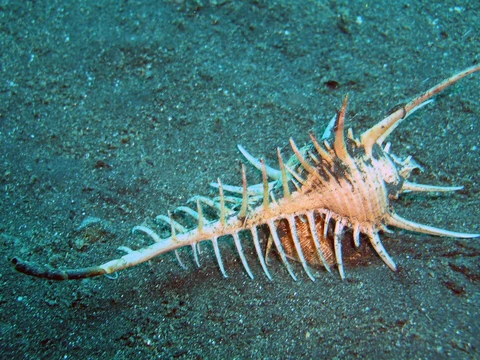
Muricinae
Subfamily of predatory sea snails including true Murex.

Muricinae is a subfamily within the family Muricidae, which includes predatory sea snails, marine gastropod molluscs commonly known as murex snails and rock snails. This group encompasses the true Murex and a number of other closely related genera. In total, the subfamily accounts for roughly 780 valid species names, split between 378 fossil and 400 recent species.
The classification of Muricidae into subfamilies largely follows the 2005 work of Bouchet and Rocroi, which combined morphological and molecular data to define Muricinae. However, current knowledge suggests this subfamily may be polyphyletic.
1. The Muricinae (s.s.) group includes *Flexopteron*, *Murex* (with subgenus *Promurex*), *Haustellum*, *Vokesimurex*, *Siratus*, *Bolinus*, *Hexaplex* (with subgenus *Trunculariopsis*), *Muricanthus*, *Chicoreus* (with subgenera *Chicopinnatus*, *Rhizophorimurex*, and *Triplex*), *Chicomurex*, *Phyllonotus*, and *Naquetia*.
2. The Pterynotus-Textilomurex group contains *Pterynotus* (with subgenus *Pterymarchia*) and *Textiliomurex*.
3. The basal muricids group includes *Timbellus*, *Pterochelus*, *Purpurellus*, *Ponderia*, *Prototyphis*, *Poirieria* (with subgenera *Actinotrophon*, *Caelobassus*, and *Pagodula*), *Paziella* (with subgenus *Bouchetia*), *Crassimurex* (with subgenus *Eopaziella*), *Harmatia*, *Gamurex*, and *Falsimuricopsis*.
4. The Calotrophon-Attiliosa group comprises *Calotrophon* (with subgenera *Acantholabia* and *Panamurex*).
The subfamilial placement of the last groups is considered provisional.
Quick Facts
- Taxon
- Muricinae
Facts from the source article.
Lore & Background
The subdivision of the Muricidae into subfamilies is mainly based on the work of Bouchet & Rocroi (2005), who combined morphological and molecular data in order to define the Muricinae. However, based on latest knowledge this subfamily might represent a polyphyletic group. Traditionally the Muricinae are subdivided into five informal groups, which contain 47 genera and subgenera. The first group, Muricinae (s.s.), includes genera such as Murex, Haustellum, Vokesimurex, Siratus, Bolinus, Hexaplex, Muricanthus, Chicoreus, Chicomurex, Phyllonotus, and Naquetia. The second group, Pterynotus-Textilomurex, contains Pterynotus and Textiliomurex. The third group, Basal muricids, includes Timbellus, Pterochelus, Purpurellus, Ponderia, Prototyphis, Poirieria, Paziella, Crassimurex, Harmatia, Gamurex, and Falsimuricopsis. The fourth group, Calotrophon-Attiliosa, includes Calotrophon with its subgenera. The subfamilial place of the last groups should be regarded as provisional.
Reader's Guide
The Muricinae represent approximately 780 valid names of fossil (378) and recent (400) species, making them a significant component of the muricid lineage. Their classification, based on the work of Bouchet & Rocroi (2005), integrates morphological and molecular data, yet the subfamily might be polyphyletic, indicating that current groupings may not reflect true evolutionary relationships. The five informal groups—Muricinae (s.s.), Pterynotus-Textilomurex, Basal muricids, and Calotrophon-Attiliosa—serve as a working framework, but the placement of the last groups is provisional. This uncertainty underscores ongoing research into muricid phylogeny. The subfamily's legacy lies in its taxonomic complexity and the diversity of forms within the true Murex and related genera, which have been studied extensively in both fossil and recent contexts. The provisional nature of some groupings highlights the dynamic state of gastropod systematics, where new data may refine or challenge established classifications.
Did You Know?
- The Muricinae contain approximately 780 valid names, including 378 fossil and 400 recent species.
- Based on latest knowledge, the Muricinae might represent a polyphyletic group.
- The subfamilial place of the Calotrophon-Attiliosa group and other groups is regarded as provisional.
Ancient Roots of the Name
The name murex traces back to the Latin word mūrex, which likely shares a deep linguistic root with the Greek term myax, meaning sea mussel. Scholars have further noted a possible connection to the Greek word mys, meaning mouse, suggesting that ancient observers perceived a resemblance between the shape of certain mollusks and small rodents. Aristotle himself referenced these creatures in his History of Animals, employing the Greek word porphyra. The term has endured for millennia as one of the oldest classical seashell names still actively employed by modern scientific communities. Even as taxonomy has evolved and many species originally slotted under Murex have been reassigned to other genera, the common name persists across the broader family Muricidae. This remarkable continuity of nomenclature spans from ancient Greek natural philosophy through Linnaean classification to contemporary malacology, making the word a living thread connecting thousands of years of human observation of the marine world.
The Purple Dye and Its Sacred Legacy
Perhaps no aspect of Murex biology has shaped human civilization as profoundly as its role in producing one of history's most coveted dyes. Ancient Phoenicians developed the painstaking process of extracting mucus from the hypobranchial gland of snails—specifically what are now classified as Bolinus brandaris and Hexaplex trunculus—to create Tyrian purple, also known as royal purple. The chemical process relies on a specific bromide peroxidase enzyme that acts on dissolved bromide in seawater, yielding a rare animal-produced organobromine compound. The resulting color was reserved for royal robes, ceremonial garments, and clothing denoting high social rank. The dye also holds deep religious significance: it is hypothesized to be the same pigment that featured in the ancient Temple in Jerusalem, adorning the garments of the High Priest. Recent archaeological research on regional dyes increasingly points to Hexaplex trunculus as the source of the biblical tekhelet, a blue-purple dye still used by some Jewish communities in the ritual fringes called tzitzit on four-cornered garments.
Taxonomic Turmoil and a Legacy of Synonyms
The genus Murex carries an extraordinary burden of synonyms, a direct consequence of how it was originally defined and subsequently narrowed over centuries. When Linnaeus first established the genus, it encompassed a vast array of taxa that today are scattered across the entire superfamily Muricoidea. Throughout the nineteenth century, malacologists including Kiener, Reeve, Küster and Kobelt, and Sowerby broadly treated all muricoid forms as members of Murex. Lamarck and his contemporaries worked to restrict the definition, first limiting it to the family Muricidae and then further to the subfamilies Muricinae and Ocenebrinae. This prolonged ambiguity means that dozens of species once published under the name Murex now belong to entirely different genera such as Vokesimurex, Ocinebrina, Chicoreus, and Bela. The World Register of Marine Species must maintain extensive synonymy lists to track these reassignments, and the result is that a single common name may appear in historical literature under a Murex designation while its valid modern name sits in a completely different genus, creating persistent confusion for researchers and collectors alike.
Fossil Depth and Tropical Range
The fossil record of Murex stretches across an immense span of geological time, from the Cretaceous period roughly 125 million years ago through the Quaternary to the present day. Fossils attributed to this genus have been recovered from sites around the globe, and approximately twenty-five extinct species have been identified within the lineage. Despite this widespread fossil distribution, the living genus is geographically constrained: Ponder and Vokes demonstrated in 1988 that Murex is exclusively an Indo-Pacific genus, and species previously assigned to it from the western Atlantic have since been reclassified under the genus Haustellum. In their natural habitats, most Murex species inhabit the intertidal zone or the shallow subtidal region, sheltering among rocks and coral formations. These medium to large predatory sea snails are carnivorous in diet, and many produce strikingly ornate shells with elongated forms, heavy sculpturing, prominent spines or fronds, and inner surfaces that display vivid coloration, making them among the most visually distinctive members of the Muricidae.
Frequently Asked Questions
Who is Muricinae?
Muricinae is a subfamily nested inside the larger Muricidae family, and it houses the true Murex alongside several closely related genera. Together they represent a group of predatory sea snails that live in marine environments.
What are Muricinae's powers/role?
Members of this subfamily are active predators that feed on other marine organisms, functioning as important hunters within coastal and reef ecosystems. They are marine gastropod molluscs commonly called murex snails or rock snails.
Why is Muricinae important?
It accounts for approximately 780 valid species names spread across 47 genera and subgenera, making it one of the most species-rich branches of the murex family. Its sheer diversity makes it a key group for understanding the evolution of predatory gastropods.
Who wrote Muricinae's origin story?
The modern framework for this subfamily traces back to the 2005 classification by Bouchet and Rocroi, who blended morphological traits with molecular data to delineate its members. That work remains the standard reference, even as new data continues to test its boundaries.
More in Murex Snails, Part 2 1-24
Spotted an error? Know more?
Reader corrections go straight into our review queue. Suggest an edit · How this site is sourced