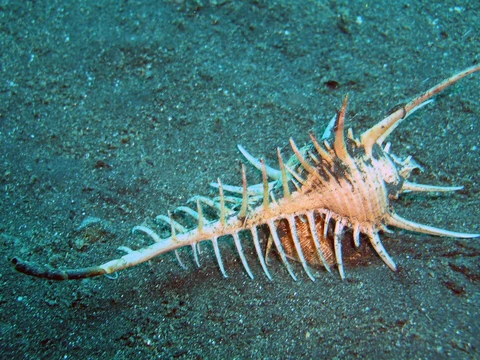
Ocinebrina aciculata
A marine gastropod mollusc in the family Muricidae.

Ocinebrina aciculata is a marine gastropod mollusc belonging to the family Muricidae, commonly known as murex or rock snails. This sea snail has a notably tangled taxonomic history, with many previously recognized varieties and subspecies now considered synonyms. Among these are *Ocinebrina aciculata aciculata*, *Ocinebrina aciculata corallinoides*, and several named forms such as *Murex aciculatus var. curta* and *Ocinebrina aciculata var. scalariformis*. The species is found in European waters, the Mediterranean Sea, and the northeastern Atlantic Ocean, including the Azores.
Quick Facts
- Genus
- Ocinebrina
- Species
- aciculata
Facts from the source article.
Lore & Background
The species was originally described by Lamarck in 1822. Over time, many forms were proposed as varieties or subspecies, including Ocinebrina aciculata aciculata, Ocinebrina aciculata corallinoides, and numerous varieties such as curta, elongata, minor, cingulifera, and scalariformis. Most of these have since been recognized as synonyms of Ocinebrina aciculata. The species is part of the Ocinebrina aciculata complex, which has been the subject of taxonomic revision. It occurs in European waters, the Mediterranean Sea, and the Northeast Atlantic Ocean as far as the Azores.
Reader's Guide
Ocinebrina aciculata holds significance as a representative of the small mussel drills within the Muricidae family, particularly in the northeastern Atlantic and Mediterranean regions. Its taxonomic complexity, with numerous historical varieties and synonyms, reflects the challenges in distinguishing closely related marine gastropods. The species has been studied in the context of the Ocinebrina aciculata complex, leading to the description of a new species in 2012. Its distribution across European waters, the Mediterranean, and the Azores underscores its ecological role in these marine environments. The legacy of Ocinebrina aciculata lies in its contribution to understanding muricid diversity and the importance of careful taxonomic work in marine biology.
Did You Know?
- Ocinebrina aciculata belongs to the family Muricidae, known as murex snails or rock snails.
- The species has at least ten listed synonyms, including Fusus gyrinus and Murex aciculatus var. curta.
- Its distribution includes the Mediterranean Sea and the Azores in the Northeast Atlantic Ocean.
Frequently Asked Questions
What is Ocinebrina aciculata?
It is a species of marine gastropod (sea snail) placed in the Muricidae family, the same group that contains the familiar murex and rock snails. The name was established by Lamarck in 1822 and remains the accepted designation today.
Why does Ocinebrina aciculata carry so many synonyms?
Taxonomists once split this snail into numerous regional forms and subspecies—such as O. a. corallinoides and Murex aciculatus var. scalariformis—before modern revision folded them all back into the single species. At least ten of those older names are now listed as synonyms, making it one of the more heavily reclassified muricids.
Where can you find Ocinebrina aciculata in the wild?
The species occurs along European coastlines, throughout the Mediterranean basin, and in the northeastern Atlantic Ocean as far as the Azores archipelago. Its range thus spans both temperate and subtropical shallow-water habitats.
Who originally described Ocinebrina aciculata and when?
The French naturalist Jean-Baptiste Lamarck gave the species its formal name and description in 1822. That publication still serves as the type reference anchoring the species name in modern taxonomy.
What makes Ocinebrina aciculata a useful example for murex enthusiasts?
Its long, tangled history of former subspecies and variety names illustrates how mollusc classification has been repeatedly revised over two centuries. For fans tracking taxonomic change, it is a textbook case of how many once-separate 'forms' collapse into a single valid species.
More in Murex Snails, Part 2 1-24
Spotted an error? Know more?
Reader corrections go straight into our review queue. Suggest an edit · How this site is sourced