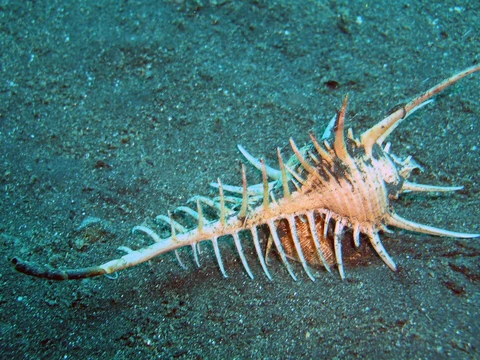
Homalocantha
A genus of marine gastropod mollusks in the family Muricidae.

Homalocantha is a genus of marine gastropod mollusks, commonly known as sea snails, and belongs to the family Muricidae—the murex or rock snails. While its classification within the subfamily Muricopsinae remains uncertain, the structure of its radula confirms its placement in the family Muricidae. The genus includes the following species: Homalocantha anatomica, Homalocantha anomaliae, Homalocantha digitata, Homalocantha dondani, Homalocantha dovpeledi, Homalocantha elatensis, Homalocantha granpoderi, Homalocantha lamberti, Homalocantha melanamathos, Homalocantha ninae, Homalocantha nivea, Homalocantha oxyacantha, Homalocantha pele, Homalocantha pisori, Homalocantha scorpio, Homalocantha secunda, Homalocantha tortua, Homalocantha vicdani, and Homalocantha zamboi. Several species once assigned to this genus are now considered synonyms: Homalocantha echiniformis is a synonym of Favartia balteata; Homalocantha fauroti and Homalocantha rota are both synonyms of Homalocantha anatomica.
Quick Facts
- Taxon
- Homalocantha
- Type Species
- Murex scorpio / Linnaeus, 1758
Facts from the source article.
Lore & Background
The genus Homalocantha comprises sea snails within the family Muricidae, commonly known as murex snails or rock snails. Its taxonomic placement in the subfamily Muricopsinae is considered doubtful, though radula characters confirm its membership in Muricidae. Species within the genus include Homalocantha anatomica, Homalocantha scorpio, and Homalocantha melanamathos, among others. Several species have been brought into synonymy, such as Homalocantha echiniformis, which is now considered a synonym of Favartia balteata, and Homalocantha fauroti and Homalocantha rota, both synonymized with Homalocantha anatomica. The genus has been studied in works such as the catalog of conchylia by Mörch (1852–1853) and a 2011 description of new Muricidae species from the Philippines and the Caribbean area by Merle & Garrigues.
Reader's Guide
The genus Homalocantha holds significance within the family Muricidae as a group of marine gastropods whose radula characters firmly place it among the murex snails, despite ongoing uncertainty about its subfamilial classification. Its species, described from the 18th century to as recently as 2014, illustrate a long history of taxonomic study. The synonymy of several species, such as Homalocantha echiniformis and Homalocantha fauroti, reflects the refinement of species concepts over time. The genus has been documented in major malacological works, including Mörch's 1852–1853 catalog and Merle & Garrigues' 2011 revision, which described new species from the Philippines and the Caribbean. This ongoing research underscores the genus's role in understanding muricid diversity and evolution. The legacy of Homalocantha lies in its contribution to the broader knowledge of marine gastropod taxonomy and the persistent questions about its phylogenetic relationships within Muricidae.
Did You Know?
- Homalocantha is a genus of sea snails in the family Muricidae, the murex snails.
- The placement of Homalocantha in the subfamily Muricopsinae is doubtful.
- Homalocantha scorpio was described by Linnaeus in 1758.
A Name That Outlived Its Genus
The word murex carries a lineage stretching back to antiquity, making it one of the most enduring seashell names still recognized in modern malacology. Its Latin root, mūrex, appears connected to the Greek myax, a term for sea mussel, and both may trace to an even older root related to mys, meaning mouse—a nod to the perceived resemblance between certain coiled mollusks and the small rodent. Aristotle himself catalogued these creatures in his History of Animals under the Greek word porphyra. Over two centuries of taxonomy, the genus definition shifted dramatically. Linnaeus originally cast a wide net, but by the nineteenth century, Lamarck and his peers narrowed it first to the family Muricidae and then to just two subfamilies. Yet contemporaries like Kiener, Reeve, Küster, Kobelt, and Sowerby kept lumping every spiny muricoid form under Murex, generating a tangled web of synonyms that still complicates identification today.
Deep Time and Global Fossils
The fossil record tells a remarkably long story for this lineage. Species bearing the Murex name have been recovered from strata spanning the Cretaceous through the Quaternary, covering a window of roughly 125 million years. Fossils attributed to the genus have surfaced on every continent, indicating that its ancient relatives once occupied marine environments far beyond the tropical Indo-Pacific waters where the living genus is now restricted. Approximately twenty-five extinct species have been formally described from these deposits, each representing a snapshot of predatory carnivorous gastropods that once dominated coastal ecosystems. These snails were medium to large in size, armed with the same kind of spiny, sculptured shells that characterize their modern descendants, and they occupied the same ecological niche as active hunters among rocky and coral substrates for well over a hundred million years.
The Dye That Crowned Empires
Perhaps no biological product has shaped human culture as profoundly as the deep purple extracted from murex snails. Ancient Phoenician dyers harvested mucus from the hypobranchial glands of two species—then called Murex brandaris and Murex trunculus, now reclassified as Bolinus brandaris and Hexaplex trunculus—to produce Tyrian purple, a rare organobromine compound. The chemistry is striking: a specific bromide peroxidase enzyme acts on dissolved bromide in seawater to create the pigment. The process was so costly and labor-intensive that the resulting dye became a marker of supreme authority, reserved for royal robes and ceremonial garments denoting the highest rank. Scholars hypothesize this same hue adorned the High Priest's vestments in the ancient Temple in Jerusalem, and the blue-purple thread known as tekhelet, still woven into the tzitzit fringes of four-cornered garments by some Jewish communities today, is believed by recent archaeological dye analysis to have originated from Murex trunculus.
Architecture of the Shell and Its Rocky Realm
Few marine invertebrates rival the visual drama of murex shells. Members of this genus produce elongated, highly sculptured structures bristling with spines, fronds, and elaborate surface ornamentation, while the interior surfaces often glow in vivid, saturated colors that contrast sharply with the rugged exterior. These architectural flourishes are not merely decorative; they belong to active, carnivorous predators that hunt in the intertidal and shallow subtidal zones, navigating among rocks and coral formations. The genus is exclusively Indo-Pacific in its modern distribution, a conclusion firmly supported by the 1988 work of Ponder and Vokes, who also clarified that western Atlantic species once lumped under Murex actually belong to the separate genus Haustellum. The result is a group of tropical sea snails whose ornate shells and predatory lifestyle make them among the most striking inhabitants of warm, rocky coastlines.
Taxonomic Whiplash and the Synonym Problem
The history of Murex is inseparable from a century of taxonomic confusion that left an enormous trail of synonyms. When Linnaeus first defined the genus, it swallowed a vast array of taxa that modern systematists now scatter across the entire superfamily Muricoidea. Through the nineteenth century, the definition was progressively tightened—Lamarck restricted it to Muricidae, then to the subfamilies Muricinae and Ocenebrinae—yet many malacologists of the era, including Kiener, Reeve, Küster, Kobelt, and Sowerby, continued to assign every spiny or muricoid-looking shell to Murex regardless of true affinity. The consequence is a synonym list of staggering length: species like Murex rota (now Homalocantha anatomica), Murex brandaris (now Bolinus brandaris), and Murex canaliculatus (now Busycotypus canaliculatus) all carry the old name in the literature. The World Register of Marine Species and the Indo-Pacific Molluscan Database now maintain the corrected, much narrower genus, but the legacy of those broad early classifications means that any serious study of muricoid diversity must navigate a thicket of outdated names still encountered in older texts and museum catalogs.
Frequently Asked Questions
Who is Homalocantha?
Homalocantha is a genus of marine sea snails that falls under the family Muricidae, the well-known murex or rock snails. It is a moderately diverse group currently comprising 19 recognized species.
What is Homalocantha's taxonomic placement and how is it confirmed?
The genus is placed in Muricidae, with a tentative (but doubtful) assignment to the subfamily Muricopsinae. Its solid membership in the murex family is backed by the distinctive structure of its radula, the rasping feeding organ.
Why is Homalocantha important to murex enthusiasts?
Its lineage stretches back to 1758, when Linnaeus described Homalocantha scorpio, making it one of the older named groups within Muricidae. With 19 species spanning a wide range of names and forms, it offers fans a rich set of specimens to study.
Which species are included in the genus Homalocantha?
Members include H. anatomica, H. anomaliae, H. digitata, H. dondani, H. dovpeledi, H. elatensis, H. granpoderi, H. lamberti, H. melanamathos, H. ninae, and H. nivea, among others. Altogether, 19 species are currently recognized under this genus.
More in Murex Snails, Part 2 1-24
Spotted an error? Know more?
Reader corrections go straight into our review queue. Suggest an edit · How this site is sourced