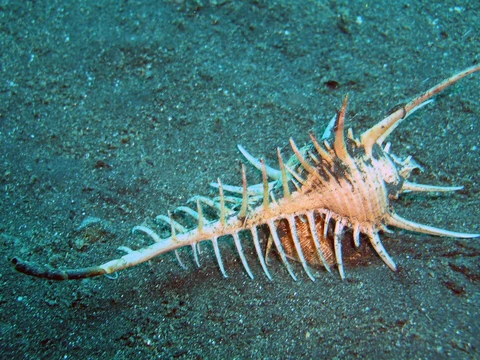
Pygmaepterys
A genus of small murex snails in the subfamily Muricopsinae.

Pygmaepterys is a genus of marine gastropod molluscs, specifically sea snails, belonging to the subfamily Muricopsinae within the family Muricidae—commonly known as murex snails or rock snails. The genus includes a wide range of both living and fossil species, found in marine environments across different regions.
Quick Facts
- Taxon
- Pygmaepterys
- Type Species
- Murex alfredensis
- Type Species Authority
- Bartsch, 1915
Facts from the source article.
Lore & Background
The genus Pygmaepterys was established within the subfamily Muricopsinae of the family Muricidae. Its species are small marine gastropods commonly known as murex snails or rock snails. The genus includes both living and fossil taxa, with fossil species such as Pygmaepterys aturensis and Pygmaepterys exoletus described by Lozouet in 1999.
Species within Pygmaepterys have been described from diverse localities, including the eastern coast of Africa, the Caribbean, the Indo-Pacific, and the Arabian Sea. Many species were originally described in other genera before being transferred to Pygmaepterys. The genus name reflects the small size of its members, with 'pygmae' referring to diminutive stature.
Reader's Guide
Pygmaepterys represents a taxonomically rich genus within the Muricidae, contributing to the understanding of murex snail diversity in tropical and subtropical marine environments. The genus includes species described by numerous malacologists over several decades, such as Houart, Wranik, Petuch, Bartsch, Espinosa, Ortea, and others. The fossil species Pygmaepterys aturensis and Pygmaepterys exoletus provide evidence of the genus's presence in the geological record, as documented by Lozouet in 1999.
The genus's species are distributed across a wide geographic range, from the Atlantic (e.g., Pygmaepterys habanensis from Cuba) to the Indian Ocean (e.g., Pygmaepterys yemenensis from Yemen) and the Pacific (e.g., Pygmaepterys funafutiensis from Tuvalu). The work of Vokes in 1978 on Muricidae from the eastern coast of Africa helped establish the foundation for later taxonomic revisions. Pygmaepterys continues to be a subject of systematic study, with new species described regularly, reflecting ongoing exploration of marine biodiversity.
Did You Know?
- Pygmaepterys is a genus in the subfamily Muricopsinae of the family Muricidae.
- Fossil species include Pygmaepterys aturensis and Pygmaepterys exoletus, both described by Lozouet in 1999.
- The species Pygmaepterys yemenensis was described by Houart & Wranik in 1989.
- Pygmaepterys includes over 30 extant species described from the Atlantic, Indian, and Pacific Oceans.
Taxonomic Identity & Classification
Pygmaepterys is a genus of marine gastropod mollusk placed within the family Muricidae, the group commonly referred to as murex snails or rock snails. As a member of the class Gastropoda under the phylum Mollusca, it shares the fundamental body plan of other sea snails while belonging to one of the most species-rich families of predatory marine gastropods. The Muricidae are characterized by their spiny, sculptured shells and are found across tropical and subtropical seas worldwide. Pygmaepterys occupies a distinct position within this diverse family, recognized as a separate genus in the 2018 taxonomic treatment by Garrigues and Lamy. The genus was formally treated alongside the related genus Pagodula in a paper describing new species from deep-water Caribbean collections. Its placement within Muricidae connects it to a long lineage of well-studied marine snails, yet the relatively recent formal description of its species indicates that aspects of its biology and diversity were only beginning to be documented in the late 2010s.
Discovery & Formal Description
The genus Pygmaepterys gained formal taxonomic attention in 2018 when French malacologists Bernard Garrigues and Dominique Lamy published a paper describing new species of Muricidae, including representatives of Pygmaepterys. These specimens were gathered during the KARUBENTHOS 2 research campaign, an expedition organized by the Muséum National d'Histoire Naturelle in Paris, which specifically targeted deep-water benthic communities around Guadeloupe in the French Antilles. The resulting taxonomic work appeared in the journal Xenophora Taxonomy, volume 20, on pages 34 through 52. In that same publication, the authors also described new species belonging to the genus Pagodula, indicating that the KARUBENTHOS 2 collections yielded a cluster of previously unrecognized muricid lineages. The campaign thus served as a critical vehicle for revealing hidden deep-water diversity in the Caribbean, bringing Pygmaepterys into the formal scientific record alongside other newly named muricid taxa.
Geographic Setting & Deep-Water Habitat
The currently documented locality for Pygmaepterys is the deep waters surrounding Guadeloupe, a volcanic island situated within the Lesser Antilles arc of the Caribbean Sea. This geographic context places the genus in the French Antilles, a region of the western Atlantic known for its rich marine biodiversity. The deep-water collection context of the KARUBENTHOS 2 campaign, conducted by the Muséum National d'Histoire Naturelle, indicates that Pygmaepterys inhabits benthic environments at depths well beyond the shallow reef zones where many familiar murex snails are typically encountered. The Lesser Antilles form a biogeographically significant corridor stretching through the Caribbean, supporting numerous distinct marine invertebrate lineages. For Pygmaepterys, the Guadeloupe deep-water habitat represents the only confirmed range documented to date, suggesting that the genus may be a relatively localized or poorly sampled component of the Caribbean deep-sea molluscan fauna, with its full distributional extent still awaiting further expeditions and collections.
Scientific Context & Broader Research
The 2018 description of new Pygmaepterys species by Garrigues and Lamy sits within a broader tradition of Caribbean muricid taxonomy that has been building for decades. Their work draws upon foundational references such as the 2011 volume by Merle, Garrigues, and Pointier, a 648-page treatment of fossil and recent Muricidae of the world covering the subfamily Muricinae, published by Conchbooks in Hackenheim. That comprehensive reference provided the taxonomic scaffolding against which newer discoveries, including the Pygmaepterys species, could be properly contextualized and compared. The journal Xenophora Taxonomy, which hosted the 2018 paper, is a dedicated venue for gastropod nomenclature and classification, ensuring that the new names received rigorous peer review. Together, these publications and the KARUBENTHOS 2 fieldwork illustrate a continuing scientific effort to document the full inventory of Caribbean marine mollusks, confirming that even in well-studied regions like the Lesser Antilles, genera such as Pygmaepterys can still yield previously unknown species to the scientific community.
Frequently Asked Questions
What is Pygmaepterys?
Pygmaepterys is a genus of small sea snails classified as marine gastropod molluscs. It sits within the subfamily Muricopsinae of the murex snail family Muricidae, commonly referred to as rock snails.
How many extant species belong to Pygmaepterys?
The genus contains more than 30 living species distributed across various marine regions worldwide.
Are there any fossil species in the genus Pygmaepterys?
Yes, two fossil species are recognized: Pygmaepterys aturensis and Pygmaepterys exoletus, both of which extend the genus's known history beyond its living representatives.
What is the taxonomic placement of Pygmaepterys?
It belongs to the family Muricidae (murex or rock snails) and is nested in the subfamily Muricopsinae, grouping it with other small, often spiny-featured gastropods.
Where can Pygmaepterys species be found?
Members of this genus inhabit marine environments in a variety of geographic regions, though they remain relatively small in size compared to many other murex snails.
More in Murex Snails, Part 2 1-24
Spotted an error? Know more?
Reader corrections go straight into our review queue. Suggest an edit · How this site is sourced