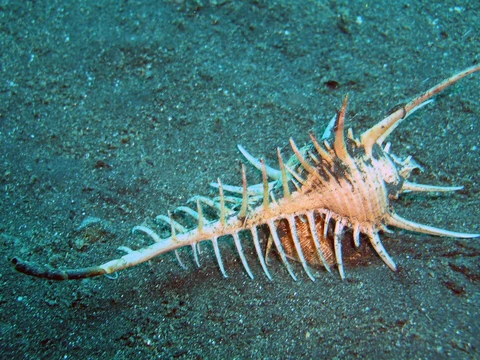
Naquetia annandalei
A fusiform murex with three foliaceous varices and a recurved siphonal canal.

Naquetia annandalei belongs to the Muricidae family, a group of marine gastropod molluscs commonly called murex or rock snails. Its fusiform shell, pale reddish-brown with faint chestnut bands, typically measures about 76.5 mm in length, though specimens up to 100 mm have been recorded. The spire consists of roughly nine and a half whorls, with three foliaceous varices running along the shell; the first two of these form hollow spines. The later whorls have a rough, scabrous texture, sculpted with fine beaded spiral striae and transverse nodulous ribs. The sutures are impressed and coarsely crenellated where the transverse ribs end. The columella is slightly curved, white, and expanded. The outer lip is nearly continuous, reflexed, and whitish, marked by three widely spaced chestnut spots that align with the shell’s colour bands. The aperture is oval, with a notch where the outer lip meets the parietal wall. The siphonal canal is elongated, closed, and curves forward, its margin nearly erect and extending into a thick, well-defined white callus with an indistinct nodule. This species is found in the Bay of Bengal, off Vietnam, the Philippine Islands, Taiwan, southern Japan, Queensland (Australia), and the Marquesas. Originally described as *Pteronotus annandalei* by Preston in 1910, the type material came from Gopalpur in the Bay of Bengal, collected at depths of 30 to 38 fathoms.
Quick Facts
- Genus
- Naquetia
- Species
- annandalei
Facts from the source article.
Lore & Background
The shell of Naquetia annandalei is fusiform and bears three foliaceous varices along its length, the first two forming hollow spines. The remaining whorls have a somewhat rough (scabrous) appearance, sculptured with fine beaded spiral striae and transverse nodulous ribs. The sutures are impressed and coarsely crenellated by the terminations of the transverse ribs. The columella is slightly curved, white, and expanded. The outer lip is nearly continuous, reflexed, and whitish, with three widely spaced chestnut spots corresponding to the termination of the colour bands. The aperture is oval, with a notch at the junction of the outer lip and parietal wall. The siphonal canal is elongated, closed, and recurved anteriorly, with a margin that is nearly erect and extends into a thick, well-defined white callus bearing an indistinct nodule.
The species was originally described as Pteronotus annandalei by Preston in 1910, based on material collected off Gopalpur, Bay of Bengal, at depths of 30–38 fathom. Its distribution includes the Bay of Bengal, Vietnam, the Philippine Islands, Taiwan, South Japan, Queensland (Australia), and the Marquesas.
Reader's Guide
Naquetia annandalei is a distinctive member of the Muricidae, notable for its fusiform shell with three foliaceous varices and a recurved siphonal canal. The species was originally placed in the genus Pteronotus before being reassigned to Naquetia, reflecting taxonomic refinements within the murex snails. Its occurrence across a wide Indo-West Pacific range—from the Bay of Bengal to the Marquesas—indicates a broad distribution in marine environments, typically at depths of 30–38 fathom as recorded in the original collection. The shell's pale reddish-brown coloration with indistinct chestnut bands and its sculptured surface of beaded striae and nodulous ribs contribute to its identification among related species. The elongated, closed siphonal canal and the white callus with an indistinct nodule are key morphological features. The species remains of interest to malacologists studying muricid diversity and biogeography in the Indo-Pacific region, with its original description by Preston in 1910 providing a historical baseline for subsequent research, including modern revisions by Houart, Moe, and Chen in 2021.
Taxonomic Identity and Classification
Naquetia annandalei is a medium-sized sea snail classified within the family Muricidae, a group of marine gastropod mollusks popularly known as rock snails or murex snails. The species was described by Preston in 1910, adding it to a genus that Jousseaume had originally established in 1880 when he published his methodological division of the Purpuridés family. As a member of the Muricidae, this particular snail is part of a well-studied group of marine gastropods whose members are distributed across the Indo-West Pacific region, as documented in comprehensive taxonomic surveys of living species in that area. The placement of Naquetia annandalei within this framework reflects a long tradition of conchological research, stretching from Jousseaume's foundational 1880 work through Preston's 1910 species description and continuing into modern revisions that have refined the boundaries of the genus and its constituent species over more than a century of accumulated taxonomic scholarship.
A Genus of Enduring Diversity
The genus Naquetia encompasses nine currently recognized valid species, representing a remarkable span of taxonomic history. The oldest species in the group, Naquetia triqueter, was described by Born as far back as 1778, while the most recent addition, Naquetia rhondae, was named by Houart and Lorenz in 2015. Between those two endpoints, the genus has accumulated species described by a rotating cast of conchologists across more than two centuries: Reeve in 1858, A. Adams in 1853, Tapparone Canefri in 1875, Preston in 1910, D'Attilio and Hertz in 1987, Houart in 1986, and Houart and Héros in 2013. This steady stream of new species descriptions underscores that Naquetia remains an active area of taxonomic inquiry, with researchers continuing to identify and formalize new members of the genus well into the twenty-first century.
Taxonomic Revisions and Synonymy
Not all names once placed within Naquetia have survived scrutiny. Two species that were historically assigned to the genus have since been moved into synonymy with members of other muricid genera. Naquetia capucina, originally described by Lamarck in 1822, is now recognized as a synonym of Chicoreus capucinus, also attributed to Lamarck in the same year. Similarly, Naquetia superbus, described by G. B. Sowerby III in 1889, has been reclassified as a synonym of Chicomurex superbus, retaining Sowerby's original authorship and date. These reassignments highlight the fluid nature of taxonomic classification within the Muricidae, where species boundaries and generic affiliations are periodically revisited as researchers refine their understanding of morphological relationships. The fact that these two names were once considered part of Naquetia before being transferred to Chicoreus and Chicomurex illustrates how the genus has been shaped by ongoing scholarly debate and revision.
Scholarly Documentation and Ongoing Research
The taxonomic record for Naquetia annandalei and its genus is supported by a body of substantial scholarly literature that spans nearly two centuries. A key modern reference is the 2021 monograph by Houart, Moe, and Chen, published in Novapex, which provides a comprehensive treatment of living species of both Chicomurex and Naquetia across the Indo-West Pacific region. This work builds upon the earlier 2011 volume by Merle, Garrigues, and Pointier, a 648-page reference covering fossil and recent Muricidae worldwide, specifically addressing the subfamily Muricinae. The original genus description by Jousseaume appeared in 1880 in the journal Le Naturaliste, where he outlined a methodological division of the Purpuridés family. Together, these publications form a layered scholarly foundation that documents the ongoing refinement of Naquetia's species roster and its relationships to neighboring muricid genera.
Frequently Asked Questions
What is Naquetia annandalei?
Naquetia annandalei is a species of marine gastropod mollusc placed in the Muricidae family, the group widely known as murex or rock snails. It is identified by its elongated fusiform shell bearing three foliaceous varices and a recurved siphonal canal.
How large does Naquetia annandalei typically grow?
Most collected specimens measure roughly 76.5 mm in shell length, although the species has been recorded reaching up to about 100 mm at its maximum.
What does the shell of Naquetia annandalei look like?
The shell is fusiform with a pale reddish-brown ground color crossed by faint, indistinct chestnut bands. The later whorls feel rough and scabrous to the touch, sculpted with fine beaded spiral striae and transverse nodulous ribs, while the sutures are distinctly impressed.
How many whorls and varices does Naquetia annandalei possess?
The spire comprises approximately nine and a half whorls, and three foliaceous varices run along the shell; the first two of these varices develop into hollow spines.
What features set Naquetia annandalei apart from other murex snails?
Its particular combination of a recurved siphonal canal, three foliaceous varices (two forming hollow spines), and the fine beaded-and-nodulous surface sculpture on the body whorl distinguishes it within the Muricidae.
More in Murex Snails, Part 2 1-24
Spotted an error? Know more?
Reader corrections go straight into our review queue. Suggest an edit · How this site is sourced