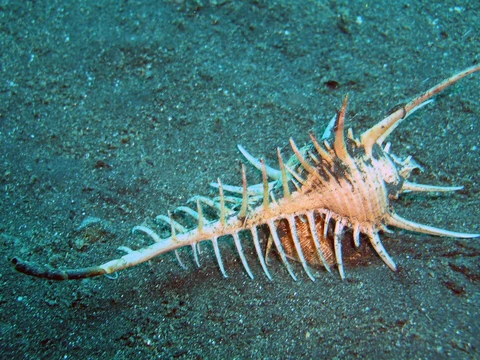
Typhina
A genus of marine gastropod mollusks in the murex snail family.

The murex snail genus *Typhina* groups together a number of sea snails, all of which are marine gastropod mollusks. These animals belong to the subfamily Typhinae within the larger family Muricidae—the family commonly known as murex snails or rock snails. French zoologist Félix Pierre Jousseaume first described the genus in 1880.
Among the species recognized within *Typhina* are *Typhina belcheri*, *Typhina campbelli*, *Typhina carolskoglundae*, *Typhina clarki*, *Typhina clarksoni*, *Typhina claydoni*, *Typhina coronata*, *Typhina expansa*, *Typhina gabonensis*, *Typhina grandis*, *Typhina lamyi*, *Typhina latipennis*, *Typhina neocaledonica*, *Typhina nitens*, *Typhina pallida*, and *Typhina puertoricensis*. Several fossil species are also included, such as *†Typhina alata*, *†Typhina canaliculata*, *†Typhina cryptica*, *†Typhina radulfiensis*, *†Typhina rutoti*, and *†Typhina subburdigalensis*.
A few names once placed in *Typhina* have since been reassigned. *Typhina pavlova* is now considered a synonym of *Choreotyphis pavlova*, *Typhina ramosa* is treated as a synonym of *Typhis ramosus*, and *Typhina riosi* is a synonym of *Siphonochelus riosi*.
Quick Facts
- Taxon
- Typhina
- Type Species
- Typhis belcheri / Broderip, 1833
Facts from the source article.
Lore & Background
The genus Typhina was established by French naturalist Félix Pierre Jousseaume in 1880. It belongs to the subfamily Typhinae within the family Muricidae, commonly known as murex snails or rock snails. The genus includes both extant and extinct species, with fossil taxa such as †Typhina alata, †Typhina canaliculata, †Typhina cryptica, †Typhina radulfiensis, †Typhina rutoti, and †Typhina subburdigalensis. Living species are distributed across various marine environments, with records from New Caledonia, the South China Sea, Western Australia, and other regions. Some species originally placed in Typhina have since been reassigned to other genera; for example, Typhina pavlova is now considered a synonym of Choreotyphis pavlova, Typhina ramosa is a synonym of Typhis ramosus, and Typhina riosi is a synonym of Siphonochelus riosi.
Reader's Guide
The genus Typhina contributes to the taxonomic understanding of the Typhinae subfamily within the Muricidae. Its description by Jousseaume in 1880 provided a framework for classifying a group of marine gastropods characterized by their shell morphology. The inclusion of both living and fossil species highlights the evolutionary continuity and diversity within the group. Taxonomic revisions, such as the 2021 study by Houart, Buge & Zuccon, have refined the species boundaries and expanded knowledge of Typhina distribution, particularly in New Caledonia, the South China Sea, and Western Australia. The synonymies recorded for species like Typhina pavlova, Typhina ramosa, and Typhina riosi reflect ongoing scientific reassessment of morphological and genetic data. The genus remains a subject of study in malacology, with new species continuing to be described, such as Typhina clarksoni in 2021 and Typhina gabonensis and Typhina pallida in 2021. The checklist of New Zealand living Mollusca includes Typhina, indicating its presence in that region's marine fauna.
Did You Know?
- Typhina was first described by Félix Pierre Jousseaume in 1880.
- The genus includes both living and extinct species, such as †Typhina alata and †Typhina cryptica.
- Typhina pavlova is a synonym of Choreotyphis pavlova.
- New species like Typhina clarksoni were described as recently as 2021.
Taxonomic Identity & Classification
Typhina coronata belongs to the class of marine gastropod mollusks, specifically a sea snail that has been placed within the family Muricidae. This family, commonly referred to as the murex snails or rock snails, represents a diverse and well-known group of predatory marine gastropods. Within this broader family, the species occupies the genus Typhina, a grouping that has received renewed taxonomic attention in recent years. The specific epithet coronata distinguishes this particular species from its congeners. As a member of the Muricidae, Typhina coronata shares the general body plan and ecological niche associated with rock-dwelling marine snails, though its precise behavioral ecology is not detailed in the available taxonomic literature. The species was formally recognized in the nineteenth century, emerging from collections gathered along the Pacific coasts of the Americas, and it has since been incorporated into broader taxonomic revisions of the subfamily Typhinae, which encompasses related genera across multiple oceanic regions.
Morphology & Shell Dimensions
The most readily measurable characteristic of Typhina coronata is the size of its shell, which reaches a maximum length of approximately 21 millimeters, equivalent to roughly 0.83 inches. This places the species firmly in the small-to-modest size range for a marine gastropod, consistent with many members of the Muricidae family that inhabit rocky coastal environments. The shell, as is typical of murex and rock snails, serves as the primary external identifier for the organism and is the structure most frequently preserved in museum collections and scientific literature. As a sea snail, Typhina coronata possesses the coiled, calcareous shell characteristic of gastropod mollusks, and its modest dimensions suggest a life spent navigating the crevices and surfaces of rocky substrates rather than open sandy bottoms. The 21-millimeter measurement represents the upper limit of shell growth for this species, meaning most individuals in a natural population would likely be somewhat smaller. No further morphological details—such as spination, coloration, or aperture shape—are provided in the available taxonomic records, leaving the full visual character of the shell to be appreciated through original type specimens and the illustrations accompanying its nineteenth-century descriptions.
Geographic Range & Habitat
Typhina coronata is known from a series of localities along the eastern Pacific Ocean, stretching from the coast of Mexico down through Central and South America. The species has been recorded off Acapulco on the Mexican Pacific coast, and its range extends southward to include the waters off Panama, Peru, and Ecuador. Perhaps most notably, it has also been found in the waters surrounding the Galápagos Islands, a volcanic archipelago situated in the eastern Pacific that is renowned for its extraordinary biodiversity. This distribution pattern—spanning the continental coasts of western Mexico, Central America, and western South America, as well as the island waters of the Galápagos—suggests a species adapted to the temperate-to-tropical marine environments of the eastern Pacific basin. As a member of the Muricidae, the rock snail family, Typhina coronata likely favors rocky or reef-associated habitats where it can anchor itself and forage among sessile invertebrates. The presence of this species across such a broad latitudinal and geographic span, from the Mexican coast to the equatorial Galápagos, underscores the ecological versatility of small muricid gastropods along the Pacific's eastern margin.
Historical Discovery & Taxonomic Legacy
The formal scientific recognition of Typhina coronata traces back to the early nineteenth century, a period when European naturalists were actively describing the vast array of marine invertebrates collected during voyages of exploration along the Pacific coasts of the Americas. Broderip and Sowerby published descriptions of new shell species in 1832–1833, drawing on specimens gathered by Mr. Cuming along the western coast of South America and among the islands of the southern Pacific. Around the same era, Hinds described new shell species in 1843 from material collected during the voyage of HMS Sulphur under Sir Edward Belcher, while Lesson contributed descriptions of new Murex species in 1844. These early works laid the groundwork for understanding the diversity of muricid snails in the eastern Pacific. More recently, a comprehensive taxonomic update by Houart, Buge, and Zuccon in 2021 revisited the subfamily Typhinae, reviewing species from New Caledonia, the South China Sea, and Western Australia, and providing a modern framework within which Typhina coronata and its relatives are now classified. This ongoing refinement highlights how nineteenth-century collections continue to inform contemporary malacological taxonomy.
Frequently Asked Questions
What is Typhina?
Typhina is a genus of marine gastropod mollusks that brings together several species of sea snails. It is classified within the subfamily Typhinae of the murex snail family Muricidae.
Who first described the genus Typhina and when?
French zoologist Félix Pierre Jousseaume formally described and named the genus. His original work on this group was published in 1880.
Which species are recognized under the genus Typhina?
Members include species such as Typhina belcheri, T. campbelli, T. coronata, T. expansa, and T. grandis, among others. All of these are marine snails sharing the Typhinae subfamily placement.
Where does Typhina sit in the murex snail taxonomy?
Typhina belongs to the family Muricidae, the large group commonly referred to as murex or rock snails. Within that family it is assigned to the subfamily Typhinae, distinguishing it from other murex lineages.
Why is the genus Typhina significant to murex snail enthusiasts?
It represents a distinct cluster of marine gastropods within the well-known murex family, each species displaying its own characteristic shell form. The genus has been steadily expanded since Jousseaume's 1880 description as additional species have been identified and assigned to the group.
More in Murex Snails, Part 2 1-24
Spotted an error? Know more?
Reader corrections go straight into our review queue. Suggest an edit · How this site is sourced