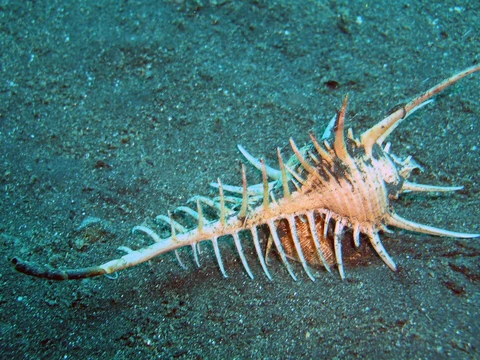
Bolinus cornutus
A predatory sea snail from which Tyrian purple dye can be extracted.

Bolinus cornutus, also called the horned murex, is a predatory marine snail belonging to the murex family, Muricidae. It is common along the west coast of Africa, where it lives in moderately shallow waters on gravelly or rocky seabeds. The snail is carnivorous and hunts other animals for food.
Its shell is large, thick, and club-shaped, reaching a maximum length of about 200 millimetres. The shell is usually pale brown or tan, with three evenly spaced darker brown spiral bands across the body whorl. The spire is low, and the body whorl has six or seven varices, each forming two long, hollow spines. The siphonal canal is long, straight, and narrowly open along its length, with short spines spiraling off it. Most of the shell’s outer surface is rough. The aperture is mostly white, with an apricot tint on the lip edge, the inductura, and the parietal callus.
Though not as widely used as other murex species like Bolinus brandaris, Bolinus cornutus is one of the snails from which Tyrian purple dye can be obtained. This dye comes from a mucus secreted by the snail’s hypobranchial gland, which the animal uses for defense and to help capture prey.
The species is found along the Atlantic coast of Africa and is not uncommon.
Quick Facts
- Taxon
- Bolinus cornutus
Facts from the source article.
Lore & Background
Bolinus cornutus is a marine gastropod mollusk in the family Muricidae, common along the west coast of Africa. It inhabits moderately shallow waters and prefers gravelled or rocky substrate. The snail is carnivorous and predatory. Its shell is large, thick, spiny, and club-shaped, with a broad body whorl and a low spire. The body whorl bears six or seven varices, each forming two long, hollow spines, and short spines also spiral off the long, straight siphonal canal, which is narrowly open along its length. The shell is usually pale brown or tan, interrupted on the body whorl by three darker brown spiral bands spaced evenly. The ovate aperture is mostly white, with an apricot shade on the lip edge, the inductura, and the parietal callus. Most of the outer surface of the shell is rough in texture. The maximum shell length is approximately 200 millimetres.
Reader's Guide
Bolinus cornutus holds significance as one of the sea snail species from which Tyrian purple dye can be extracted. The dye is a mucus secreted from the snail's hypobranchial gland, used by the snail for defence and as an aid in predation. Although not as widely utilised as other murex species such as Bolinus brandaris, its ability to produce this historically valuable dye places it within the broader context of ancient dye production. The species is not uncommon along the Atlantic coast of Africa, where it is found in moderately shallow waters on gravelly or rocky substrates. Its large, spiny shell provides protection, and its predatory nature contributes to its ecological role. The legacy of Bolinus cornutus is tied to the enduring cultural and economic importance of Tyrian purple, a dye that has been prized since antiquity, even though this particular species was less exploited than its relatives.
Did You Know?
- Bolinus cornutus is also known as the horned murex.
- Its shell can reach a maximum length of approximately 200 millimetres.
- The dye extracted from this species is a mucus from the hypobranchial gland.
Frequently Asked Questions
What is Bolinus cornutus?
It is a predatory sea snail in the murex family (Muricidae), commonly nicknamed the horned murex, native to Africa's Atlantic coastline.
What does a Bolinus cornutus shell look like?
The shell is thick and club-shaped, typically pale brown or tan with three evenly spaced darker brown spiral bands wrapping around the body whorl. The aperture is mostly white, with a warm apricot tint along the lip edge, inductura, and parietal callus.
Where does Bolinus cornutus live?
It is found along the west coast of Africa, favoring moderately shallow waters over gravelly or rocky seabeds.
What does Bolinus cornutus eat and how big does it get?
It is a carnivorous predator that actively hunts other marine animals for food. Its shell can reach a maximum length of roughly 200 millimetres, making it one of the larger murex species.
Why is Bolinus cornutus historically significant?
This snail is the source from which the prized Tyrian purple dye was extracted in antiquity, giving it a long and culturally important role in ancient Mediterranean trade and craftsmanship.
More in Murex Snails, Part 2 1-24
Spotted an error? Know more?
Reader corrections go straight into our review queue. Suggest an edit · How this site is sourced