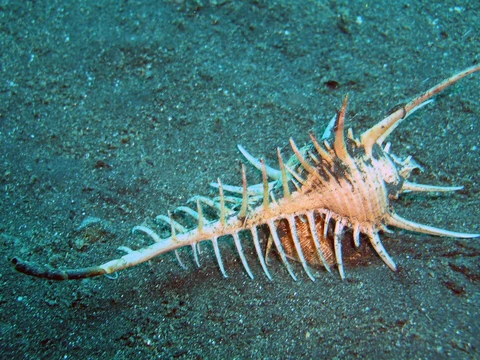
Phyllonotus margaritensis
A predatory murex snail of seagrass beds and reefs.

Phyllonotus margaritensis, commonly known as the Margarita Murex, is a species of sea snail in the family Muricidae. It is a marine gastropod mollusc noted for its large, strong shell and its role as an active predator of bivalves.
Quick Facts
- Genus
- Phyllonotus
- Species
- margaritensis
Facts from the source article.
Lore & Background
The shell of Phyllonotus margaritensis is large and strong, reaching sizes between 7 and 11 cm. It bears 4 or 5 lap varices that are simple, nodular and obtuse, and its siphonal canal is wide and curved. The mouth displays colors that can vary from yellow, orange and red, and the inner lip is nodulated at the base. Studies on sexual dimorphism suggest that females tend to have a larger size than males and greater variation in shape. This species is distributed from North Carolina to Florida and across the Caribbean Sea to Brazil, with noted occurrences in Colombia, Venezuela and Trinidad in the Southern Caribbean. It is often found in abundance in seagrass beds, but can also be observed on rocky areas and reef areas at lower densities, having been collected at depths from 0 to 200 m. As a muricid, it is an active predator of bivalves such as sand-dwelling clams.
Reader's Guide
Phyllonotus margaritensis occupies a significant ecological role as an active predator of bivalves, particularly sand-dwelling clams, within its range from North Carolina to Brazil. Its abundance in seagrass beds and presence on rocky and reef areas at lower densities highlight its adaptability across different marine habitats. The species' bathymetric range from 0 to 200 m indicates a broad vertical distribution. The observed sexual dimorphism, with females tending to be larger and more variable in shape than males, adds to the biological understanding of this muricid. The shell's distinctive features—large size, nodular varices, and variable mouth colors—make it a recognizable member of the Muricidae family. Its occurrence in the Southern Caribbean, particularly in Colombia, Venezuela, and Trinidad, underscores its presence in tropical and subtropical waters. The species contributes to the biodiversity of seagrass ecosystems and reef environments, where it helps regulate bivalve populations.
Did You Know?
- The shell of Phyllonotus margaritensis reaches sizes between 7 and 11 cm.
- Its mouth colors can vary from yellow, orange and red.
More in Murex Snails, Part 2 1-24
Spotted an error? Know more?
Reader corrections go straight into our review queue. Suggest an edit · How this site is sourced