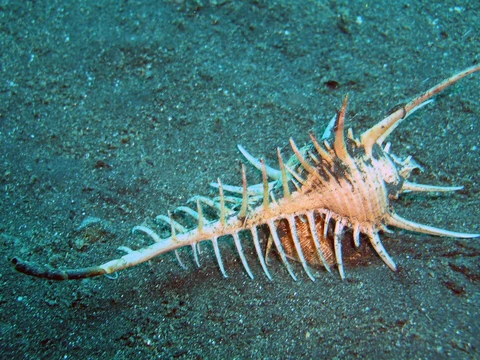
Hadriania (gastropod)
A genus of murex snails with fossil and living species.

Hadriania is a genus of marine gastropod mollusks, specifically sea snails, belonging to the family Muricidae—commonly referred to as murex snails or rock snails. The genus includes both living and fossil species, with several described from Neogene deposits in the Aquitaine region. Among the recognized species are *Hadriania craticulata* and *Hadriania sperata*, as well as extinct forms such as *Hadriania brevituba*, *Hadriania minutisquama*, *Hadriania mioincrassata*, and *Hadriania textiliosa*. Some names once considered distinct species have since been reclassified as synonyms of *Hadriania craticulata*, including *Hadriania brocchii*, *Hadriania craticuloides*, *Hadriania oretea*, and *Hadriania provencalis*.
Quick Facts
- Taxon
- Hadriania
- Type Species
- Hadriania craticulata / Bucquoy & Dautzenberg, 1882
Facts from the source article.
Lore & Background
The genus Hadriania was established by Bucquoy and Dautzenberg in 1882 with the species Hadriania craticulata. Several other species have been described, including fossil forms such as Hadriania brevituba (Millet, 1865), Hadriania minutisquama (Cossman & Peyrot, 1924), Hadriania mioincrassata (Sacco, 1904), and Hadriania textiliosa (Lamarck, 1803). The extant species Hadriania sperata was described by Cossmann in 1921.
A number of names have been brought into synonymy with Hadriania craticulata, including Hadriania brocchii (Monterosato, 1872), Hadriania craticuloides (Vokes, 1964), Hadriania oretea (de Gregorio, 1885), and Hadriania provencalis (Risso, 1826). These synonymies reflect taxonomic revisions within the genus. The species are marine gastropods belonging to the subfamily Ocenebrinae, as indicated by molecular phylogenetic work.
Reader's Guide
Hadriania holds significance as a genus within the Muricidae, contributing to the understanding of murex snail diversity in both modern and fossil contexts. The fossil species, particularly those from the Neogene of Aquitaine described by Cossmann and Peyrot in 1924, provide stratigraphic and paleobiogeographic data. The synonymy of several names under Hadriania craticulata illustrates the historical challenges in distinguishing species based on shell morphology. The inclusion of Hadriania in molecular phylogenetic frameworks (Barco et al., 2017) has clarified its placement within the subfamily Ocenebrinae, linking traditional taxonomy with modern systematics. The genus is documented in works such as Bucquoy, Dautzenberg & Dollfus's 'Les mollusques marins du Roussillon' (1882-1886), which remains a key reference for Mediterranean marine mollusks. The legacy of Hadriania lies in its role as a case study for taxonomic revision and as a component of the rich muricid fauna of the northeastern Atlantic and Mediterranean regions.
Did You Know?
- Hadriania craticulata has four synonyms: H. brocchii, H. craticuloides, H. oretea, and H. provencalis.
- Fossil species include Hadriania brevituba, H. minutisquama, H. mioincrassata, and H. textiliosa.
- The genus belongs to the subfamily Ocenebrinae within the family Muricidae.
More in Murex Snails, Part 2 1-24
Spotted an error? Know more?
Reader corrections go straight into our review queue. Suggest an edit · How this site is sourced