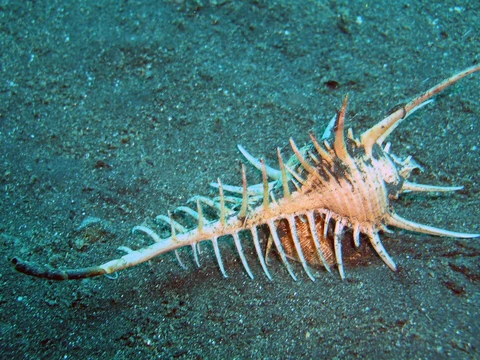
Hadriania craticulata
A marine gastropod mollusc in the family Muricidae.

Hadriania craticulata is a marine gastropod mollusc belonging to the Muricidae family, commonly referred to as murex or rock snails. Its shell typically measures between 20 and 45 millimeters in length. This sea snail is found in the Mediterranean Sea, specifically off the coast of Morocco.
Quick Facts
- Genus
- Hadriania
- Species
- craticulata
Facts from the source article.
Lore & Background
This species is part of the diverse group of murex snails, known for their often ornate and spiny shells. The shell size range of 20 to 45 mm places it among the smaller to medium-sized members of its family. Its distribution is recorded in the Mediterranean Sea off the coast of Morocco, indicating a restricted geographic range within that sea.
Reader's Guide
Hadriania craticulata contributes to the understanding of muricid diversity in the Mediterranean region. Its presence off Morocco adds to the biogeographic knowledge of murex snails in the western Mediterranean. The species has been referenced in taxonomic works, including those by Monterosato, Vokes, and Coen, which have helped define supraspecific groups within the Muricinae and Tritonaliinae subfamilies. Its shell size range provides a morphological benchmark for comparison with related species. The species is also represented in museum collections, such as a lectotype held at the Muséum national d'Histoire naturelle in Paris, which serves as a reference for identification. The work of Bucquoy, Dautzenberg, and Dollfus on marine molluscs of Roussillon, as well as Risso's natural history of southern Europe, include this species in their broader surveys of regional gastropods. Kobelt's iconography of European marine shells further documents its appearance. These references collectively place Hadriania craticulata within the historical and ongoing study of Mediterranean molluscan fauna.
Did You Know?
- The shell size varies between 20 mm and 45 mm.
- This species occurs in the Mediterranean Sea off Morocco.
- It is a marine gastropod mollusc in the family Muricidae.
More in Murex Snails, Part 2 1-24
Spotted an error? Know more?
Reader corrections go straight into our review queue. Suggest an edit · How this site is sourced