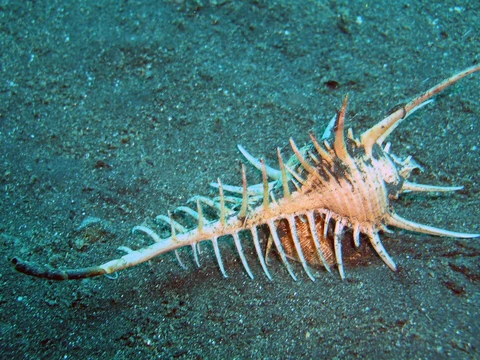
Acanthotrophon
A genus of murex snails with fossil and living species.

Acanthotrophon is a genus of sea snails, specifically marine gastropod mollusks belonging to the family Muricidae—commonly known as murex snails or rock snails. This genus contains both living species and fossil forms. Its known species include †Acanthotrophon aquensis, †Acanthotrophon ascensus, †Acanthotrophon aturi, Acanthotrophon carduus, Acanthotrophon latispinosus, Acanthotrophon sentus, Acanthotrophon sorenseni, Acanthotrophon striatoides, and †Acanthotrophon striatus.
Quick Facts
- Taxon
- Acanthotrophon
Facts from the source article.
Lore & Background
The genus Acanthotrophon was established within the family Muricidae, and its species are characterized by their spiny or sculptured shells typical of murex snails. Fossil species such as † Acanthotrophon aquensis, † Acanthotrophon ascensus, † Acanthotrophon aturi, and † Acanthotrophon striatus have been described from Oligocene and Miocene deposits in Aquitaine, France, indicating a historical presence in the northeastern Atlantic region. Extant species include Acanthotrophon carduus, Acanthotrophon latispinosus, Acanthotrophon sentus, Acanthotrophon sorenseni, and Acanthotrophon striatoides, which are known from the eastern Pacific, particularly from the west coast of Mexico and Central America.
The taxonomy of the genus has been reviewed by various authors, with species descriptions contributed by Broderip (1833), Berry (1969), Hertlein & Strong (1951), Vokes (1980), and Garrigues & Lamy (2019). The fossil record shows that the genus was present in the Oligocene and Miocene of Aquitaine, as documented by Lozouet (1999). The genus is part of the subfamily Muricopsinae according to Merle, Garrigues & Pointier (2022).
Reader's Guide
The genus Acanthotrophon contributes to the understanding of muricid diversity and biogeography, linking fossil faunas of the Oligocene and Miocene in southwestern France with modern assemblages in the eastern Pacific. Its fossil species provide evidence of a broader historical distribution that has since contracted or shifted. The genus is notable for including both extinct and living forms, allowing comparisons of shell morphology and evolutionary trends within the Muricidae. The work of Vokes (1980) provided a review of the genus, establishing a framework for species identification. The inclusion of Acanthotrophon in the comprehensive work by Merle, Garrigues & Pointier (2022) on Fossil and Recent Muricidae of the world underscores its significance in the study of muricopsine gastropods. The genus also appears in regional faunal lists, such as those for Peru (Ramírez, Paredes & Arenas, 2003), indicating its role in modern biodiversity assessments. The fossil species from Aquitaine, described by Lozouet (1999), add to the paleontological record of the region and help date the sedimentary sequences of the Oligocene and Miocene.
Did You Know?
- The genus includes both fossil and extant species.
- Fossil species have been found in Oligocene and Miocene deposits of Aquitaine, France.
- Extant species occur along the west coast of Mexico and Central America.
- The genus was reviewed by Vokes in 1980.
More in Murex Snails, Part 2 1-24
Spotted an error? Know more?
Reader corrections go straight into our review queue. Suggest an edit · How this site is sourced