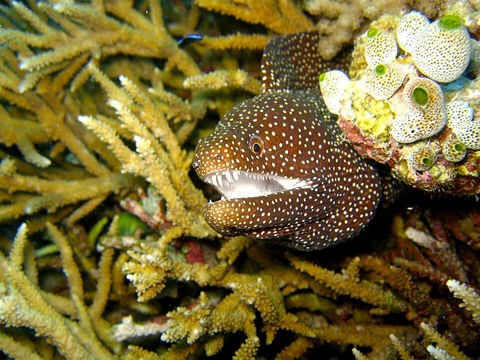
Yellow-edged moray
A large Indo-Pacific moray eel that preys on lionfish Pterois miles in the Red Sea.

The yellow-edged moray (Gymnothorax flavimarginatus) is a moray eel of the family Muraenidae, found in the Indo-Pacific Oceans at depths to 150 m. It is also known as the yellow-margin moray, leopard moray, and speckled moray. This species is notable for its large size, distinctive coloration, and its role as a natural predator of the lionfish Pterois miles in the Red Sea.
Quick Facts
- Taxon
- Gymnothorax flavimarginatus
Facts from the source article.
Lore & Background
The yellow-edged moray is a long, slender fish with a bulbous head, rounded snout, and gradually tapering tail. Its large mouth contains a single row of small pointed teeth in the lower jaw and several vomerine teeth on the roof of the mouth. The dorsal fin extends continuously from just behind the head along the back to round the tail, where it continues as the caudal and anal fins. It can grow to a maximum length of about 240 cm, though a more typical length is 80 cm. The body is basically dull yellow with a mottled pattern of dark brown or black covering most of the surface. The head is purplish-grey with a large black blotch at the operculum, and the margins of the fins on the posterior part of the body are yellowish or greenish. Young fish may have a brighter yellow background color with brown blotches. This moray occurs in the tropical Indo-Pacific region, inhabiting coral or rocky areas of reef flats and the protected sides of seaward reefs, down to about 150 m. It is usually solitary, hiding in a crevice or submerged in sediment with just its head protruding, and sometimes shares its shelter with conspecifics or other moray eel species. It is mainly nocturnal but also swims freely in the morning and evening. Its diet includes fish, cephalopods, and crustaceans. It is quick to appear when a fish is speared on the reef, being sensitive to stimuli from injured or stressed fish.
Reader's Guide
The yellow-edged moray holds significance as a natural predator of the invasive lionfish Pterois miles in its native habitat in the Red Sea, a role that highlights its ecological importance in controlling lionfish populations. Its sensitivity to stimuli from injured or stressed fish makes it a notable scavenger and predator on coral reefs. The species also exhibits a possible cleaning symbiosis with the shrimp-like crustacean Stenopus pyrsonotus, which has often been found in close proximity to the eel. This relationship, though not confirmed, suggests a mutualistic interaction that could benefit both organisms. The yellow-edged moray's wide distribution across the Indo-Pacific, from East Africa to the Galápagos Islands, and its occurrence at depths up to 150 m, underscore its adaptability to diverse reef environments. Its distinctive coloration—dull yellow with dark mottling, a purplish-grey head, and yellowish fin margins—makes it easily recognizable among moray eels. The species' solitary and nocturnal habits, along with its occasional sharing of shelters, contribute to its ecological niche as a cryptic predator. Its legacy is tied to its role in reef ecosystems and its potential as a biological control agent for lionfish.
Did You Know?
- The yellow-edged moray is also called the leopard moray and speckled moray.
- The shrimp-like crustacean Stenopus pyrsonotus is often found in close proximity to this eel, suggesting a possible cleaning symbiosis.
More in Moray Eels 1-24
Spotted an error? Know more?
Reader corrections go straight into our review queue. Suggest an edit · How this site is sourced