Scuticaria okinawae
A rarely sighted moray eel with a short tail.

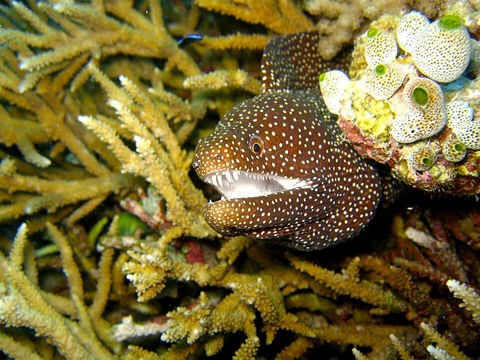
Scuticaria okinawae, also called the shorttailed snake moray, shorttail moray, Seale's moray eel, or Bennett's moray, is a species of moray eel that lives in the Pacific and Indian Oceans. Its body is slender, with a blunt head and small eyes, and it is uniformly gray, brown, or purplish-brown. It can grow up to 90.5 centimeters (35.6 inches) in standard length. The eel is easily recognized by its very short tail—the anus is located at two-thirds of the total length. It is thought to be nocturnal, though its sleep cycle is not confirmed. Because it is rarely seen, little is known about its life history.
This moray inhabits the tropical Indo-Pacific region, including Japan, Hawaii, Indonesia, the Philippines, and South Africa. It typically hides among coral reefs and rocks.
Taxonomically, the species was once listed under names such as *Gymnomuraena bennetti*, *Scuticaria bennetti*, or *Uropterygius bennetti*. However, in 1997, Böhlke and McCosker showed that *Gymnomuraena bennetti* is actually a junior synonym of *Channomuraena vittata*, so the name *okinawae* was revived for this eel, which had been misidentified as *bennetti*. Other synonyms include *Uropterygius unicolor* (with its unnecessary replacement name *U. sealei*) and *Gymnomuraena brevicauda*.
Quick Facts
- Genus
- Scuticaria (fish)
- Species
- okinawae
Facts from the source article.
Lore & Background
The shorttail moray is uniform gray, brown, or purplish-brown in color, having a slender body with a blunt head and small eyes, and attains a length of up to 90.5 centimetres SL. This species is identified by its noticeably short tail, with the anus at 2⁄3 TL. The shorttail moray is believed to be nocturnal, as there is no certainty in its sleep cycle. This species of moray has been rarely sighted, and not much is known regarding its life.
The shorttail moray can be found in the tropical Indo-Pacific region, including Japan, Hawaii, etc, as well as Indonesia, the Philippines, South Africa, etc. It is usually found hiding in coral reefs and rocks.
Scuticaria okinawae was previously referred to as Gymnomuraena bennetti, Scuticaria bennetti, or Uropterygius bennetti in a number of publications. However, Böhlke and McCosker demonstrated that Gymnomuraena bennetti is a junior synonym of Channomuraena vittata, so they resurrected okinawae for the eel previously misidentified as bennetti. Uropterygius unicolor Seale and Gymnomuraena brevicauda Regan are synonyms.
Reader's Guide
Scuticaria okinawae holds significance as a rarely sighted moray eel with a distinctive short tail, setting it apart from many other morays. Its taxonomic history reflects a correction by Böhlke and McCosker, who clarified that the name bennetti had been misapplied and resurrected okinawae. The species is known from the tropical Indo-Pacific, including Japan, Hawaii, Indonesia, the Philippines, and South Africa, typically hiding in coral reefs and rocks. Its nocturnal behavior is uncertain, and little is known about its life cycle, underscoring its status as an enigmatic species. The synonyms Uropterygius unicolor Seale and Gymnomuraena brevicauda Regan further illustrate the historical confusion in its classification. Despite its rarity, the shorttail moray contributes to the diversity of moray eels and highlights the ongoing need for taxonomic clarity in marine biology.
Did You Know?
- The shorttail moray has a noticeably short tail, with the anus at 2/3 of total length.
- It is believed to be nocturnal, but there is no certainty in its sleep cycle.
- This species was previously misidentified as Gymnomuraena bennetti, which was later shown to be a junior synonym of Channomuraena vittata.
- It attains a maximum length of 90.5 cm SL.
Physical Form and Distinguishing Features
The shorttail moray presents as a uniformly colored eel, its body taking on shades of gray, brown, or purplish-brown without any mottling or pattern to break up its silhouette. Its build is notably slender, topped by a blunt head that houses small eyes—features that give it a somewhat subdued, almost unassuming appearance compared to the more flamboyant moray species. The species reaches a maximum length of roughly 90.5 centimetres (about 35.6 inches) in standard length, placing it in the mid-to-larger range for moray eels. The single most reliable field mark, however, is its tail. The posterior section is conspicuously truncated, with the anus positioned at approximately two-thirds of the total body length. This abbreviated tail is the trait that earned the eel its most common English name and remains the quickest way to separate it from look-alike species in the wild.
Range and Preferred Environment
The shorttail moray occupies a broad swath of the tropical Indo-Pacific, spanning both the Pacific and Indian Oceans. Documented locations stretch from the waters around Japan and Hawaii in the Pacific to regions encompassing Indonesia, the Philippines, and as far south as South Africa in the Indian Ocean. This wide distribution suggests the species is not restricted to a single reef type or depth zone, though its preferred microhabitat is consistent: it favors the sheltered crevices of coral reefs and rocky substrates. Rather than patrolling open water, the eel tends to remain tucked away in these structures, using the complexity of living coral and stone as both refuge and hunting ground. The fact that it is usually found hiding rather than actively foraging in the open reinforces the impression of a creature that values concealment above all else, blending its uniform coloration into the surrounding reef matrix and emerging only when conditions suit its likely nocturnal activity.
A Tangled Taxonomic History
The identity of this eel has been a source of considerable confusion in the scientific literature. For years, specimens now recognized as Scuticaria okinawae were catalogued under several different names, including Gymnomuraena bennetti, Scuticaria bennetti, and Uropterygius bennetti, appearing in publications by Smith (1962), McCosker and colleagues (1984), and Randall (1996). The knot was finally untangled when Böhlke and McCosker (1997) demonstrated that Gymnomuraena bennetti was actually a junior synonym of Channomuraena vittata—a completely different species. With the bennetti name effectively invalidated for this eel, the researchers resurrected the name okinawae to properly identify the misclassified specimens. Additional synonyms in the literature include Uropterygius unicolor (described by Seale in 1917, later given the replacement name U. sealei by Whitley in 1932) and Gymnomuraena brevicauda (Regan, 1903). The common names—shorttailed snake moray, Seale's moray, Bennett's moray—reflect the different taxonomic authorities who first encountered the animal.
An Elusive and Poorly Understood Species
Despite its wide geographic range, the shorttail moray remains one of the least well-known moray eels. It is rarely sighted by divers or researchers, and the body of behavioral and ecological knowledge surrounding it is remarkably thin. The eel is generally believed to be nocturnal, yet even this basic aspect of its daily rhythm lacks firm confirmation; there is no definitive data establishing a precise sleep or activity cycle. Its preference for hiding deep within coral formations and rocky outcrops makes direct observation difficult, and the uniform, unpatterned coloration only compounds the challenge of spotting it in its natural setting. The result is a species for which we can describe physical dimensions and geographic spread with reasonable confidence, yet whose feeding habits, reproductive biology, social interactions, and long-term population dynamics remain largely speculative. The shorttail moray stands as a reminder that even in well-studied reef ecosystems, entire species can persist in the margins of scientific understanding, known primarily by their silhouette and a handful of museum specimens.
Frequently Asked Questions
What is Scuticaria okinawae?
It's a slender, uniformly colored moray eel native to tropical Indo-Pacific waters, often called the shorttailed snake moray or Seale's moray. It has a blunt snout, tiny eyes, and a plain gray-to-purplish-brown body with no patterns.
How big does Scuticaria okinawae get?
This species tops out at roughly 90.5 centimeters (about 35.6 inches) in standard length, making it a medium-sized moray.
Where can you find Scuticaria okinawae?
It ranges across coral reefs and rocky outcrops throughout the tropical Indo-Pacific, with documented sightings in places like Japan, Hawaii, Indonesia, the Philippines, and South Africa.
What's the easiest way to tell Scuticaria okinawae apart from other morays?
Its super-short tail is the giveaway: the anus sits at only about two-thirds of total body length, a trait no other common moray shares. Pair that with its slim build, blunt head, and small eyes, and it stands out quickly.
What do we actually know about Scuticaria okinawae's behavior?
Most researchers believe it hunts at night, but its exact sleep cycle has never been verified. Because it is so rarely encountered in the wild, its full life history remains largely a mystery.
More in Moray Eels 1-24
Spotted an error? Know more?
Reader corrections go straight into our review queue. Suggest an edit · How this site is sourced