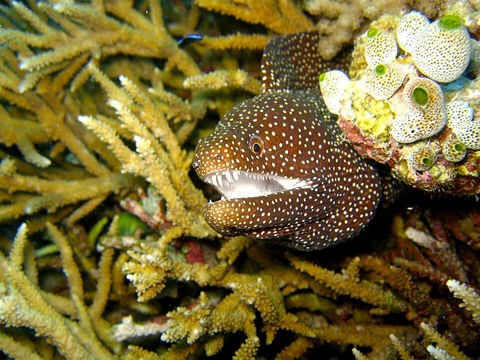
Echidna nocturna
A specialized carnivorous moray eel of the eastern Pacific.

The freckled moray, also called the palenose moray, is a species of moray eel. Its scientific name is *Echidna nocturna*, though it was discovered to be the same species as *Muraena acutis*. It lives in the eastern Pacific Ocean, specifically in the Gulf of California, and around Peru and the Galapagos Islands. Cope first named it in 1872.
This eel has a long, snake-like body. On average, adults reach about 48.26 cm in length, while juveniles range from 8.52 cm to 35.48 cm, with an average of 22 cm. Their weight varies from 1.12 g to 296.1 g, averaging 49.62 grams. The average number of vertebrae is 120.4. Its color is gray-brown, marked with rows of small white spots, and its nose is paler than the rest of its body.
*Echidna nocturna* is found throughout the tropical eastern Pacific Ocean, in both intertidal zones and coral reefs. Juveniles usually live in rocky tidepools, while adults stay near those tidepools or in coral reefs. Like other moray eels, it has a pelagic larval stage.
It is strictly carnivorous and a specialized feeder with a narrow diet. Its main food is shrimp from the superfamily Penaeoidea, but it also eats crabs, stomatopods, and other small animals. This eel sometimes hosts a digenean parasite called *Theletrum lamothei*, which was first discovered in its intestine.
Quick Facts
- Taxon
- Echidna nocturna
Facts from the source article.
Lore & Background
Echidna nocturna has a long snake-like body with an average vertebral count of 120.4 vertebrae. The average length of an adult eel is 48.26 cm. Juveniles range in size from 8.52 cm to 35.48 cm with the average length being 22 cm. They weigh between 1.12g and 296.1 g with the average weight being 49.62 grams. It is gray-brown in color with rows of small white spots along its body. Its nose is paler in color compared to the rest of its body.
Echidna nocturna habitats are distributed throughout the tropical Eastern Pacific Ocean. They are found in both intertidal and coral reef habitats. Juveniles typically reside in rocky shore tidepools while adults reside near the tidepools or in coral reefs. Like other moray eels they have a pelagic larval phase.
Echidna nocturna is an exclusively carnivorous species. They have a low niche breadth, meaning they are specialized feeders. Their diet consists primarily of the shrimp Penaeoidea. They also consume crabs, stomatopods, and some other small animals. Echidna nocturna are sometimes host to Theletrum lamothei, a species of digenean parasite. This species of Theletrum was first discovered in the intestine of Echidna nocturna.
Reader's Guide
Echidna nocturna, first named by Cope in 1872, is notable for being synonymous with Muraena acutis, a taxonomic discovery that clarified its identity. Its common names—freckled moray and palenose moray—reflect its distinctive gray-brown body with rows of small white spots and a paler nose. The species is a specialized carnivore with a low niche breadth, feeding primarily on Penaeoidea shrimp, as well as crabs, stomatopods, and other small animals. This dietary specialization highlights its ecological role in intertidal and coral reef habitats of the tropical Eastern Pacific, including the Gulf of California, Peru, and the Galapagos Islands. Juveniles occupy rocky shore tidepools, while adults reside near tidepools or in coral reefs, and like all moray eels, they undergo a pelagic larval phase. Additionally, Echidna nocturna serves as a host for the digenean parasite Theletrum lamothei, which was first discovered in its intestine, underscoring its significance in parasitological studies. Its average adult length of 48.26 cm and weight of 49.62 grams, along with an average vertebral count of 120.4, provide key biological metrics for this species.
Did You Know?
- Echidna nocturna was first named by Cope in 1872.
- It was discovered that Echidna nocturna and Muraena acutis are the same species.
- The digenean parasite Theletrum lamothei was first discovered in the intestine of Echidna nocturna.
Taxonomy & Naming History
Echidna nocturna entered the scientific record in 1872 when Cope first formally named the species. Over the years, this moray eel has carried two common names that capture its most visible traits: the freckled moray and the palenose moray. The freckled reference almost certainly points to the neat rows of small white spots that break up its otherwise uniform gray-brown coloration, while the palenose name highlights the noticeably paler snout that distinguishes the head from the rest of the body. A meaningful taxonomic development came with the recognition that Muraena acutis, long listed as a separate entry, is in fact the very same animal as Echidna nocturna. Collapsing these two names into a single species streamlined the literature on eastern Pacific morays and removed a redundant classification. Cope's 1872 description still serves as the foundational reference from which all later observations of this eel descend, anchoring more than a century of study to a single original act of identification.
Physical Form & Growth
The freckled moray displays the long, sinuous, snake-like silhouette typical of moray eels, yet it carries its own precise measurements. On average, an individual bears roughly 120.4 vertebrae along its body, lending it the elongated flexibility needed to thread through reef crevices and rocky overhangs. Adult specimens average about 48.26 centimeters in total length, though the species exhibits wide size variation across its life stages. Juveniles span a broad range from just 8.52 centimeters up to 35.48 centimeters, with the average young eel measuring around 22 centimeters. Weight tracks a similar spread: the smallest recorded individuals tip the scale at 1.12 grams while the largest reach 296.1 grams, and the average sits near 49.62 grams. Coloration is a subdued gray-brown, punctuated by orderly rows of small white spots running along the body. The snout region is distinctly paler than the surrounding tissue, a feature that has earned the eel its palenose common name and makes it easy to spot even in dim reef light.
Range & Habitat
Echidna nocturna is a creature of the tropical eastern Pacific, with its distribution stretching from the Gulf of California southward to the waters surrounding Peru and the Galapagos Islands. Within this broad region, the species occupies two primary habitat types: intertidal zones and coral reef environments. A clear life-stage separation governs where different ages of eels are typically found. Young morays in their juvenile phase tend to take shelter in rocky shore tidepools, the shallow semi-protected waters that offer refuge from larger predators. As they mature, adults either remain in the vicinity of those same tidepools or shift their presence to coral reef structures. Like other members of the moray eel family, Echidna nocturna undergoes a pelagic larval phase, during which its earliest life stage drifts in open ocean currents before eventually settling into the coastal and reef habitats where it will spend the remainder of its life. This dispersal strategy likely helps sustain genetic connectivity across the species' scattered range.
Feeding Ecology & Parasitic Relationships
As a strictly carnivorous predator, Echidna nocturna occupies a narrow ecological niche. Its low niche breadth marks it as a specialized feeder rather than a generalist, meaning it depends on a relatively limited set of prey types to meet its nutritional needs. The cornerstone of its diet is the shrimp family Penaeoidea, which constitutes the primary food source. Beyond shrimp, the eel also takes crabs, stomatopods, and various other small animals it can capture within its reef or tidepool environment. This dietary focus on small, hard-bodied invertebrates is consistent with the eel's modest adult size and the crevice-dwelling lifestyle it shares with other morays. An additional ecological relationship worth noting is the eel's role as host to Theletrum lamothei, a digenean fluke parasite. This particular species of Theletrum was originally discovered living in the intestine of Echidna nocturna, making the moray both the type host and the very species in which the parasite was first identified by researchers.
Frequently Asked Questions
Who is Echidna nocturna?
Echidna nocturna is the scientific name for the freckled moray, also known by the common name palenose moray. It is a long, snake-bodied species of moray eel that was first described and named by Cope back in 1872.
Where can you find Echidna nocturna in the wild?
This eel is restricted to the eastern Pacific, with populations documented in the Gulf of California, along the Peruvian coast, and around the Galápagos Islands. It does not appear to range outside that region.
How big does Echidna nocturna get?
Adults average roughly 48 centimetres in total length, while juveniles span a wide range from about 8.5 cm up to 35.5 cm, with a typical juvenile sitting near 22 cm. Weights run from just over a gram in the smallest specimens to nearly 300 grams, averaging around 50 grams.
What is Echidna nocturna's role in its ecosystem?
It is a specialized carnivorous predator, meaning it relies on hunting other animals rather than scavenging or filter-feeding. Its elongated body and roughly 120 vertebrae are adapted for squeezing into rocky crevices and ambush-hunting prey on the eastern Pacific seabed.
Why is Echidna nocturna notable to eel researchers?
The species became a small taxonomic curiosity when it was determined to be the same animal previously catalogued under the name Muraena acutis, effectively merging two entries into one. That synonymy is a useful reminder of how much early 19th-century ichthyology still gets revised as collections are re-examined.
More in Moray Eels 1-24
Spotted an error? Know more?
Reader corrections go straight into our review queue. Suggest an edit · How this site is sourced