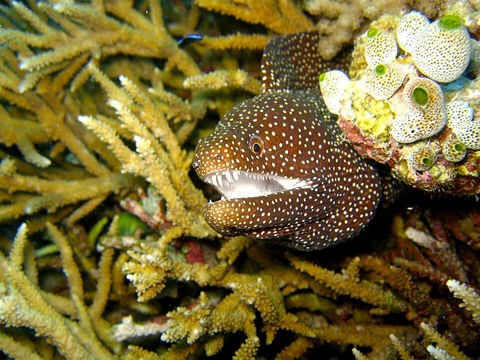
Muraena
A genus of large, scaleless eels with formidable teeth.

Muraena is a genus of large eels belonging to the family Muraenidae, containing nine recognized species. These eels are frequently found in the Mediterranean and are also common in tropical and subtropical waters, particularly among rocky areas and coral reefs. Most species have a single long fin that runs from the head along the back, around the tail, and ends at the vent; they lack both pectoral and ventral fins. Their skin is smooth and scaleless, and in many species it is brightly colored with varied patterns.
The mouth is broad, with strong jaws lined with sharp, pointed teeth. These teeth allow the Muraena to catch prey—mainly other fish—and to inflict serious, sometimes dangerous, wounds on attackers. The eel will strike at anyone who approaches its hiding spots in shallow water, and it is feared by fishermen. At least one species, *Muraena retifera*, has an extra mobile "raptorial pharyngeal jaw" inside the pharynx that can shoot forward to help grab prey.
Some tropical Muraena species can exceed 5 feet (150 cm) in length, but most, including the Mediterranean moray, are smaller. The Mediterranean moray—called *Muraena helena* by ichthyologists and "murena" by Italians—was considered a great delicacy by the ancient Romans, who kept it in large ponds and aquaria. It is native to the coasts of southern Europe, North Africa, and Macaronesia, and has been introduced to the Red Sea. Records of it from Australia are probably mistaken.
**Species** - *Muraena appendiculata* (Guichenot, 1848) *incertae sedis* - *Muraena argus* (Steindachner, 1870) (White-spotted moray) - *Muraena augusti* (Kaup, 1856) - *Muraena clepsydra* C. H. Gilbert, 1898 (Hourglass moray) - *Muraena helena* Linnaeus, 1758 (Mediterranean moray) - *Muraena lentiginosa* Jenyns, 1842 (Jewel moray) - *Muraena melanotis* (Kaup, 1860) (Honeycomb moray) - *Muraena pavonina* J. Richardson, 1845 (Whitespot moray) - *Muraena retifera* Goode & T. H. Bean, 1882 (Reticulate moray) - *Muraena robusta* Osório, 1911 (Stout moray) - A single fossil species, †*Muraena saheliensis* Arambourg, 1928, is known from the latest Miocene (Messinian) of Algeria.
**Formerly Included Species** - *Muraena anguilla* Linnaeus, 1758 (European eel) – now valid as *Anguilla anguilla* Linnaeus, 1758
**References** Fricke, Ron; Eschmeyer, William N. & van der Laan, Richard (eds.). "Species in the genus *Muraena*".
- Valid species
- 9
- Family
- Muraenidae
- Maximum length
- over 5 feet (150 cm) in some tropical species
- Type species
- Muraena helena (Mediterranean moray)
- Fossil species
- Muraena saheliensis (latest Miocene, Algeria)
Lore & Background
In the majority of Muraena species, a long fin runs from the head along the back, round the tail to the vent, but all are destitute of pectoral and ventral fins. The skin is scaleless and smooth, and in many species it is ornamented with varied and bright colours. The mouth is wide, the jaws strong and armed with formidable, generally sharply pointed teeth, which enable the Muraena not only to seize its prey (chiefly other fishes) but also to inflict serious, and sometimes dangerous, wounds on its enemies. It attacks persons who approach its places of concealment in shallow water and is feared by fishermen. At least one species, Muraena retifera, possesses an additional 'raptorial pharyngeal jaw' within the pharynx, which is mobile and can be thrust forwards quickly to assist in grasping prey.
Reader's Guide
The Mediterranean moray, Muraena helena, was considered by the ancient Romans to be one of the greatest delicacies and was kept in large ponds and aquaria. It is native to the coasts of southern Europe, North Africa, and Macaronesia, but has also been introduced to the Red Sea; records of it from Australia are likely erroneous. The genus includes nine valid species, among them the white-spotted moray (Muraena argus), the hourglass moray (Muraena clepsydra), the jewel moray (Muraena lentiginosa), the honeycomb moray (Muraena melanotis), the whitespot moray (Muraena pavonina), the reticulate moray (Muraena retifera), and the stout moray (Muraena robusta). A single fossil species, Muraena saheliensis, is known from the latest Miocene (Messinian) of Algeria. The European eel, formerly included as Muraena anguilla, is now considered valid as Anguilla anguilla.
Did You Know?
- Muraena species lack pectoral and ventral fins.
- At least one species, Muraena retifera, has a mobile raptorial pharyngeal jaw.
- The Mediterranean moray (Muraena helena) was kept in ponds by ancient Romans as a delicacy.
Physical Form and Anatomy
The Mediterranean moray presents a striking silhouette in the underwater world: a long, eel-shaped body that can stretch to roughly a metre and a half and tip the scales past fifteen kilograms. Rather than the plated armour of typical fish, its skin is smooth, slimy, and entirely scaleless, draped in a palette that shifts from deep grey to dark brown, peppered with fine dark spots. The mouth is a defining feature—long, robust, and extending well behind the gill openings, lined with teeth that are long and sharply pointed in the classic moray fashion. Notably, the species lacks pectoral fins altogether, relying instead on a single dorsal fin that originates just behind the head and runs uninterrupted to the tail, where it merges seamlessly with the anal fin to form a continuous caudal structure. This streamlined, fin-simplified design underscores its identity as a creature built for weaving through crevices rather than open-water cruising.
Habitat and Behavioral Ecology
From the rocky shores off the British Isles down to the coast of Senegal, across the waters surrounding the Canary Islands and the Azores, and throughout the entire Mediterranean basin, the Mediterranean moray carves out a niche in coastal environments. It favours rocky substrates and occupies a remarkable depth range, from just one metre below the surface to over eight hundred metres, though the band between one hundred and three hundred metres represents its most typical home. The species is fiercely solitary and territorial, rarely sharing its chosen territory with a conspecific. During daylight hours it largely withdraws into cavities and clefts between rocks, remaining largely motionless, but as night falls it emerges to hunt. Its diet is varied, encompassing live fish, crabs, and cephalopods, yet it will also scavenge on dead animals when the opportunity arises. This combination of ambush predation and opportunistic scavenging makes it a versatile predator within its rocky domain.
Reproduction and the Enduring Mystery
Reproduction in the Mediterranean moray remains one of the great unsolved puzzles of eel biology. Across the eel family, the actual act of mating has never been witnessed in the wild, and the Mediterranean species is no exception. What scientists do know is that fertilization is external. Sex and reproductive maturity can be assessed by visually inspecting the gonads: mature females carry large orange eggs, while mature males develop white, enlarged testes. In the Adriatic Sea, a seasonal rhythm governs the cycle—maturity is reached during the warmer months, spawning occurs in summer, and the colder months serve as a resting period. A single spawning event releases approximately sixty thousand eggs into open water, from which tiny, transparent, planktonic larvae known as leptocephali eventually hatch. Despite these confirmed details, the full courtship and spawning behaviour of the Mediterranean moray in its natural habitat remains shrouded in mystery, a gap that marine biologists continue to strive to close.
Human Encounters and Ecological Relationships
The Mediterranean moray holds a complex place in human experience. Its bite, delivered by a mouth studded with long, sharp teeth, can pose a genuine danger to people, not merely from the mechanical wound but from the mildly toxic slime coating its scaleless skin. Despite this hazard, the fish has historically been harvested as a food source, prepared fresh and cooked by broiling, boiling, or baking, while its skin has found a secondary use in leather production. Beyond human interaction, the moray exists within a web of ecological relationships that include parasitic associations. Two specific parasites have been documented on the species: the trematode Folliculovarium mediterraneum and the flatworm Lecithochirium grandiporum. These organisms highlight that even a solitary, territorial predator at the top of its local food chain is subject to the quiet pressures of parasitism. Together, these interactions—human, culinary, and parasitic—paint a picture of a fish that is simultaneously feared, utilised, and ecologically entangled.
Frequently Asked Questions
What is Muraena?
Muraena is a genus of large, scaleless eels classified within the family Muraenidae. It encompasses nine currently recognized species, all of which are notable for their powerful jaws and sharp, pointed teeth.
What do Muraena eels look like?
Most species have a smooth, scaleless body with a single continuous fin that wraps from the head along the back, around the tail, and terminates at the vent. They completely lack pectoral and ventral fins, and many display vivid coloration with intricate patterns.
How big can Muraena eels grow?
Some tropical species in the genus exceed five feet (150 cm) in length, making them among the larger members of the moray eel family.
Where are Muraena eels typically found?
They are common in Mediterranean waters as well as tropical and subtropical regions worldwide. They favor rocky habitats and coral reef environments where they can hide and ambush prey.
What is the type species of the genus Muraena?
The type species is Muraena helena, commonly known as the Mediterranean moray. Additionally, a fossil species called Muraena saheliensis has been identified from late Miocene deposits in Algeria.
More in Moray Eels 1-24
Spotted an error? Know more?
Reader corrections go straight into our review queue. Suggest an edit · How this site is sourced