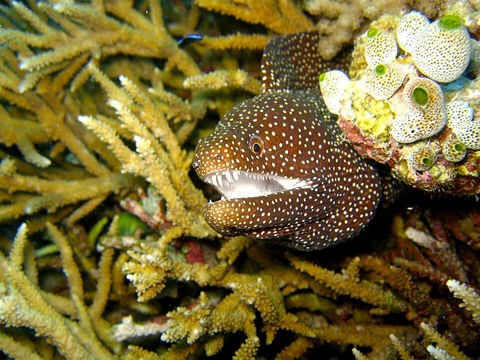
Channomuraena vittata
A large, secretive moray eel with a projecting lower jaw.

The broadbanded moray, also called the banded moray, Chinese moray, double-ended moray, or long-jawed moray, is a reef-dwelling eel belonging to the order Anguilliformes. It is a large, thick-bodied, muscular species, reaching up to 150 cm (59 in) in length, though most individuals are around 80 cm (31 in). Its fins are limited to the rear part of a short tail, and it lacks both pectoral and pelvic fins. The skin is scaleless and coated in mucus. The eyes are small and sit at the tip of a short snout. The jaws are large and deep, extending back into the head, and are lined with numerous short, sharp teeth. A second set of jaws, the pharyngeal jaws, lies farther down the throat and helps capture and move prey. The posterior nostril is a short tube, and the gills are positioned well behind the head. The anus is located at the rear third of the body.
Key identifying features include a small cranium, eyes placed far forward, a lower jaw that extends beyond the upper jaw, and 13 to 16 dark bars or bands running across the body. This eel is not invasive anywhere, as only native populations are known. In the Atlantic Ocean, it occurs around Ascension Island, the Cape Verde Islands, Annobon Island, São Tomé Island, Bermuda, the Bahamas, the Gulf of Mexico near northwestern Cuba, and the Caribbean from Mona Island and Puerto Rico to St. Vincent, Colombia, Curaçao, Margarita Island, St. Paul’s Rocks, and Brazil (Bahia). In the Indo-Pacific, it is found near Réunion, Mauritius, Christmas Island, Palau, the Hawaiian Islands, Kiribati, Palmyra Island, Micronesia (Pohnpei), and Indonesia (Bali).
Its habitat includes subtidal rocks, rocky reefs, and coral reefs. It is an uncommon bottom-dwelling species with a snake-like appearance and behavior. Solitary and secretive, it is mostly found on outer reef slopes under ledges and in holes, and it is nocturnal. Depth range is 5–100 meters (20–330 ft), typically around 40 meters (130 ft). Because it is a relatively newly discovered species, its feeding habits remain unknown. Like other moray eels, it likely undertakes long migrations to spawn in open waters, where eggs are fertilized externally, but the specific spawning rituals of the broadbanded moray have not been observed.
This eel is occasionally caught by local fisheries and consumed, and it is also sought after for the aquarium trade.
Quick Facts
- Taxon
- Channomuraena vittata
Facts from the source article.
Lore & Background
The broadbanded moray is a large, thick, muscular moray that can grow up to 150 cm in length, though its common length is 80 cm. Its fins are confined to the posterior part of the tail, which is short and lacks pectoral and pelvic fins. It has no scales and produces a mucus over its thick skin. It has rather small eyes positioned at the end of the short snout, and numerous short, sharp teeth inserted into a large and profound jaw that extends back into the head. In addition, it possesses a second jaw, the pharyngeal jaw, located further down the throat, used to capture and transport prey. It has a posterior nostril in a short tube, gills positioned far back behind the head, and its anus is located at the posterior third of the total length of its body.
Its distinctive features include a small cranium, anterior position of the eyes, an enlarged lower jaw that projects beyond the upper jaw, and 13 to 16 dark bars or bands throughout the body. It is a benthic and solitary species, mostly found in outer reef slopes under ledges and in holes, and is secretive and nocturnal. It inhabits subtidal rocks, rocky reefs, and coral reefs, and is an uncommon bottom dwelling species, uniquely snake-like in appearance and behavior.
Reader's Guide
The broadbanded moray is a species of moray eel from the Anguiliformes order found in reefs. It is known by several common names, including broadbanded moray, banded moray, Chinese moray, double-ended moray, and long-jawed moray. Its distribution includes the Atlantic Ocean (Ascension Island, Cape Verde Islands, Annobon Island, Sao Tome Island, Bermuda, the Bahamas, Gulf of Mexico from northwestern Cuba, Caribbean from Mona Island, Puerto Rico to St. Vincent, Colombia, Curaçao to Margarita Island, St. Paul's Rocks, and Brazil) and the Indo-Pacific (Reunion, Mauritius, Christmas Island, Palau, Hawaiian Islands, Kiribati Island, Palmyra Island, Micronesia, and Indonesia). Only native cases have been found, so it is not invasive anywhere.
Its feeding habits are still unknown, as it is a relatively newly discovered species. Moray eels are known to have very long migrations for spawning in open waters, where eggs are fertilized by the male outside the female's body, but the spawning rituals specific to the broadbanded moray are still unknown, as they are hard to capture. This species is captured occasionally and consumed in local fisheries, and is also sought for the aquarium fish trade. There are currently no major threats to this species apart from the occasional impact from local fisheries and the aquarium trade. There are no species-specific conservation measures, and according to the IUCN Red List Status, it is classified as Least Concern.
Did You Know?
- It has a second jaw, the pharyngeal jaw, located further down the throat to capture and transport prey.
- It is found in both the Atlantic Ocean and the Indo-Pacific, but is not invasive anywhere.
Frequently Asked Questions
Who is Channomuraena vittata?
Channomuraena vittata is a large, secretive reef-dwelling moray eel in the order Anguilliformes, commonly called the broadbanded moray, banded moray, Chinese moray, or long-jawed moray. It is a thick-bodied, muscular predator that patrols coral reef structures in tropical waters.
What does Channomuraena vittata look like?
This species is marked by 13 to 16 dark bands along its body, a small cranium with eyes set at the very tip of a short snout, and a notably enlarged lower jaw that projects well beyond the upper jaw. Its skin is entirely scaleless and slicked with mucus, and it has no pectoral or pelvic fins—only a small fin fold at the rear of a short tail.
How big does Channomuraena vittata get?
Most individuals measure around 80 cm (31 in), but the species can grow to a maximum of 150 cm (59 in). Compared to many other reef morays, it is considered a large, heavily built eel.
Where and how deep does Channomuraena vittata live?
This moray is a reef specialist typically encountered near 40 metres (130 ft) depth, though its recorded range spans from 5 to 100 metres (20–330 ft). It stays close to reef structures and is known for a secretive, ambush-style hunting behavior.
Is Channomuraena vittata endangered or threatened?
No; the IUCN currently classifies this species as Least Concern, indicating its population is stable and not facing significant pressure. It remains a healthy component of the reef ecosystems it inhabits.
More in Moray Eels 1-24
Spotted an error? Know more?
Reader corrections go straight into our review queue. Suggest an edit · How this site is sourced