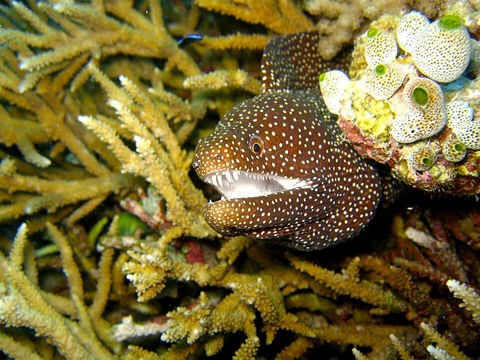
Muraenidae
Moray eels are predatory fish with pharyngeal jaws and worldwide distribution.

Moray eels, or Muraenidae, are a family of eels found worldwide, with approximately 200 species in 16 genera. They are almost exclusively marine, though several species are regularly seen in brackish water and a few are found in fresh water. Morays are notable for their elongated, scaleless bodies, small gills, and the use of pharyngeal jaws to actively capture and restrain prey—a unique feeding mechanism among animals.
Quick Facts
- Taxon
- Muraenidae
Facts from the source article.
Lore & Background
The English name 'moray' dates to the early 17th century, derived from Portuguese 'moreia', from Latin 'mūrēna', and Greek 'μύραινα'—the ancient names for the Mediterranean moray. Anatomically, the dorsal fin extends from behind the head and joins with the caudal and anal fins, except in Uropterygiinae where fins are restricted to the tail tip. Most species lack pectoral and pelvic fins, have small eyes, and rely on a highly developed sense of smell while concealed to ambush prey. Their jaws are wide with protruding snouts; most have large tearing teeth, but some like the snowflake moray and zebra moray have blunt, molar-like teeth for crushing crustaceans. Morays secrete protective mucus over smooth, scaleless skin, which in some species contains a toxin. Their small, circular gills are placed far behind the mouth, requiring a gulping motion to breathe.
Reader's Guide
Moray eels are significant as apex predators in many ecosystems, feeding primarily on smaller fish, crabs, and octopuses. Their unique pharyngeal jaws—the only known example in animals used to actively capture and restrain prey—allow them to lunge and bite while reducing water displacement that would otherwise alert prey. Cooperative hunting has been observed between reef-associated roving coral groupers and giant morays, where the grouper initiates the hunt by head-shaking, allowing morays to flush prey from crevices. Most species are oviparous with external fertilization; fertilized eggs develop into transparent, ribbon-like leptocephalus larvae that remain pelagic for up to a year before metamorphosing into juveniles. Their reproductive biology remains incompletely understood due to nocturnal activity and inaccessible habitats. Several moray species are popular in the aquarium trade for their hardiness and disease resistance, including the snowflake, zebra, and goldentail moray. Some species, such as the giant moray and yellow-edged moray, are associated with food poisoning.
Did You Know?
- Moray eels are the only known animals that use pharyngeal jaws to actively capture and restrain prey in this way.
- The snowflake moray (Echidna nebulosa) and zebra moray (Gymnomuraena zebra) have blunt, molar-like teeth for crushing crustaceans.
- Reef-associated roving coral groupers have been observed recruiting giant morays to hunt by head-shaking.
- Moray eels secrete a protective mucus that in some species contains a toxin.
Anatomy and Physical Adaptations
Moray eels possess a body plan that is as unusual as it is effective. Their dorsal fin runs continuously from just behind the head all the way along the back, merging seamlessly with the caudal and anal fins—a configuration interrupted only in the subfamily Uropterygiinae, where fin tissue is confined to the tail tip. Most species have completely lost their pectoral and pelvic fins, giving them that unmistakable elongated silhouette. Their eyes are comparatively small, a trait that makes sense given their reliance on an extraordinarily acute sense of smell while they lurk in concealment. The skin is smooth and scaleless, coated in a protective mucus that, in certain species, carries a toxin. Morays produce this mucus at a far higher rate than other eels, thanks to thicker skin and dense populations of goblet cells in the epidermis. In sand-dwelling species, this mucus helps bind sand granules to burrow walls, lending structural permanence through glycosylation of mucins. Their small, circular gills sit on the flanks well behind the mouth, forcing the eel into a constant gulping motion to breathe.
Predatory Strategy and the Pharyngeal Jaw
Moray eels are opportunistic carnivores that primarily target smaller fish, crabs, and octopuses, though a spotted moray has even been documented consuming a red lionfish without apparent harm. Their jaws are wide, framing a protruding snout, and most species carry large, pointed teeth ideal for tearing flesh or gripping slippery prey. A smaller group, including the snowflake moray and zebra moray, has evolved blunt, molar-like teeth suited to crushing hard-shelled crustaceans. What makes morays truly unique in the animal kingdom is their use of pharyngeal jaws—secondary jaws located deep in the head that closely mirror the oral jaws, complete with tiny teeth. When striking prey, these pharyngeal jaws launch forward into the mouth cavity to seize and transport the catch down the throat. Morays are the only known animals that actively capture and restrain prey this way. Their mouth openings extend far back into the head, so that when they lunge and bite, water exits from the posterior side, minimizing the wave that would otherwise startle prey. In the California moray, teeth on the palate can fold downward as prey slides backward, preventing breakage while maintaining grip.
Global Distribution and Habitat Range
Moray eels are found on every continent's coastlines, with approximately 200 species spread across 16 genera. The overwhelming majority are strictly marine, though several species regularly inhabit brackish waters and a handful, such as Gymnothorax polyuranodon, live in freshwater. Within the ocean, their vertical range is impressive: they occupy shallow nearshore zones, continental shelves and slopes, deep benthic environments, and even mesopelagic waters. Most species favor tropical or subtropical seas, with only a few, like the yellow moray, venturing into temperate waters. Morays are not particularly attached to living coral; they more commonly shelter in dead patch reefs, coral rubble, and rocky outcrops. Their small eyes and ambush strategy mean they spend much of their time concealed, relying on smell rather than sight to detect prey. Despite this global and vertical breadth, the majority of moray eels concentrate in warm saltwater reef environments, where the complex architecture of broken coral and rock provides the hiding places their body plan demands.
Reproduction and the Pelagic Larval Journey
The reproductive biology of moray eels remains only partially understood, largely because their nocturnal habits and the inaccessibility of their spawning environments make direct observation of courtship and spawning exceedingly rare. Most species are oviparous, with both males and females releasing gametes simultaneously into the water column for external fertilization. Once fertilized, the eggs are left to the mercy of ocean currents, which disperse them widely. They develop into leptocephalus larvae—transparent, ribbon-like creatures that drift in the pelagic zone for extended periods, sometimes up to a full year, feeding on microscopic plankton. This prolonged larval phase serves as a powerful mechanism for geographic dispersal, carrying offspring far from their parents' home reefs. When conditions are right, the larvae settle onto benthic substrates such as coral reefs or rocky areas, where metamorphosis transforms them into juvenile eels. This transition brings dramatic changes in pigmentation, body form, and behavior. Juveniles typically adopt the solitary, territorial lifestyle that characterizes adult morays, completing a lifecycle that spans open ocean to sheltered reef.
Frequently Asked Questions
Who is Muraenidae?
Muraenidae is the family name for moray eels, a group of roughly 200 species spread across 16 genera. They inhabit marine waters around the entire globe, with a handful of species venturing into brackish or even freshwater environments.
What are Muraenidae's powers?
Their signature ability is a pair of secondary pharyngeal jaws that slide forward to seize and hold prey while the main mouth stays open, a feeding trick found in no other animal group. They also sport long, scaleless bodies and unusually small gill openings that suit their ambush-predator lifestyle.
Why is Muraenidae important?
Moray eels occupy a critical predatory niche in reef and coastal ecosystems worldwide, keeping local fish populations in check. Their pharyngeal-jaw feeding mechanism is also a landmark example of evolutionary innovation that has fascinated biologists since the name 'moray' first appeared in English in the early 1600s.
What are Muraenidae's main factions?
The family splits into two subfamilies, Muraeninae and Uropterygiinae, which together cover all known species. The genus Gymnothorax dominates the roster, accounting for more than half of the family's roughly 200 species.
More in Moray Eels 1-24
Spotted an error? Know more?
Reader corrections go straight into our review queue. Suggest an edit · How this site is sourced