Enchelycore
A genus of moray eels with curved jaws and vivid colors.

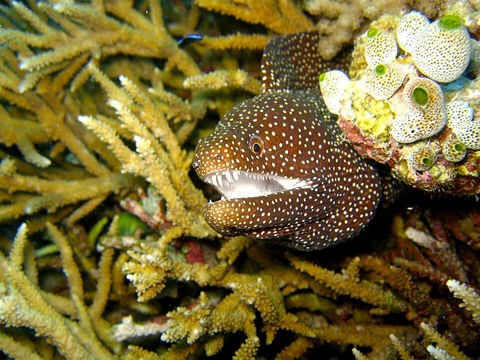
Enchelycore is a genus of moray eels belonging to the family Muraenidae. These eels are generally small to medium-sized, with most ranging from 2 to 3 ft in length. The largest member is the Mosaic Moray (E. ramosa), which reaches a length of 6 ft. A key feature of this genus is their curved jaws, which cannot close completely; this adaptation helps them capture and hold onto prey. Some species display very bright colors or intricate patterns, such as the Leopard moray (E. pardalis), the Fangtooth moray (E. anatina), and the Reticulate hookjaw moray (E. lichenosa). The genus includes 13 recognized species.
- Typical length range
- 2 to 3 ft
- Maximum length
- 6 ft
Lore & Background
Enchelycore is a genus within the family Muraenidae, comprising moray eels that are generally small to medium-sized. Most range from 2 to 3 ft in length, though the Mosaic Moray (E. ramosa) is the largest, reaching a length of 6 ft. A defining characteristic of the genus is their distinctive, curved jaws, which prevent the eels from fully closing their mouth; this adaptation helps them catch and hold onto prey. Some Enchelycore species exhibit extremely bright colors, such as E. pardalis and E. anatina, while others, like E. lichenosa, have ornate markings. The genus currently contains 13 recognized species, including the Fangtooth moray (E. anatina), Bayer's moray (E. bayeri), and the Leopard moray (E. pardalis), among others.
Reader's Guide
The genus Enchelycore holds significance within the family Muraenidae due to its distinctive jaw morphology and the notable size range of its species. The curved jaws that prevent full mouth closure are a key adaptation for capturing and securing prey, a trait that distinguishes these eels from other morays. The largest species, the Mosaic Moray (E. ramosa), reaches 6 feet (180 cm), while most other species are smaller, typically 2 to 3 feet (61 to 91 cm). The genus also includes species with extremely bright colors, such as E. pardalis and E. anatina, and ornate markings like those of E. lichenosa. With 13 recognized species, Enchelycore represents a diverse group within the Muraenidae, contributing to the broader understanding of moray eel biology and adaptation.
Did You Know?
- Enchelycore species have curved jaws that prevent them from fully closing their mouth.
- The largest Enchelycore species is the Mosaic Moray (E. ramosa), reaching a length of 6 ft.
- Some Enchelycore species, such as E. pardalis and E. anatina, feature extremely bright colors.
- There are currently 13 recognized species in the genus Enchelycore.
Frequently Asked Questions
What is Enchelycore?
Enchelycore is a genus of moray eels placed within the family Muraenidae. It groups together a set of small-to-medium eels that share a distinctive jaw anatomy and, in several members, eye-catching coloration.
How large do Enchelycore eels typically grow?
Most species in the genus stay in the 2-to-3-foot range, which is modest by moray standards. The standout is the Mosaic Moray (E. ramosa), which can reach roughly 6 feet in length.
What makes Enchelycore's jaws unique?
Every member of this genus has curved jaws that simply cannot snap fully shut. That permanent gap is actually an advantage, because it lets the eel clamp down on slippery prey and keep a firm grip.
Which Enchelycore species are the most colorful?
The Leopard moray (E. pardalis), the Fangtooth moray (E. anatina), and the Reticulate hookjaw moray (E. lichenosa) are all celebrated for vivid hues or intricate patterning. These visual traits make them favorites among reef photographers and hobbyist aquarists.
How many species belong to the Enchelycore genus?
Thirteen species are currently recognized within the genus. They all share the hallmark curved-jaw build while differing in size, preferred habitat, and coloration.
More in Moray Eels 1-24
Spotted an error? Know more?
Reader corrections go straight into our review queue. Suggest an edit · How this site is sourced