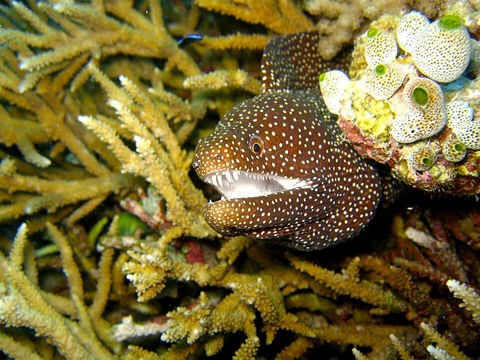
Moray eel
Moray eels are predatory fish with pharyngeal jaws and protective mucus.

Moray eels, or Muraenidae, are a family of eels found worldwide, with approximately 200 species in 16 genera. They are almost exclusively marine, though several species are regularly seen in brackish water and a few are found in fresh water. The English name dates to the early 17th century, derived from Portuguese moreia, from Latin mūrēna, and Greek μύραινα.
Quick Facts
- Taxon
- Muraenidae
Facts from the source article.
Lore & Background
The dorsal fin extends from just behind the head along the back and joins seamlessly with the caudal and anal fins, except in Uropterygiinae where fins are restricted to the tail tip. Most species lack pectoral and pelvic fins. Their eyes are small; they rely on a highly developed sense of smell while concealed to ambush prey. The body is generally patterned, and in some species the mouth interior is patterned as well. Jaws are wide with a protruding snout; most have large teeth for tearing flesh or grasping slippery prey, while species like the snowflake moray and zebra moray have blunt, molar-like teeth for crushing crustaceans.
Morays secrete a protective mucus over smooth, scaleless skin, which in some species contains a toxin. They have thicker skin and high densities of goblet cells, allowing mucus production at a higher rate than other eels. This helps sand granules adhere to burrow walls in sand-dwelling species. Their small, circular gills are placed on the flanks far behind the mouth, requiring a gape/gulping motion for respiration.
Morays are the only known animals that use pharyngeal jaws to actively capture and restrain prey. When feeding, they launch these jaws into the mouth cavity to grasp prey and transport it into the throat. Their mouth openings extend far back into the head, allowing water to flow out posteriorly during a bite, reducing waves that would displace prey. In the California moray, teeth in the roof of the mouth can fold down as prey slides backward, maintaining hold without breaking.
Reader's Guide
Morays are opportunistic, carnivorous predators feeding primarily on smaller fish, crabs, and octopuses. A spotted moray eel has been observed eating a red lionfish without harm. Groupers, barracudas, and sea snakes are among their few known predators, making many morays apex predators in their ecosystems. Reef-associated roving coral groupers have been observed recruiting giant morays to help them hunt, initiated by head-shaking, allowing morays to flush prey from niches not accessible to groupers.
The vast majority of species are strictly marine. Within the marine realm, they are found in shallow nearshore areas, continental slopes, shelves, deep benthic habitats, and mesopelagic zones, in both tropical and temperate environments. Most species occupy warm saltwater environments containing reefs, and they inhabit shelters such as dead patch reefs and coral rubble rocks, less frequently live coral reefs.
Reproductive biology remains incompletely understood. Most species are oviparous with external fertilization; both sexes release gametes simultaneously, and fertilized eggs are dispersed by ocean currents. Eggs develop into leptocephalus larvae, transparent and ribbon-like, remaining in the pelagic zone for up to a year feeding on plankton before metamorphosis into juvenile eels. Juvenile morays adopt solitary, territorial behavior. Direct observations of courtship and spawning are rare.
Did You Know?
- The English name 'moray' derives from Portuguese moreia, from Latin mūrēna, and Greek μύραινα.
- The genus Gymnothorax contains more than half of all moray eel species.
Anatomy & Physical Adaptations
Moray eels possess a body plan shaped around concealment and ambush. Their dorsal fin runs continuously from just behind the head along the back, merging seamlessly with both the caudal and anal fins—a design shared by nearly all members of the family except the Uropterygiinae subfamily, whose fins are confined to the tail tip. Most species have entirely lost their pectoral and pelvic fins, giving them the unmistakable elongated silhouette that defines the group. Vision plays a minor role; their eyes are small, and instead they depend on a remarkably acute sense of smell to locate prey while remaining hidden. The skin is smooth and scaleless, coated in a thick protective mucus produced by an unusually dense population of goblet cells in the epidermis. In some species this mucus carries a toxin. For sand-dwelling morays, the mucus serves a structural purpose: its glycosylated mucins cause sand grains to stick to the walls of their burrows, lending the tunnels greater permanence. Respiration presents another engineering challenge. Because their small, circular gill openings sit on the flanks well behind the mouth, morays must maintain a constant gulping or gape motion to pump water over the gills.
The Pharyngeal Jaw & Feeding Mechanics
Few predators in the animal kingdom employ a mechanism as specialized as the moray eel's dual-jaw system. In addition to their oral jaws, morays carry a second set of pharyngeal jaws positioned farther back in the head, complete with their own tiny teeth. When striking at prey, these internal jaws lunge forward into the mouth cavity, seize the struggling animal, and haul it down the throat. No other known animal uses pharyngeal jaws to actively capture and restrain prey in this manner. The mouth opening itself extends unusually far back into the skull. During a lunge, water is expelled from the rear of this extended opening, dampening the pressure wave that would otherwise push prey away before the bite lands. This hydraulic trick lets morays deliver fast, effective strikes despite a short bite window. In the California moray, roof-of-mouth teeth can fold downward as prey slides backward, preventing tooth fracture while maintaining a secure grip. Across the family, jaw and tooth morphology tracks diet: durophagous species like the zebra moray and members of the genus Echidna evolved short, rounded jaws with blunt, molar-like teeth for crushing crustaceans, while piscivorous relatives developed pointed jaws and elongated teeth for gripping slippery fish.
Habitat & Ecological Niche
With roughly two hundred species spread across sixteen genera, moray eels occupy an astonishing range of aquatic environments. The overwhelming majority are strictly marine, though a handful regularly venture into brackish water and a few—most notably Gymnothorax polyuranodon—thrive in freshwater. Within the ocean, their range spans shallow nearshore zones, continental shelves and slopes, deep benthic habitats, and even the mesopelagic zone. Most species favor tropical or subtropical waters, with only a small number, such as the yellow moray, venturing into temperate seas. Morays are not indiscriminate reef dwellers; they prefer shelters like dead patch reefs and coral rubble, and less commonly settle on living coral. Ecologically, many larger morays sit at the top of their food webs. Their diet is opportunistic and carnivorous, encompassing smaller fish, crabs, and octopuses, and a spotted moray has even been documented consuming a red lionfish without apparent harm. Their few natural predators include groupers, barracudas, and sea snakes. In a remarkable cooperative interaction, roving coral groupers have been observed recruiting giant morays to hunt alongside them, with the grouper initiating the partnership through a distinctive head-shaking display. This alliance allows the pair to flush prey from crevices that neither could access alone.
Reproduction & Lifecycle
The reproductive biology of moray eels remains one of the great unsolved puzzles in marine science. Most species are oviparous, releasing eggs and sperm simultaneously into the open water column, where external fertilization takes place. The resulting zygotes are then carried by ocean currents, setting the stage for a larval phase of extraordinary duration. Fertilized eggs develop into leptocephalus larvae—delicate, transparent, ribbon-shaped organisms that drift through the pelagic zone for as long as a full year, subsisting on microscopic plankton. This extended period of open-ocean drift serves as a powerful dispersal mechanism, carrying larvae vast distances before they eventually settle onto benthic substrates such as coral reefs or rocky outcrops. Upon settlement, metamorphosis triggers a dramatic transformation: the larva develops the pigmentation, body shape, and ecological habits of an adult moray. Juveniles typically adopt the solitary, territorial lifestyle characteristic of their adult counterparts. Direct observation of courtship and spawning remains exceedingly rare, owing to the nocturnal habits of these eels and the often inaccessible environments in which reproduction occurs, leaving much of their reproductive behavior shrouded in uncertainty.
Frequently Asked Questions
What is a moray eel?
A moray eel is a member of the family Muraenidae, a group of elongated, predatory fish that inhabit marine environments across the globe. The English name traces back through Portuguese and Latin to the ancient Greek word for the creature.
How many species of moray eel are there?
There are roughly 200 recognized species spread across 16 genera, divided into two subfamilies: Muraeninae and Uropterygiinae. The genus Gymnothorax alone accounts for more than half of all known species.
What makes moray eels dangerous to divers?
Moray eels possess a second set of pharyngeal jaws that can project forward to seize prey, making their bite extremely difficult to escape. They also coat their bodies in a thick protective mucus that helps them resist infection and makes handling them tricky.
Can a moray eel live in freshwater?
While the vast majority of moray eels are strictly marine, a handful of species tolerate brackish water, and at least one, Gymnothorax polyuranodon, is known to inhabit freshwater environments.
How far back in the fossil record do moray eels go?
The earliest known fossil genus, Eomuraena, dates to the Early Eocene of Germany, pushing the lineage back tens of millions of years. This tells us the family has been evolving in seas for a very long time.
More in Moray Eels 1-24
Spotted an error? Know more?
Reader corrections go straight into our review queue. Suggest an edit · How this site is sourced