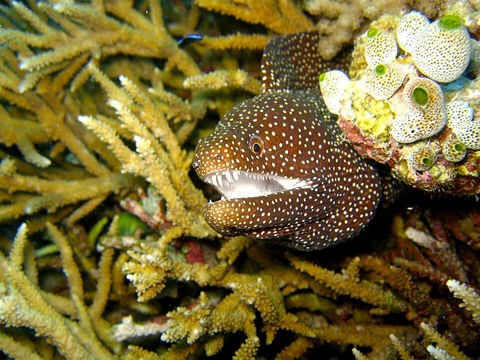
Chain moray
A nocturnal reef eel with chain-like yellow markings.

The chain moray (Echidna catenata) is a species of moray eel inhabiting shallow waters of the western Atlantic and various Atlantic islands. It sometimes appears in the aquarium trade. While it can reach up to 165 cm (65 in) in length, individuals are more commonly around 40 cm (16 in).
This eel has a heavy, elongated body, typically measuring 30 to 45 cm (12 to 18 in). Its head features a rounded snout and blunt, pointed teeth, particularly on the roof of the mouth, which it uses to crush crabs—its primary prey. The dorsal, tail, and anal fins merge into one continuous fin; pectoral and ventral fins are absent. Its scaleless skin is coated in clear mucus. The body is dark brown to black, marked with a yellow, chain-like lattice pattern, and the eyes are yellow.
The chain moray ranges across the western Atlantic from Bermuda, Florida, and the Bahamas through the Antilles to Brazil. It is common in the Caribbean and also appears in the eastern Atlantic near Cape Verde and Ascension Island, plus some southern Atlantic islands. It lives on reefs and rocky shores in clear water, usually at depths less than 12 m (39 ft) and often within 2 m (6.6 ft) of the surface.
Primarily nocturnal, it hides in holes and crevices during the day, often with its head protruding. It constantly opens and closes its mouth to aid gill ventilation. A carnivore, it eats crabs (its main food), shrimp, worms, octopuses, and small fish. Its blunt teeth are adapted for crushing crustaceans. It may ambush prey from its hiding spot or forage in tide pools, surviving up to half an hour out of water. Feeding strategies include searching under pool rims, rocks, and in holes; stalking prey; or chasing it up to 5 m (16 ft). It strikes when prey is within 5 to 10 cm (2 to 4 in), even with its body partly or fully out of water. Large crabs are torn apart; small ones are swallowed whole.
Quick Facts
- Taxon
- Echidna catenata
Facts from the source article.
Lore & Background
The chain moray is an elongated, heavy, eel-like fish that commonly grows to a length of about 30 to 45 cm (12 to 18 in). The head has a rounded snout and pointed, blunt teeth, especially on the roof of the mouth. These teeth are used to crush the shells of crabs, their main source of food. The dorsal, tail and anal fins are combined into a single long fin, and there are no pectoral or ventral fins. The skin does not bear scales, but is covered with a layer of clear mucus. This fish is dark brown to black, marked with an interconnecting lattice-work of yellow, chain-like lines. The eyes are yellow.
Mainly nocturnal, the chain moray hides in holes and crevices in shallow water during the day, often with its head projecting. It continually opens and closes its mouth to increase the flow of water over its gills. A carnivore, it feeds on such organisms as crabs, which are the mainstay of its diet, shrimps, worms, octopuses and small fish. Its blunt teeth are especially adapted for feeding on crustaceans. It does not always leave its hiding place to forage, sometimes remaining where it is, ready to grab any prey that passes. It sometimes forages in tide pools and is able to survive for up to half an hour out of water.
Reader's Guide
The chain moray is notable for its distinctive chain-like yellow markings on a dark brown to black body, which give it its common name. Its blunt, crushing teeth are specially adapted for feeding on crustaceans, particularly crabs, which form the mainstay of its diet. The species is found in clear water on reefs and rocky shores at depths less than 12 m, usually within 2 m of the surface, across a wide Atlantic range including the Caribbean, Bermuda, Florida, Brazil, and several Atlantic islands. It occasionally enters the aquarium trade. Its feeding strategies include ambushing prey, searching under rims of pools and beneath rocks, stalking, and chasing prey up to 5 m. When close enough (within 5 to 10 cm), it strikes, an action it can perform with its body wholly or partly out of water. Large crabs are torn apart while small ones are swallowed whole. The chain moray can survive up to half an hour out of water, allowing it to forage in tide pools.
Did You Know?
- Its blunt teeth are especially adapted for crushing the shells of crabs.
- It sometimes chases prey for a distance of up to 5 m (16 ft).
Anatomy and Striking Coloration
The chain moray presents a robust, elongated silhouette that immediately sets it apart from more slender reef fish. Its body is heavy and eel-shaped, capped by a rounded snout that gives the head a blunt, almost circular profile. Inside the mouth, rows of pointed yet blunt teeth line the palate, forming a natural crushing mechanism perfectly suited to shattering the hard shells of crabs. Rather than the separate fin structures seen in most fish, the dorsal, caudal, and anal fins merge into one continuous, unbroken fin running the length of the body, while pectoral and ventral fins are entirely absent. The skin lacks scales altogether and is instead sheathed in a slick layer of transparent mucus. Coloration is perhaps the most arresting feature: a deep brown-to-black base is overlaid with an intricate, interconnecting lattice of yellow lines that resemble a chain draped across the body, giving the species its common name. The eyes, set within this dark-and-gold pattern, are a vivid yellow.
Geographic Range and Reef Habitat
The chain moray is predominantly a western Atlantic species, with a range stretching from Bermuda and the Florida coast through the Bahamas, across the Antilles, and as far south as Brazilian waters. It is particularly common throughout the Caribbean Sea. Beyond its primary range, the species has also been documented on several islands in the eastern Atlantic, including Cape Verde and Ascension Island, as well as on certain southern Atlantic islands. In terms of habitat, the chain moray favors clear-water environments where it can exploit the structural complexity of coral reefs and rocky shorelines. It is a shallow-water fish, typically encountered at depths not exceeding twelve metres, and most often found within just two metres of the surface. This preference for the upper water column aligns with its lifestyle of occupying crevices and holes in reef structures, where it can remain concealed during daylight hours while staying close enough to the surface to intercept passing prey.
Nocturnal Hunting and Feeding Strategies
The chain moray is primarily a creature of the night. During daylight it tucks itself into holes and crevices in shallow reef structures, often leaving only its head protruding while it rhythmically opens and closes its mouth to draw water across the gills. When darkness falls, this ambush predator becomes active. Crabs form the backbone of its diet, supplemented by shrimps, worms, octopuses, and small fish. Its blunt, pointed teeth are specifically adapted for crushing the hard carapaces of crustaceans. The eel does not always venture far from its refuge; it will simply wait, ready to seize any prey that drifts within reach. When it does forage, it may probe beneath rock rims, search inside tide pools, or stalk a spotted target, pursuing it for as much as five metres. The killing strike occurs at a distance of only five to ten centimetres, and the eel can deliver this blow even with part of its body above the waterline. Large crabs are torn apart before consumption, while smaller ones are gulped down whole. Remarkably, the chain moray can survive up to thirty minutes out of water while foraging in exposed tide pools.
Size, Growth, and the Aquarium Trade
Echidna catenata, the scientific designation behind the familiar name chain moray, can reach a maximum length of one hundred and sixty-five centimetres, though this figure marks the absolute upper limit of the species. In everyday encounters, most chain morays fall in the thirty-to-forty-five-centimetre range, with a commonly observed size of roughly forty centimetres. This means the typical individual is a moderate-sized eel, well suited to the crevices and holes of shallow reef environments where it spends its days. Beyond its natural habitat, the chain moray has made occasional forays into the aquarium trade, with specimens appearing in the ornamental fish market from time to time. This remains an infrequent event rather than a steady stream of supply. The eel's bold coloration—a dark brown or black body crisscrossed by a lattice of yellow chain-like lines, paired with striking yellow eyes—gives it a visually arresting appearance that likely accounts for its appeal to hobbyists. Even so, its presence in the ornamental trade remains something of a rarity rather than a regular occurrence.
Frequently Asked Questions
What is a chain moray?
The chain moray (Echidna catenata) is a nocturnal reef eel recognizable by its distinctive chain-like yellow markings along a heavy, elongated body. It is a relatively small moray that inhabits shallow Atlantic waters and is occasionally kept in home aquariums.
Where does the chain moray live in the wild?
It ranges across the western Atlantic—from Bermuda and Florida through the Bahamas, Antilles, and Brazil—as well as parts of the eastern Atlantic near Cape Verde and Ascension Island, plus a few southern Atlantic islands. It stays in very shallow water, typically no deeper than 12 m and most often within about 2 m of the surface.
What does a chain moray eat and how does it hunt?
Crabs are its staple prey, and it uses blunt, pointed teeth on the roof of its mouth to crush their shells. It will also take shrimps, worms, octopuses, and small fish, relying on its nocturnal activity to ambush these invertebrates and small vertebrates on the reef.
How big does a chain moray get?
Although the species can reach a maximum of roughly 165 cm (65 in), most individuals you encounter are far smaller, usually falling in the 30-to-45 cm (12-to-18 in) range. A commonly cited average length is around 40 cm (16 in).
Why is the chain moray popular among reef-aquarium hobbyists?
Its compact size, striking chain-patterned coloration, and manageable temperament for a moray make it a frequent choice in the aquarium trade. Because it is a nocturnal species, keepers appreciate watching it emerge after lights-out to forage over the substrate, giving the tank a lively, natural feel.
More in Moray Eels 1-24
Spotted an error? Know more?
Reader corrections go straight into our review queue. Suggest an edit · How this site is sourced