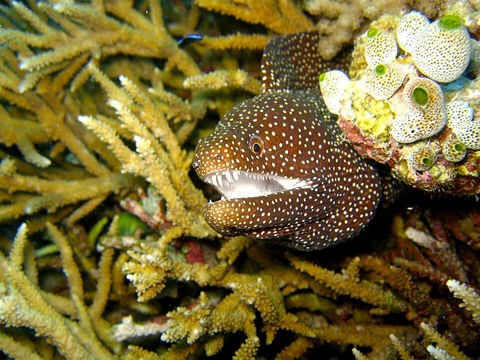
Viper moray
A nocturnal predator with fang-like teeth and pharyngeal jaws.

The viper moray (Enchelynassa canina) is a saltwater eel and the sole species in its genus within the Muraenidae family. It lives across the Indo-Pacific region. This eel can reach 250 centimeters in length and is built for predation, with a slender, sturdy body and a tail shorter than its head and trunk combined. Its most striking feature is its large, fang-like teeth, which stay visible even when the mouth is shut. The mouth is wide with curved jaws, and the teeth are arranged in two rows along the jaws, plus two small conical teeth on the roof of the mouth. The rear nostrils are large, oval, and set in front of the eyes, surrounded by a fleshy rim; the front nostrils are tube-shaped, each with a bilobed flap. The dorsal fin starts ahead of the gill openings. The body is a nearly uniform dark brown, while the dorsal and anal fins grow lighter toward the back.
This species ranges widely across tropical and subtropical Indo-Pacific waters, from the eastern coast of Africa and the Red Sea to the central and western Pacific. It appears near India, Indonesia, Australia, Japan, the Philippines, Papua New Guinea, and various Pacific islands, including Hawaii and French Polynesia. Viper morays inhabit outer reefs and reef flats down to about 30 meters deep. They are thought to be nocturnal, hiding in crevices during the day and emerging at night to hunt fish and octopus. Though their distribution is broad, detailed information on local population numbers is scarce.
As carnivores, they rely on fish and octopus for food. Like other morays, they have a second set of jaws—pharyngeal jaws—located in the throat.
Quick Facts
- Taxon
- Enchelynassa canina
Facts from the source article.
Lore & Background
The viper moray can grow up to 250 cm and has a slender, elongated body with a dark brown or grayish coloration. Its most distinctive feature is its set of large, pointed teeth that remain visible even when the mouth is closed. The body is long and sturdy, with a tail shorter than the combined length of the head and trunk. It has a wide mouth with curved jaws, large oval-shaped rear nostrils surrounded by a fleshy rim, and tubular front nostrils with bilobed fleshy flaps. Its teeth are arranged in two rows along the jaws, with two small conical teeth on the vomer at the roof of the mouth. The dorsal fin begins in front of the gill openings, and the body is a nearly uniform dark brown, while the dorsal and anal fins are lighter towards the back.
This species inhabits outer reefs and reef flats at depths up to 30 meters. It is believed to be nocturnal, hunting for fish and octopuses at night. During the day, it tends to remain hidden in crevices, emerging at night to hunt. Its population distribution is broad, but localized data on its abundance are limited.
Like other moray eels, the viper moray possesses a secondary set of jaws known as pharyngeal jaws, located in its throat, which aid in capturing and swallowing prey.
Reader's Guide
The viper moray is significant as the sole member of the genus Enchelynassa, highlighting its distinct evolutionary lineage within the Muraenidae family. Its wide distribution across the Indo-Pacific, from the eastern coast of Africa to Hawaii and French Polynesia, underscores its adaptability to tropical and subtropical marine environments. The species is recognized for its formidable predatory adaptations, including sharp, fang-like teeth that remain visible when the mouth is closed, and pharyngeal jaws that assist in feeding on fish and octopus. Its nocturnal behavior and preference for hiding in crevices during the day contribute to its role as an effective predator on coral reefs. Despite its broad range, localized abundance data remain limited, indicating gaps in knowledge about its population dynamics. The viper moray's physical traits, such as its elongated body, dark coloration, and distinctive nostril structures, make it a notable subject for studies of reef ecology and moray eel biology.
Did You Know?
- The viper moray is the only member of the genus Enchelynassa.
- It can grow up to 250 cm in length.
- It possesses pharyngeal jaws in its throat.
Body Architecture & Sensory Strategy
Moray eels possess a body plan that is both streamlined and deceptively simple. Their dorsal fin runs without a break from just behind the head all the way along the back, merging into both the caudal and anal fins—a design shared by most of the family, though members of the Uropterygiinae subfamily restrict their fins to the tail tip alone. The absence of pectoral and pelvic fins in most species gives these eels their unmistakably elongated silhouette. Vision plays a minor role in their survival; their eyes are comparatively small, and instead they depend on a highly refined sense of smell to locate prey while remaining hidden in ambush positions. Their skin is smooth and scaleless, coated in a protective mucus that some species render mildly toxic. The epidermis contains dense clusters of goblet cells, enabling mucus production at rates far exceeding those of other eel families. In sand-dwelling species, this mucus helps bind granules to burrow walls, lending structural permanence to their shelters. Perhaps most strikingly, their small, circular gills sit far behind the mouth on the flanks, forcing the eel to maintain a constant gulping motion to keep water flowing over the gill surfaces for respiration.
Jaw Mechanics & the Art of the Strike
No other known animal employs its pharyngeal jaws the way moray eels do. Located deep in the head, these secondary jaws bear tiny teeth and, during a strike, are launched forward into the oral cavity to seize prey and shuttle it toward the throat. This mechanism is unique to the Muraenidae family. The mouth opening extends far back into the skull, a design that differs sharply from the suction-feeding strategy used by many other fish. When a moray lunges and clamps down, water is expelled from the rear of the mouth, dampening the pressure waves that would otherwise startle and dislodge the target. This lets the eel deliver a powerful bite in a short window without losing its prey. In the California moray, teeth along the palate can fold downward as prey slides backward, preventing tooth fracture while maintaining a secure grip. Across the family, jaw and tooth morphology tracks diet: species specializing on crustaceans and other hard-shelled invertebrates—such as the zebra moray and members of the genus Echidna—evolved short, rounded jaws with blunt, molar-like teeth for crushing, while fish-eating genera developed pointed jaws and longer, grasping teeth. These same patterns are mirrored on the pharyngeal jaw.
Global Range & Ecological Niche
Moray eels are among the most geographically versatile of all eel families, with roughly 200 species spread across 16 genera found in oceans worldwide. The overwhelming majority are strictly marine, though a handful regularly inhabit brackish water and a very few—most notably Gymnothorax polyuranodon—thrive in freshwater. Within the marine realm, their range spans an extraordinary depth gradient: from shallow nearshore reefs and continental shelves all the way down to deep benthic zones and even the mesopelagic layer of the open ocean. Climate-wise, most species favor tropical and subtropical waters, with only a small number, such as the yellow moray, venturing into temperate seas. In terms of microhabitat, morays gravitate toward structural shelters—dead patch reefs, coral rubble, and rocky crevices—rather than live coral, which they occupy less frequently. Their role in the food web is significant: as opportunistic carnivores feeding on smaller fish, crabs, and octopuses, many larger moray species sit at the apex of their local ecosystems, with only groupers, barracudas, and sea snakes posing a credible threat. One documented observation even shows a spotted moray consuming a red lionfish without apparent harm, underscoring their dietary flexibility.
Reproduction, Dispersal & the Larval Odyssey
The reproductive biology of moray eels remains one of the least thoroughly documented aspects of their natural history, largely because they are nocturnal and their spawning occurs in environments that are difficult for researchers to access. What is known is that most species are oviparous, releasing eggs and sperm simultaneously into the water column for external fertilization. Once fertilized, the eggs develop into leptocephalus larvae—delicate, transparent, ribbon-shaped organisms that drift in the open pelagic zone for extended periods, sometimes as long as a full year, feeding on microscopic plankton. This prolonged larval phase is ecologically critical: it enables wide geographic dispersal, connecting distant populations and allowing the species to colonize new reef and rocky-substrate habitats far from the spawning site. Upon settlement, the larvae undergo metamorphosis into juvenile eels, a transition marked by dramatic changes in pigmentation, body form, and ecological behavior. Juveniles typically adopt the solitary, territorial lifestyle that characterizes adults. The rarity of direct observations of courtship and spawning means that many fundamental questions about moray reproduction—mating signals, spawning frequency, and the precise triggers for larval settlement—remain open areas of study.
Frequently Asked Questions
Who is Viper Moray?
Viper Moray (Enchelynassa canina) is a saltwater eel that stands alone as the only member of its genus within the Muraenidae family. It ranges across the Indo-Pacific, stretching from the waters off eastern Africa all the way to the central and western Pacific.
What are Viper Moray's signature traits or 'powers'?
Its most iconic feature is a set of oversized, fang-like teeth that remain on display even when the jaws are fully shut. As a nocturnal hunter it also wields a secondary set of pharyngeal jaws that help it grip and drag down struggling prey.
Where does Viper Moray typically operate?
It patrols reef and rocky habitats in the Indo-Pacific, generally staying within the first thirty meters of depth. Its home stretch covers a vast arc from eastern African coastlines through to the central and western Pacific basin.
How does Viper Moray hunt, and what does its body look like?
Built as a streamlined predator, it has a slender, muscular body and a tail that is noticeably shorter than the combined length of its head and trunk. It can grow to roughly two and a half metres, giving it the reach and girth to tackle sizable prey in the dark.
Why is Viper Moray considered a standout in the moray eel world?
As the lone species in the genus Enchelynassa, it has no close relatives to share its ecological niche. Its combination of permanently visible fangs, pharyngeal jaws, and a wide, curved-jawed mouth bearing two rows of teeth plus a pair of small conical palatal teeth makes it one of the most visually distinct morays in the family.
More in Moray Eels 1-24
Spotted an error? Know more?
Reader corrections go straight into our review queue. Suggest an edit · How this site is sourced