Scuticaria tigrina
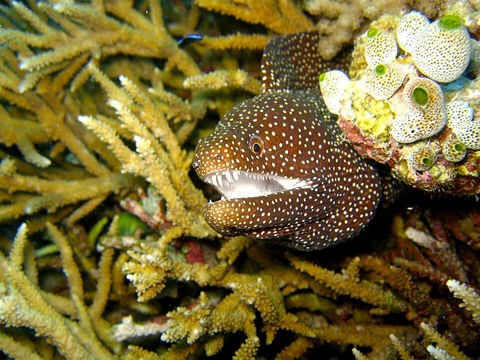
A moray eel with tiger-like spots and stripes.

The tiger reef-eel, also known as the spotted snake moray or tiger moray, is a type of moray eel that lives among coral reefs in the Pacific and Indian Oceans. Its body is marked with black spots and stripes that look like a tiger’s pattern, helping it blend into the reef. This species can grow to about 140 centimeters long. It has a long, round body with a very short tail, and its fins run mostly along the tail. Two rows of sharp, cone-shaped teeth help it catch prey. The eel’s color ranges from yellowish brown to reddish brown, with round black spots edged in yellow. It is found across the tropical Indo-Pacific, from East Africa to the Society Islands, including Hawaii, the Philippines, Indonesia, Mexico, Costa Rica, and Panama. During the day, it hides in crevices, sand, or rocky spots on shallow reefs. Divers sometimes see it, and it is kept in aquariums, but it is not a major target for fishing. In some places it is eaten, but its main role is ecological.
Quick Facts
- Genus
- Scuticaria (fish)
- Species
- tigrina
Facts from the source article.
Lore & Background
Scuticaria tigrina can reach a total length of about 140 cm (55 in). Its body is elongated and cylindrical, with a very short tail and longitudinal fins almost exclusively on the tail. It has two rows of sharp conical teeth, which allow it to catch its prey efficiently. The body color is yellowish brown to reddish brown with round black spots bordered by yellow.
This species is usually found on shallow reefs and prefers crevices, sandy or rocky areas where it can hide during the day. It is known to camouflage within the reef environment using its distinctive black spots and stripes resembling tiger marks.
Although sometimes encountered by divers and kept in aquariums, Scuticaria tigrina is not a major commercial fishery species. In some areas, it is used for food, but it is mainly of ecological importance.
Reader's Guide
Scuticaria tigrina holds significance primarily as an ecological component of coral reef systems in the Pacific and Indian Oceans. Its distinctive black spots and stripes resembling tiger marks enable it to camouflage within the reef environment, aiding its survival. The species is not a major commercial fishery species, though it is sometimes encountered by divers and kept in aquariums. In some areas, it is used for food, but its main importance is ecological. The eel's elongated, cylindrical body, very short tail, and longitudinal fins almost exclusively on the tail, along with two rows of sharp conical teeth, are key physical traits that allow it to efficiently catch prey. Its distribution spans the tropical Indo-Pacific, from East Africa to the Society Islands, including Hawaii, the Philippines, Indonesia, Mexico, Costa Rica, and Panama. It is usually found on shallow reefs, hiding in crevices, sandy or rocky areas during the day. The species is known by multiple common names, reflecting its widespread recognition among divers and aquarists, though it remains primarily a wild reef inhabitant.
Frequently Asked Questions
What is Scuticaria tigrina?
Scuticaria tigrina is a species of moray eel commonly called the tiger reef-eel or spotted snake moray. It is a reef-dwelling predator found throughout the tropical Indo-Pacific.
How large can Scuticaria tigrina grow?
This eel can reach a total body length of roughly 140 centimeters, or about 55 inches. Its form is long and cylindrical with a very short tail, and its fins are concentrated near the rear of the body.
Where can you find Scuticaria tigrina in the wild?
Its range stretches across tropical Indo-Pacific waters from East Africa to the Society Islands, with populations also recorded in Hawaii, the Philippines, Indonesia, Mexico, Costa Rica, and Panama. It favors shallow reef zones, tucking into crevices, sandy patches, or rocky outcrops.
What does Scuticaria tigrina look like?
Its base coloration runs from yellowish-brown to reddish-brown, overlaid with round black spots each ringed by a thin yellow border. The resulting tiger-like mix of spots and stripes lets it blend seamlessly into textured coral-reef surfaces.
How does Scuticaria tigrina catch and hold its prey?
It uses two rows of sharp, cone-shaped teeth to grip and subdue smaller fish and invertebrates. The eel typically lurks motionless in a reef crevice and strikes quickly when prey drifts within reach.
More in Moray Eels 1-24
Spotted an error? Know more?
Reader corrections go straight into our review queue. Suggest an edit · How this site is sourced