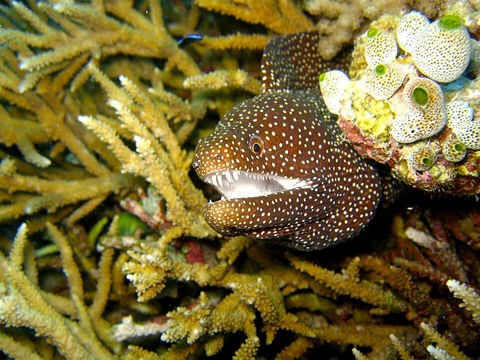
Snowflake moray
A blunt-toothed moray eel of the Indo-Pacific.

The snowflake moray (Echidna nebulosa), also called the clouded moray, is a marine eel belonging to the family Muraenidae. Its blunt teeth are suited for crushing crustaceans, a feature it shares with the zebra moray (Gymnomuraena zebra). In Hawaiian, it is known as puhi-kapa, a name tied to King Kamehameha I's nickname. The genus name comes from the Greek *echidna*, meaning "viper," while the species name *nebulosa* derives from the Latin *nebulosus*, meaning "misty" or "cloudy."
This eel is widespread across the Indo-Pacific, from the eastern coast of Africa through Micronesia, including the Red Sea, and as far as Hawaii. It also appears in the eastern Central Pacific, from southern Baja California, Mexico, down to Costa Rica and northern Colombia. Adults typically reach 50 centimeters (20 inches) in length, though some grow up to 100 centimeters (39 inches). They inhabit depths between 1 and 48 meters.
The snowflake moray has a blunt white snout marked with a speckled pattern of yellow, brown, and black stripes. A dorsal fin runs the full length of its body. Two yellow, tubular nostrils angle downward from the snout, with another pair closer to the eyes. Their eyesight is poor, so they rely on a keen sense of smell to hunt. Their small, blunt teeth are designed for eating crustaceans, which form the bulk of their diet. Like other morays, they possess pharyngeal jaws—a second set of jaws located in the throat. The species is an unconfirmed protogynous hermaphrodite, meaning it may change sex during its life. Snowflake morays lack scales and secrete a mucus over their skin, which helps them move easily through tight spaces and holes in their environment.
In the wild, they are often found in seagrass beds with rock rubble, rocky shallows, intertidal reef flats, and tide pools.
In captivity, the snowflake moray is a popular saltwater eel, known for being hardy and adaptable. It can reach up to 36 inches in length and requires an aquarium of at least 20 gallons (40–50 gallons when fully grown) with a tight-fitting lid, as these eels are skilled escape artists. They can live 15 years or more in an aquarium. As carnivores, they accept a variety of meaty foods like krill, shrimp, silversides, and octopus meat. If not already used to frozen foods, they may need live ghost shrimp at first, with gradual weaning.
Quick Facts
- Taxon
- Echidna nebulosa
Facts from the source article.
Lore & Background
The snowflake moray's Hawaiian name, puhi-kapa, originates from King Kamehameha I's nickname. Its genus name, Echidna, is derived from the Greek word for 'viper', and its species name, nebulosa, comes from the Latin word nebulosus meaning 'misty' or 'cloudy'. The eel has a blunt white snout with a yellowish, brown, and black striped speckled pattern, a dorsal fin running the length of its body, and two yellow tubular nostrils angled down from its snout plus another pair near its eyes. Its eyesight is poor, compensated by a heightened sense of smell. It has small blunt teeth and a diet mainly of crustaceans. Like other morays, it possesses pharyngeal jaws—a second set of jaws in the throat. The species is an unconfirmed protogynous hermaphrodite, meaning it may change sex during its lifetime. It is scale-less and secretes mucus over its skin for easy maneuverability in holes.
Reader's Guide
The snowflake moray is a commonly kept saltwater aquarium eel, valued for its hardiness and adaptability. In captivity, it can reach up to 36 inches and live 15 years or older. It requires an aquarium larger than 20 gallons (40–50 gallons when full grown) with a tight-fitting lid, as it is adept at escaping through small holes. It is carnivorous, accepting meaty foods like krill, shrimp, silversides, and octopus meat; live ghost shrimp may be needed initially for acclimation, and freshwater feeder fish should be avoided as they can cause liver disease. Crustaceans such as shrimp, crabs, and lobsters are unsafe tankmates due to the eel's natural diet, but most other invertebrates like starfish, anemones, and sea urchins are safe. It is reef safe and will not bother corals, though its messy eating requires strong filtration and a large protein skimmer. Very small fish like damselfish may be consumed. Compatible tankmates include larger aggressive fish such as lionfish, tangs, triggerfish, wrasses, and possibly other snowflake morays if introduced simultaneously. The eel can inflict a severe bite.
Did You Know?
- The snowflake moray's Hawaiian name, puhi-kapa, comes from King Kamehameha I's nickname.
- Its species name nebulosa means 'misty' or 'cloudy' in Latin.
Frequently Asked Questions
What is the Snowflake moray?
The Snowflake moray (Echidna nebulosa), also called the clouded moray, is a marine eel in the Muraenidae family native to the Indo-Pacific. It is distinguished by its blunt, crushing teeth and a mottled, misty coloration that gave rise to its species name.
What do the scientific names of the Snowflake moray mean?
The genus name Echidna traces back to the Greek word for "viper," while nebulosa comes from the Latin word meaning "misty" or "cloudy." Together they evoke a viper-like eel with a foggy, clouded appearance.
How big does a Snowflake moray get?
Most individuals are around 50 centimeters (about 20 inches) long, though the species can reach a maximum of 100 centimeters (39 inches). This places it in the medium range among moray eels.
Where does the Snowflake moray live?
This eel is found broadly across the Indo-Pacific, stretching from the eastern coast of Africa through to Micronesia. It occupies depths from roughly 1 meter down to about 48 meters.
What does a Snowflake moray eat and how does it feed?
Its blunt teeth are built for crushing crustaceans rather than slicing flesh, a feeding adaptation it shares with the zebra moray. In Hawaiian the eel is known as puhi-kapa, a name connected to the nickname of King Kamehameha I.
More in Moray Eels 1-24
Spotted an error? Know more?
Reader corrections go straight into our review queue. Suggest an edit · How this site is sourced