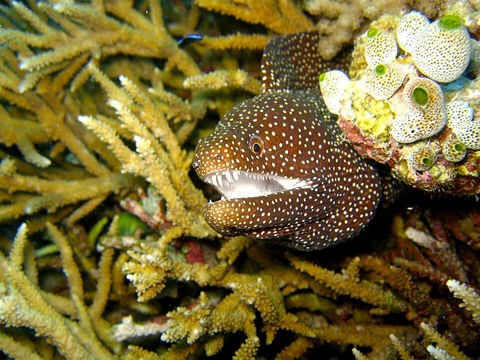
Undulated moray
A nocturnal reef-dwelling eel with cultural importance in Hawaii.

The undulated moray (Gymnothorax undulatus) is a member of the Muraenidae family, inhabiting the Indo-Pacific and east-central Pacific Ocean. It reaches a maximum length of 1.5 meters and is typically found at depths up to 30 meters.
This eel is easily recognized by its yellow head and brown-spotted body, with white borders forming a chain-link pattern across its skin. To breathe, it uses its large mouth to pump water over its gills, which are protected by a small gill opening. Like most eels, it lacks pectoral and pelvic fins, an adaptation that helps it navigate through reef crevices. Its remaining fins have thicker skin to withstand sharp coral, and it moves in an S-shaped pattern to maneuver back and forth. The teeth curve backward, allowing it to grip prey and guide it toward the throat for digestion.
The undulated moray ranges across the Pacific and as far west as East Africa. It commonly resides in lagoons, seaward reefs, and reef flats, sheltering within the reef structure. It is nocturnal, hiding during the day and hunting at night, and can be found from 1 to 50 meters deep.
In Hawaiian culture, this eel—along with several other species known as *puhi*—appears in many stories as a common *ʻaumakua*, or ancestral guardian. Called *laumilo* (meaning "milo leaf") for its swimming motion, which resembles leaves blown from the milo tree, it is considered a guardian of that tree according to the *Kumulipo*. The eel was also a form taken by Kū, the Hawaiian god of war, to interact with humans. For many native Hawaiian communities, eels were an important food source, used in special dishes for leaders entertaining honored guests, and this particular eel is described as "highly relished."
Quick Facts
- Taxon
- Gymnothorax undulatus
Facts from the source article.
Lore & Background
The undulated moray can easily be identified by its yellow head and brown spots covering its body. It is also lined by white borders forming similar to a chain link. They use their large mouths to pump water to the gills, while the gill cover is a small hole to protect the delicate gills. Like most eels, they lack the pectoral and pelvic fins to make it easier for them to move through the crevices of reefs. Their other fins are fitted with thicker skin to protect from sharp reef. They move in an S-shape to be able to move back and forth to also aid in movement through reefs. Their teeth are shaped to be curved backwards so they can hold onto their prey and easily move the prey backwards for digestion.
Gymnothorax undulatus can be found in the Pacific as well as East Africa. Most of the time they can be found in reefs of lagoons and seawards or in reef-flats. They like to shelter within reefs and can be found from depths of 1 to 50 meters. The undulated moray is nocturnal as they hide in reefs during the day and hunt for food at night.
The undulated eel and several other species of eels (puhi) are featured in many Hawaiian stories as common ʻaumakua, thought to be ancestors protecting families. This eel is known as laumilo or 'milo leaf' from the way it swims similar to blown leaves of the milo tree, it itself is considered a guardian for the tree according to the Kumulipo. This eel was also a common form that Kū, the Hawaiian god of war, would take to interact with humans.
Reader's Guide
The undulated moray holds significant cultural and practical value in Hawaiian communities. According to the source article, the undulated eel and several other species of eels (puhi) are featured in many Hawaiian stories as common ʻaumakua, thought to be ancestors protecting families. This eel is known as laumilo or 'milo leaf' from the way it swims similar to blown leaves of the milo tree, and it itself is considered a guardian for the tree according to the Kumulipo. Additionally, this eel was a common form that Kū, the Hawaiian god of war, would take to interact with humans. For many native Hawaiian communities, eels were an important food source and used for special dishes when leaders had special guests; this particular eel is deemed 'highly relished'. The article does not provide further details on its ecological role or modern conservation status, but its biological adaptations—such as the S-shaped movement, lack of pectoral and pelvic fins, and backward-curved teeth—highlight its specialization for reef life and predation.
Did You Know?
- The undulated moray can be identified by its yellow head and brown spots with white chain-link borders.
- It lacks pectoral and pelvic fins to move more easily through reef crevices.
- In Hawaiian culture, this eel is called laumilo and is considered a guardian of the milo tree.
More in Moray Eels 1-24
Spotted an error? Know more?
Reader corrections go straight into our review queue. Suggest an edit · How this site is sourced