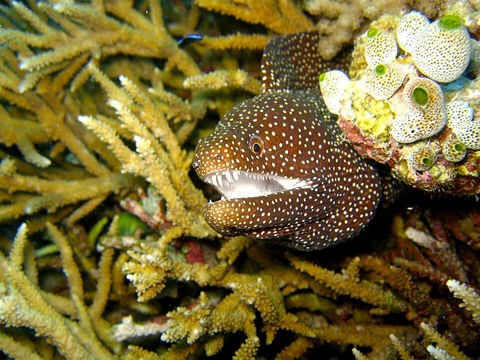
Turkey moray
A medium-sized moray with a white mouth and spotted body.

The turkey moray (Gymnothorax meleagris), also called the guineafowl moray or white-mouth moray, belongs to the Muraenidae family. This medium-sized eel reaches up to 120 centimeters in length, though most encountered are smaller. Its serpentine body is dark brown to black, covered in many small white spots. The inside of its mouth is entirely white.
Found across the Indo-Pacific, from East Africa (including the Red Sea) to Polynesia and Hawaii, and from southern Japan to New Caledonia, it is generally rare except in Hawaii, where it is common. It inhabits shallow lagoons and coral-rich reefs up to 36 meters deep, hiding in reef holes to ambush passing fish. It detects prey by smell. Active both day and night, it feeds on small fish and occasionally crustaceans.
Quick Facts
- Taxon
- Gymnothorax meleagris
Facts from the source article.
Lore & Background
The turkey moray is a medium-sized moray that can reach a maximum length of 120 cm, though specimens usually encountered are much smaller. Its serpentine body has a dark brown to black background color dotted with numerous small white spots uniformly distributed. The inside of its mouth is completely white, giving it one of its common names.
This moray is widespread throughout the Indo-Pacific area, from the eastern coast of Africa (including the Red Sea) to Polynesia and Hawaii, and from south Japan to New Caledonia. It is a relatively rare moray even within its distribution area except in Hawaii, where it seems to be common. It prefers shallow waters from lagoons and reefs rich in coral and fish life down to 36 meters deep, spending time in holes in the reef to quickly emerge and grasp passing fish by surprise attack. It senses prey by detecting smell through the water.
The turkey moray seems to be equally active day and night and feeds on small fish and occasionally crustaceans.
Reader's Guide
The turkey moray is significant as a distinctive member of the Muraenidae family, recognized by its white mouth and spotted body. According to the source article, it is notable for its rarity across most of its Indo-Pacific range, with the exception of Hawaii where it appears to be common. This uneven distribution makes it a species of particular interest within its habitat. The article describes its hunting strategy as ambush-based: it hides in reef holes and uses a surprise attack to catch passing fish, relying on smell to detect prey. Its activity pattern is equally diurnal and nocturnal, and its diet consists mainly of small fish, with occasional crustaceans. The species' preference for shallow, coral-rich lagoons and reefs up to 36 meters deep defines its ecological niche. The article provides no information on conservation status, threats, or human uses, so its legacy is limited to its biological and distributional characteristics as documented.
Did You Know?
- The inside of the turkey moray's mouth is completely white.
- It is relatively rare throughout its range except in Hawaii, where it seems to be common.
- It hunts by hiding in reef holes and quickly emerging to grasp passing fish by surprise attack.
- The turkey moray is equally active day and night.
More in Moray Eels 1-24
Spotted an error? Know more?
Reader corrections go straight into our review queue. Suggest an edit · How this site is sourced