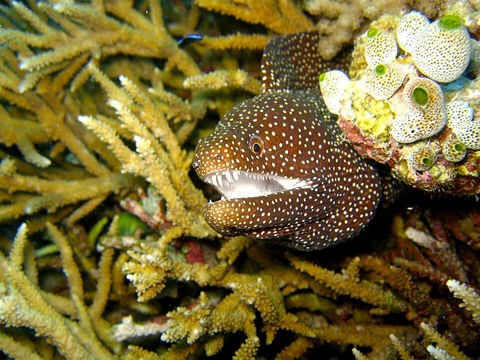
Spotted moray
A solitary, day-active moray with a dangerous bite.

The spotted moray (Gymnothorax moringa) is a medium to large moray eel found in the Western Atlantic Ocean and around Mid- and Eastern Atlantic islands. It is notable for its distinctive white or pale yellow body covered with small overlapping reddish brown to dark-brown spots, and for its solitary, daytime-active behavior.
Quick Facts
- Genus
- Gymnothorax
- Species
- moringa
Facts from the source article.
Lore & Background
The spotted moray is a solitary animal that typically hides in narrow crevices and holes in reef structures, with only its head peeking out. It is active during the day, feeding on crustaceans, molluscs, and fish at or near the sea bottom. Its bite can be dangerous to humans due to the damage caused by the pull-back effect of the bite itself, as well as potential toxins that may be released into the wound.
Reader's Guide
The spotted moray holds significance as a species that is both fished and kept in aquariums. There is a minor fishery for spotted eels, and they are also kept in aquariums until their size makes it impractical to do so. Its bite is a notable hazard to humans, combining mechanical damage from the pull-back effect with possible toxin release. The species is commonly found from the surface to depths of 200 meters, inhabiting reef structures across a wide range from North Carolina and Bermuda to Brazil, including the Gulf of Mexico and Caribbean, as well as Mid- and Eastern Atlantic islands. Its medium to large size, reaching up to 2 meters in length and 2.51 kilograms in weight, and its distinctive spotted coloration make it recognizable among moray eels.
Did You Know?
- The spotted moray can grow up to 2 m (6.6 ft) and weigh 2.51 kg (5.5 lb).
- Its bite is dangerous due to the pull-back effect and potential toxins.
- It is found from the surface to a depth of 200 m (660 ft).
More in Moray Eels 1-24
Spotted an error? Know more?
Reader corrections go straight into our review queue. Suggest an edit · How this site is sourced