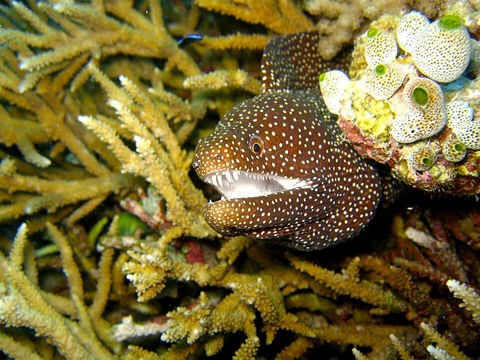
Leopard moray eel
A vividly colored moray eel of the Indo-Pacific.

The leopard moray eel (Enchelycore pardalis) goes by several common names, including dragon moray, tiger moray, and puhi-kauila in Hawaiian. It belongs to the moray eel family, Muraenidae.
This eel is found across a wide range of the Indo-Pacific, from Réunion to the Hawaiian, Line, and Society Islands, north to southern Japan and southern Korea, and south to New Caledonia. It lives on coral and rocky reefs, from shallow coastal waters down to deeper slopes at depths between 5 and 60 meters. During the day, it typically hides in crevices, coming out at night to hunt.
The leopard moray has a long, slender body and lacks pelvic and pectoral fins. It reaches a maximum length of 92 cm (36 in). Its most distinctive features are its narrow, curved jaws, elongated tubular nostrils, and vivid coloration. The body is covered with white, reddish brown, and dark brown spots that vary in shape, size, and length, while bright red stripes mark the face and surrounding area. This bold pattern makes the species easy to identify and rarely mistaken for others. It is primarily nocturnal and prefers cryptic habitats, feeding mainly on fish and small cephalopods.
The leopard moray uses two distinct feeding methods: rotation and knotting. In rotation, the eel spins its entire body along its lengthwise axis to tear chunks of flesh from prey while also preventing the prey from fighting back. Knotting involves the eel forming a loop with its body and passing its tail through it to create a knot. This technique allows the eel to handle larger prey or overcome resistance. Knotting can be used to constrict and swallow prey whole, suffocate it, or tear pieces from it, similar to rotation. Feeding begins with a strike; if successful, the eel then employs these behaviors.
Quick Facts
- Taxon
- Enchelycore pardalis
Facts from the source article.
Lore & Background
The leopard moray eel is widespread throughout the Indo-Pacific oceans from Réunion to the Hawaiian, Line and Society Islands, north to southern Japan, southern Korea, and south to New Caledonia. It inhabits coral and rocky reefs from shallow coastal waters to deeper reef slopes between 5 and 60 m in depth, typically sheltering in reef crevices during the day and hunting for prey at night. It has a long, slender body, no pelvic or pectoral fins, narrow curved jaws, and elongated tubular nostrils.
Its feeding behaviors include rotation—spinning its whole body on a longitudinal axis while tearing chunks of flesh from prey—and knotting, where it creates a loop with its body and passes its tail through to form a knot. Knotting allows the eel to feed on a wider range of prey, including larger prey or when facing resistance, and can involve constriction to consume prey whole or suffocate it, or taking pieces out of the prey similar to rotation. The leopard moray strikes at prey to begin feeding, and if successful, engages in these other behaviors.
Reader's Guide
The leopard moray eel is significant as a distinct species within the family Muraenidae, recognized for its vivid coloration that makes it easily identifiable and rarely confused with other species. Its distribution spans a wide range of the Indo-Pacific, from Réunion to the Hawaiian, Line and Society Islands, and from southern Japan and Korea to New Caledonia, inhabiting coral and rocky reefs at depths between 5 and 60 m. The species exhibits two distinct feeding behaviors—rotation and knotting—which are documented in scientific literature. Rotation involves the eel spinning its body on a longitudinal axis to tear flesh from prey, while knotting involves forming a loop and passing the tail through to create a knot, aiding in consuming larger prey or overcoming resistance. These behaviors, along with its nocturnal hunting and preference for cryptic habitats, contribute to its ecological role as a predator of fishes and small cephalopods. The leopard moray is also known by common names including dragon moray, tiger moray, and puhi-kauila in Hawaiian, reflecting its cultural recognition in parts of its range.
Did You Know?
- The leopard moray eel is also called the dragon moray, tiger moray, or puhi-kauila in Hawaiian.
- It grows up to 92 cm (36 in) in length and has no pelvic or pectoral fins.
- Its vivid red stripes on and around its face make it easily identifiable and rarely confused with other species.
Frequently Asked Questions
What is the Leopard moray eel?
The Leopard moray eel (Enchelycore pardalis) is a vividly colored reef-dwelling species in the moray eel family Muraenidae, native to the Indo-Pacific. It spends its daylight hours tucked inside crevices and emerges at night to hunt.
Where can I find a Leopard moray eel in the wild?
This species ranges across a huge stretch of the Indo-Pacific, from Réunion westward to the Hawaiian, Line, and Society Islands, and extending north to southern Japan and Korea and south to New Caledonia. It inhabits coral and rocky reef environments at depths between 5 and 60 meters.
How big does a Leopard moray eel get?
A fully grown individual reaches a maximum length of about 92 centimeters, or roughly 36 inches. That places it in the mid-range for moray eels.
What does a Leopard moray eel eat?
This nocturnal hunter feeds on small fish and cephalopods such as squid and octopus. It typically waits in reef crevices during the day and ventures out after dark to capture its meals.
What other names does the Leopard moray eel go by?
In English, the species is also known as the dragon moray or the tiger moray. In Hawaiian, it carries the local name puhi-kauila.
More in Moray Eels 1-24
Spotted an error? Know more?
Reader corrections go straight into our review queue. Suggest an edit · How this site is sourced