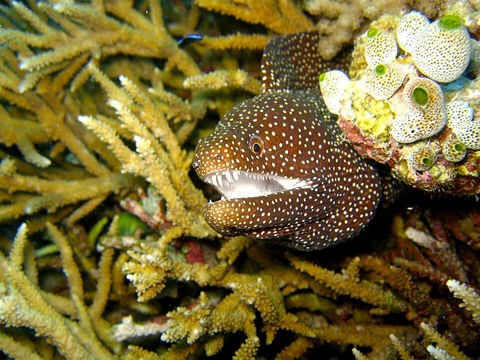
Laced moray
A large, nocturnal moray eel with a spotted body.

The laced moray (Gymnothorax favagineus) goes by several common names, including leopard moray, leopard moray eel, tessellate moray, and honeycomb moray. This marine fish belongs to the family Muraenidae. It is a large species, capable of reaching up to 3 meters (10 feet) in length, though most individuals encountered are smaller. Its body is serpentine, colored white to yellowish and covered with many black spots. The number and shape of these spots vary between individuals and depend on water clarity: those living in clear reef waters have fewer spots than those in turbid environments. This pattern gives the fish its common names.
The laced moray is found across the Indo-West Pacific, from the eastern coast of Africa (including the Red Sea) to Papua New Guinea, and from southern Japan down to the Great Barrier Reef. It inhabits the outer slopes of coral reefs, hiding in crevices during the day at depths between 1 and 45 meters (3.3 to 147.6 feet).
A carnivore, the laced moray leaves its shelter at night to actively hunt along the reef. Its diet consists mainly of small fish and cephalopods. Large adults can be aggressive in the wild.
Quick Facts
- Taxon
- Gymnothorax favagineus
Facts from the source article.
Lore & Background
The laced moray is a large moray which can reach a maximum length of 3 metres (10 feet), but specimens usually encountered are much smaller. Its body is serpentine in shape, with a white to yellowish background color dotted with numerous black spots. These spots vary in size and shape depending on the individual and on the environment in which the animals live: morays living on a reef with clear water will have fewer black spots than those living in a turbid environment. This characteristic color pattern is the source of its vernacular name.
The laced moray is widespread throughout the Indo-West Pacific area from eastern coast of Africa, Red Sea included, to Papua New Guinea and from southern Japan to the Great Barrier Reef. It lives on the outer slopes of coral reefs. During the day, it sits sheltered in crevices between 1 and 45 meters (3.3 and 147.6 feet) deep.
The laced moray is carnivorous. It leaves its lair at night to actively hunt its prey along the reef. It feeds mainly on small fish and cephalopods. Large adults are prone to be aggressive in the wild.
Reader's Guide
The laced moray is significant as a large, visually striking predator of coral reef ecosystems in the Indo-West Pacific. Its coloration, which varies with water clarity, provides camouflage and is the basis for its common names. The species is notable for its nocturnal hunting behavior, emerging from crevices to prey on small fish and cephalopods. Its large size—up to 3 meters—and the reported aggressiveness of large adults make it a formidable presence on the reef. The laced moray's distribution spans a vast area from the eastern coast of Africa and the Red Sea to Papua New Guinea, and from southern Japan to the Great Barrier Reef, indicating its adaptability to various reef environments. Its habit of sheltering in crevices during the day and hunting at night is typical of many moray eels. The species is recognized by multiple vernacular names, including leopard moray and honeycomb moray, reflecting its distinctive spotted pattern. As a carnivore, it plays a role in controlling populations of small fish and cephalopods. The laced moray's legacy is tied to its striking appearance and its ecological role as a nocturnal predator on coral reefs.
Did You Know?
- Its black spots vary in number depending on water clarity: fewer spots in clear water, more in turbid environments.
- It is also known as the leopard moray, tessellate moray, and honeycomb moray.
More in Moray Eels 1-24
Spotted an error? Know more?
Reader corrections go straight into our review queue. Suggest an edit · How this site is sourced