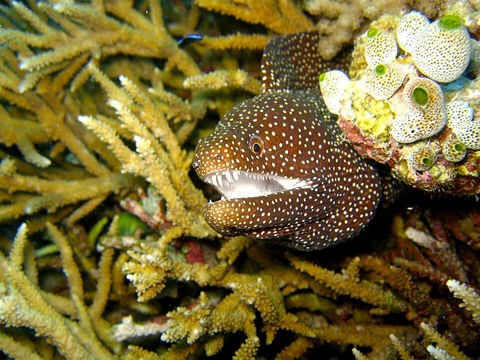
Kidako moray
A diurnal, piscivorous moray eel from Taiwan and Japan.

The Kidako moray (Gymnothorax kidako) is a marine fish from the Muraenidae family. It lives in coral reefs and lagoons, found in tropical and subtropical waters around Taiwan and Japan. Unlike many other moray eels, it is diurnal, meaning it is more active during the day. It is piscivorous, feeding on fish, octopus, and squid. There are about 200 species of moray eels in total, and the Kidako moray is one of them. Though its menacing appearance often frightens divers and snorkelers, it does not attack humans unless provoked.
This medium-sized fish reaches a maximum length of 91 centimeters. Its body is brown with white, snowflake-like spots on the head, body, and fins, along with blotches that continue onto the tail, though some patterns fade near the tail. The snout and chin are brown with yellow streaks.
The Kidako moray is found in the western Pacific, from Taiwan to Japan. It typically inhabits coral reefs or lagoons, hiding among rocky bottoms with only its head occasionally exposed. Some individuals live in waters up to 400 meters deep, where temperatures are cooler than the shallower areas most morays prefer. In parts of Japan, it is common enough to be harvested for food in minor commercial fisheries, where it is called *utsubo*—a name also used for other moray eels.
As a piscivore, the Kidako moray eats fish and cephalopods like octopus and squid. Moray feeding habits fall into two categories: piscivory and durophagy. Species with long, caniniform teeth tend to eat fish, octopus, and occasional crustaceans, while those with molariform or short caniniform teeth eat more crustaceans. The Kidako moray is piscivorous and has pharyngeal jaws—a dual-jaw system. Its oral jaws have sharp, backward-curved teeth that grip prey and pull it into the esophagus, then the pharyngeal jaws crush, shred, and prepare the food for digestion. Piscivorous morays are thought to have larger adductor muscles in the pharyngeal jaws to help carry and transport large fish.
The Kidako moray generally has large, uniserial teeth, except in small specimens. It has six large teeth on the peripheral part of the inter-maxillary segment, with the smallest pair in the most anatomical position, plus one to three tiny flanking teeth, three long median teeth, and eight to sixteen maxillary teeth that decrease in size toward the back.
Quick Facts
- Genus
- Gymnothorax
- Species
- kidako
Facts from the source article.
Lore & Background
The Kidako moray has a brownish color with white snowflake-like spots on its head, body, and fins, along with a pattern of blotches that continue onto its tail, though some patterns disappear closer to the tail. Its snout and chin are brown with yellow streaks. It hides in rocky bottoms but occasionally exposes its head. While morays are usually known to be nocturnal, observation has discovered that many, including the Kidako moray, are also diurnal.
The Kidako moray is piscivorous, consuming fish and cephalopods such as octopuses and squids. It falls into the category of piscivorous morays with pharyngeal jaws, having longer jaws and teeth and a narrower head compared to durophagous morays. Its teeth are curved backward and point towards its throat to prevent prey from escaping. The species generally has large and uniserial teeth, with six large teeth on the peripheral part of the inter-maxillary segment, and varying numbers of median, maxillary, and vomer teeth depending on specimen size.
The Kidako moray does not attack humans unless provoked. When threatened, it extends its jaws widely toward the threat. Moray eel attacks are rare and normally result from a diver placing a hand into a hole in the reef. Some moray eels have serrated teeth, and researchers speculated they might be venomous, but no study has proven this.
Reader's Guide
The Kidako moray is significant as a representative of the diverse Muraenidae family, which contains about 200 species across 16 genera. It is one of approximately 122 species under the genus Gymnothorax. The species is harvested in some minor commercial fisheries in Japan, where it is eaten and called utsubo, though this name is also used for other moray eels. Its use as food carries risks: on Saipan island, 57 people were poisoned by consuming moray eels, resulting in two deaths and 14 comatose cases, later identified as typical ciguatera poisoning, with the toxin reaching highest levels in large morays.
Research has established a correlation between length and weight in the Kidako moray, with an r² value above 0.90 based on nine samples. This relationship is also found in other moray eels such as G. chilospilus, G. meleagris, and G. pictus. The Muraenidae family is estimated to have originated 34 to 54 million years ago in the Pacific Ocean. Despite their menacing looks, which cause fear among divers and snorkelers, unprovoked attacks on humans are rare. The species' dual-jaw feeding system, with oral jaws for delivering prey and pharyngeal jaws for crushing, illustrates an evolutionary adaptation for piscivory.
Did You Know?
- The Kidako moray can reach a maximum length of 91 cm.
- It is diurnal, meaning it is more active in the daytime than at night.
- The species is used for food in Japan, where it is called utsubo.
More in Moray Eels 1-24
Spotted an error? Know more?
Reader corrections go straight into our review queue. Suggest an edit · How this site is sourced