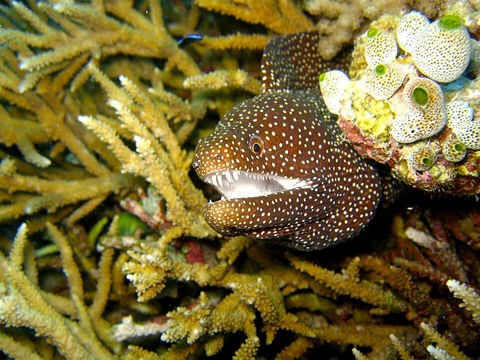
Indian mud moray eel
A moray eel that enters fresh water to breed.

The Indian mud moray eel (Gymnothorax tile), also called the freshwater moray or freshwater snowflake eel, lives in the western Pacific and Indian Oceans. Its name *Gymnothorax* comes from Greek words for "naked" and "breastplate," while *tile* is based on a Bengali name for the animal. This eel grows to about 61 centimeters (24 inches) long and can live up to 30 years. It has a gray-brown body with speckles ranging from golden yellow to white. Like all morays, it has a second set of jaws (pharyngeal jaws) to swallow prey. Its eyesight is very poor, so it relies on a strong sense of smell and water vibrations to find food or avoid danger.
The species is found from India and the Andaman Islands through Indonesia, the Philippines, New Guinea, and Australia, down to depths of 10 meters. Its natural habitat is marine neritic, often hiding in debris over mud or sand bottoms. It commonly lives in estuaries but can enter lower river sections. Although it usually stays in saltwater, it moves into fresh water to breed and spawn. In captivity, these eels do better in brackish water than pure fresh water, which can cause them to refuse food and develop diseases that shorten their lifespan. A tank lid is recommended because they can jump out.
Indian mud morays are carnivorous scavengers, eating mainly crustaceans and small fish, as well as dead fish and shrimp. Because of their poor eyesight, they rarely hunt unless necessary. In aquariums, they can be picky eaters, rejecting food they dislike, and stress may lead them to starve, sometimes fatally. No major threats are known, though coastal development, runoff, and habitat degradation may affect some populations.
Quick Facts
- Genus
- Gymnothorax
- Species
- tile
Facts from the source article.
Lore & Background
The Indian mud moray eel is characterized by a gray-brown body covered in speckles that vary in color from golden yellow to white. Like all moray eels, it possesses a second set of jaws called pharyngeal jaws to swallow prey. Its eyesight is very poor, so it relies on a keen sense of smell and vibrations in the water to detect prey or threats.
This species is known from the Indo-West Pacific, including India, the Andaman Islands, Indonesia, the Philippines, New Guinea and Australia. It occurs down to 10 m depth and is most commonly found hidden in debris resting over a soft substrate of mud or sand. It is often found in estuaries but may also enter the lower portions of rivers. While typically living in marine conditions, it travels to fresh water for breeding and spawning.
When kept as pets, Indian mud morays thrive better in brackish water rather than pure fresh water, as the latter can cause them to reject food and develop diseases that shorten their lifespan. It is advisable to place a lid on the aquarium tank, as they have the ability to jump out.
Reader's Guide
The Indian mud moray eel holds significance as a species that bridges marine and freshwater environments, traveling to fresh water specifically for breeding and spawning. Its ability to enter estuaries and lower river portions highlights its adaptability, though it remains primarily a marine neritic species. In captivity, it is known for being difficult to feed due to its tendency to reject food that is not to its liking, and stress can cause it to starve itself, leading to death in severe cases. The species faces no major known threats, though it may be impacted by coastal development, runoff, and habitat degradation in some parts of its distribution. Its poor eyesight and reliance on smell and vibrations for hunting, combined with its scavenging nature, make it a unique predator that typically does not hunt unless necessary. The etymology of its scientific name—Gymnothorax from Greek for 'naked breastplate' and tile from the Bengali vernacular name—adds cultural context to its identity.
Did You Know?
- The Indian mud moray can live up to 30 years.
- It relies on a keen sense of smell and water vibrations due to very poor eyesight.
- It travels to fresh water for breeding and spawning, though it typically lives in marine conditions.
- When kept in captivity, it may jump out of an aquarium, so a lid is advisable.
More in Moray Eels 1-24
Spotted an error? Know more?
Reader corrections go straight into our review queue. Suggest an edit · How this site is sourced