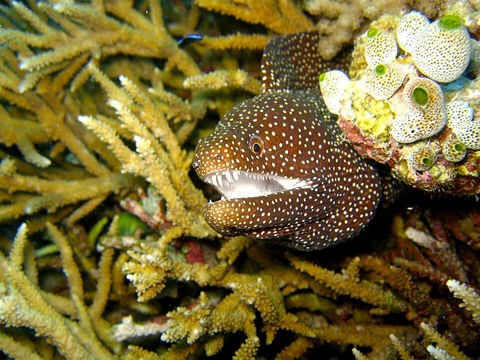
Gymnothorax rueppelliae
A nocturnal, aggressive moray with a bright yellow head and dark bars.

The banded moray, also called Rüppell's moray, the yellow-headed moray, or the black barred eel, is a species of moray eel that lives in tropical coral reefs. Its body is pale grey to greyish-brown, marked with 16 to 21 dark bars, while its head is bright yellow with a dark spot at the corner of the mouth. The snout and front of the head are yellowish, and the dark brown bands wrap fully around the body, continuing onto the head up to the snout; these bands fade as the eel ages. A close relative, *Gymnothorax pikei*, lives in Papua New Guinea and can be told apart by having more vomerine teeth. This species reaches a maximum length of 80 cm (31 in). Its scientific name honors the German naturalist and explorer Eduard Rüppell. In Hawaiian, it is called *puhi 'apo*, meaning "to catch or grasp," a name designated by Mary Kawena Pukui in 1978.
*Gymnothorax rueppelliae* is found across the Pacific and Indian Oceans, from the Red Sea and East Africa to Hawaii, the Tuamotu Archipelago, the Marquesas Islands, north to the Ryukyu Islands, and south to the Great Barrier Reef. It lives in lagoons and coral reefs, preferring clear waters at depths between 1 and 40 m (3 ft 3 in to 131 ft 3 in), with some individuals reported as deep as 30 m (98 ft). Nocturnal and mostly bottom-dwelling, it is known for nervous and aggressive behavior, especially when disturbed. An active predator, it feeds mainly on fish, crabs, and shrimp. Like other moray eels, it reproduces by laying eggs (oviparous), with little to no embryonic development inside the mother. Its reproductive behavior is thought to be influenced by water temperature, lunar cycles, and seasonal changes, though specific spawning sites and behaviors in the wild remain poorly understood.
Quick Facts
- Genus
- Gymnothorax
- Species
- rueppelliae
Facts from the source article.
Lore & Background
Gymnothorax rueppelliae is a pale grey to greyish-brown moray with 16–21 dark bars on the body, a bright yellow head, and a dark spot at the corner of the mouth. The snout and front of the head are yellowish, while the body is marked by wide, encircling dark brown bands that fade as the eel ages. A distinguishing feature is that its bands are regular and continuous around the body, extending onto the head as far as the snout. It differs from the close relative Gymnothorax pikei, which lives in Papua New Guinea, by having fewer vomerine teeth.
Reader's Guide
Gymnothorax rueppelliae is distributed throughout the Pacific and Indian Oceans, from the Red Sea and East Africa to Hawaii, Tuamotu Archipelago, the Marquesas Islands, north of the Ryukyu Islands, and south of the Great Barrier Reef. It is nocturnal and primarily benthic, residing in clear waters of lagoons and seaward reefs at depths from 1 to 40 m. Known for its nervous and aggressive behavior when disturbed, it is an active predator feeding on fish, crabs, and shrimp. Like other moray eels, it follows an oviparous reproductive strategy, laying eggs with little embryonic development within the mother. Its reproductive behavior is believed to be influenced by water temperature, lunar cycles, and seasonal changes, though further research is needed. The Hawaiian name puhi 'apo, meaning 'to catch or grasp,' was designated by Mary Kawena Pukui in 1978.
Did You Know?
- Gymnothorax rueppelliae has 16–21 dark bars on its body and a bright yellow head with a dark spot at the corner of the mouth.
- Its scientific name honors German naturalist and explorer Eduard Rüppell.
More in Moray Eels 1-24
Spotted an error? Know more?
Reader corrections go straight into our review queue. Suggest an edit · How this site is sourced