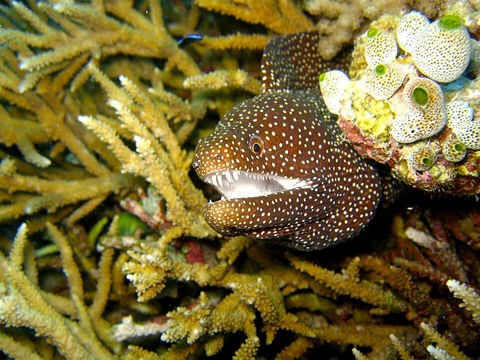
Gymnothorax polyuranodon
A moray eel that blurs the line between freshwater and marine life.

Gymnothorax polyuranodon, most often called the freshwater moray, is a moray eel found across the Indo-Pacific. Its range includes Sri Lanka, the Philippines, Indonesia, Papua New Guinea, northern Australia, and several western Pacific islands. It also goes by names like many-toothed moray, spotted freshwater moray, blackspotted moray, freshwater leopard moray, and freshwater tiger moray.
Pieter Bleeker first described this species in 1853. Adults can reach 1.5 meters in length, though specimens over 1 meter are uncommon. The body is yellow or light tan, covered in dark brown spots and blotches. Compared to its head size, its teeth are very small. Like all moray eels, it is carnivorous, feeding almost entirely on fish, with occasional shrimp, bivalves, and worms, and it prefers live prey. Its vision is poor, but its sense of smell is excellent, and it can be aggressive. The saliva is mildly toxic; a bite is not lethal but is very painful and can lead to infection.
This species lives in shallow water, typically at depths of 3 meters or less. It inhabits marine coastal waters, estuaries, river mouths, and short distances upriver. For a long time, experts believed the freshwater moray was actually a marine eel that could tolerate lower salinity only for short periods. More recent evidence, however, suggests it may be catadromous—spending most of its life in freshwater and migrating to saltwater to spawn. Young eels hatch in the ocean, then move into freshwater to mature. When ready to reproduce, adults return to the sea. Newly hatched elvers have not been seen in freshwater, and only one saltwater specimen has ever been recorded. Juveniles are often found in brackish mangrove forests, hiding from larger fish. Adults are common in freshwater, though they might only stay there temporarily. In northeastern Australia, a three-year observation study found that nearly three-quarters of specimens preferred still pools or very slow-flowing water with many boulders in tropical rainforest settings.
In the wild, Gymnothorax polyuranodon is uncommon, and it was once rare in the aquarium trade. Interest has grown since the mid-2010s, both among private owners and researchers. Several scientific papers have been published, and it appears more often in online tropical fish markets, though still in small numbers compared to other eels.
Quick Facts
- Genus
- Gymnothorax
- Species
- polyuranodon
Facts from the source article.
Lore & Background
Gymnothorax polyuranodon was named by Pieter Bleeker in 1853. The species can reach a maximum length of 1.5 metres, but is rarely seen larger than 1 metre. Its colouration is yellow or light tan, covered with dark brown spots and blotches. The freshwater moray has very small teeth in proportion to the size of its head, and, like all moray eels, is carnivorous. Its diet consists almost entirely of fish, and occasionally shrimp, bivalves, and worms, and it prefers to eat live food. Like many moray eels, it has poor vision but an excellent sense of smell, and it can be aggressive. The species' saliva is slightly toxic; while not lethal, a bite can be very painful and may result in infection.
For years, it had been accepted that the freshwater moray was a marine species able to tolerate lower salinity only for short periods. However, a growing body of evidence suggests it is catadromous, spending much of its life in freshwater but migrating to saltwater to spawn. Young eels are born in marine water, then migrate into freshwater. Adults are commonly found in freshwater, but it is possible they are only short-term residents. In northeastern Australia, nearly three-quarters of observed specimens preferred still pools or very slow-flowing water with many boulders in tropical rainforest environments.
Reader's Guide
Gymnothorax polyuranodon is an uncommon species in the wild and has been rare in the aquarium pet trade. From the mid 2010s onwards, interest increased both in private ownership and scientific research. It has been the subject of several scientific papers and is becoming more visible in the online market, though still in very small numbers compared with other eel species. Because of its full-grown size, a minimum tank size of 150 gallons is recommended. The aquarium should have a sand or smooth rounded gravel bed, with many large rocks for shelter, and low water flow. Water temperature should be maintained at 24–28 °C (75–82 °F).
Experience from aquarists has revealed confusion regarding this species being marketed as a 'freshwater' species. It can survive in pure saltwater, pure freshwater, and various degrees of brackish water. Information on long-term survival in freshwater is conflicting. One study concluded that all examined eels had likely resided in freshwater or estuarine habitats throughout their lives after metamorphosing from the leptocephalus stage. Another study demonstrated that the species can survive and grow substantially in freshwater, with yearly growth ranging from 21.0 cm to 26.5 cm total length. The species is highly individualistic in behavior; some specimens tolerate tankmates, while others are aggressive and territorial. It is unwise to keep it with small fish, as they will likely be eaten. If well-fed, the likelihood of attacking tankmates is greatly reduced.
More in Moray Eels 1-24
Spotted an error? Know more?
Reader corrections go straight into our review queue. Suggest an edit · How this site is sourced