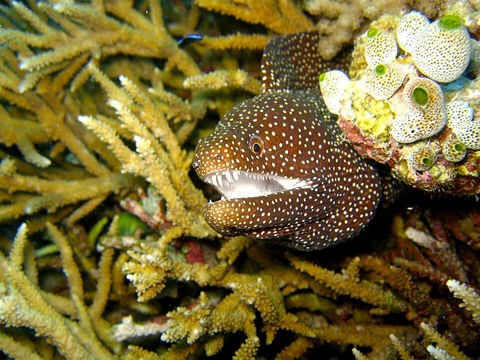
Gymnothorax pictus
A pale moray eel with purplish speckles, poisonous to eat.

Gymnothorax pictus, commonly known as the painted moray, paintspotted moray, or peppered moray, is a species of moray eel. In the Chamorro language it is called títugi. The species is notable for its distinctive coloration and for being dangerous to eat due to its toxicity.
Quick Facts
- Genus
- Gymnothorax
- Species
- pictus
Facts from the source article.
Lore & Background
The peppered moray is pale with purplish speckles that gather together with age. Young individuals have no spots or bars; they are pale purplish with white bellies. Its maximum length is 140 cm. The species eats small fish and crustaceans. While hunting for prey, they may be completely out of the water or may leap out of water. It is dangerous to eat because it is poisonous.
In taxonomy, the peppered moray was named and described by Solander in an unpublished manuscript. Richardson said the fish might be Muraena siderea, but later proved the fish was different by pointing out the difference in coloration. When the names were published as separate species, it was unknown if they were really different species. Kuep gave the species name as Sidera pantherina. Blecker later changed it to its current name. The reason why the name is still the same is because of all three people's work.
The peppered moray can commonly be found in tropical marine waters of the Indo-Pacific and from islands of the tropical Eastern Pacific. They can also be found in very shallow water on reef flats. Places where the species has been found include Suva Reef, the Fiji Islands, Clarion Island, and the Revillagigedo Islands.
Reader's Guide
The significance of Gymnothorax pictus lies in its distinctive appearance and its known toxicity, which makes it dangerous to eat. The species is also notable for its taxonomic history, which involved multiple researchers—Solander, Richardson, Kuep, and Blecker—whose work contributed to its current classification. The uncertainty about whether it was a separate species from Muraena siderea was never fully resolved in the source, and the name remains due to the combined contributions of all three people. Its behavior of leaping out of water while hunting is a notable characteristic. The species is found across a wide geographic range, from the Indo-Pacific to the tropical Eastern Pacific, including specific locations such as Suva Reef, the Fiji Islands, Clarion Island, and the Revillagigedo Islands. The Chamorro name títugi adds cultural context to its identity.
More in Moray Eels 1-24
Spotted an error? Know more?
Reader corrections go straight into our review queue. Suggest an edit · How this site is sourced