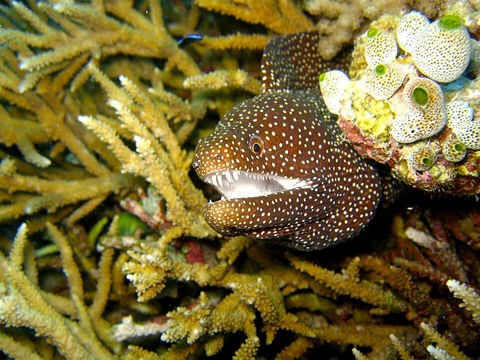
Gymnothorax melatremus
A small, colorful moray eel from the Indo-Pacific.

Gymnothorax melatremus, commonly known as the blackspot moray, dirty yellow moray, or dwarf moray, is a species of moray eel from the Indo-Pacific region. It is notable for its small size and distinctive coloration, and it rarely makes its way into the aquarium trade.
Quick Facts
- Taxon
- Gymnothorax melatremus
Facts from the source article.
Lore & Background
Gymnothorax melatremus has dorsal fins originating about midway between the gill opening and the corner of the mouth. Its teeth are small and stout with no canines; there is a single row of teeth at the front of the upper jaw with 1–2 median teeth, then teeth in two rows on each side of the upper jaw, with longer and more slender teeth in the inner row and larger teeth at the front of the lower jaw. It grows up to 26 cm in length. Its body color varies from gold, yellow, and white throughout, with black spots in the gill openings and deep blue in the eyes.
In the wild, this moray eel is carnivorous, feeding on any crustaceans and small fish it can catch, including ghost shrimp, dead squid, firefish, and jawfish. It is mostly nocturnal, making it very hard to find during the day. When scared or in danger, it will attack, and its bite can cause infections. In small places, it becomes nervous and more alert to movements and prey.
Reader's Guide
Gymnothorax melatremus is a moray eel from the Indo-Pacific, ranging from East Africa to the Marquesas and Mangaréva, north to the Hawaiian Islands, and south to the Australs islands. It rarely enters the aquarium trade, though it is part of the aquarium hobby. In captivity, it can be fed dead fishes, chopped cephalopods, and small shrimp. The species is mostly peaceful but remains a moray, so it will attack vulnerable species such as small bottom feeders and other small fishes. Its nocturnal nature and tendency to become nervous in confined spaces are important considerations for any keeper. The eel's bite can cause infections, adding a cautionary note to its handling. Its small size—up to 26 cm—and variable coloration of gold, yellow, and white with black spots at the gill openings and deep blue eyes make it visually distinctive. The article notes no further details on its conservation status or broader ecological significance, focusing instead on its physical traits, diet, and behavior.
Did You Know?
- It has black spots in its gill openings and deep blue eyes.
- It is mostly nocturnal and very hard to find during the day.
More in Moray Eels 1-24
Spotted an error? Know more?
Reader corrections go straight into our review queue. Suggest an edit · How this site is sourced