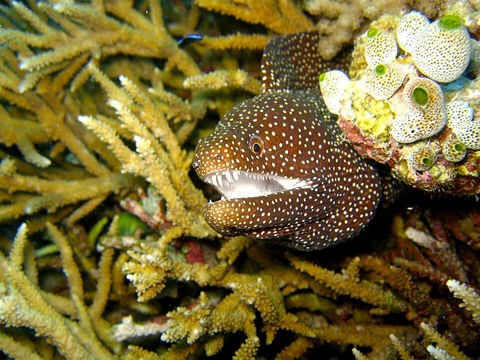
Gymnothorax fimbriatus
A nocturnal carnivorous moray eel of Indo-Pacific reefs.

The fimbriated moray, also called the dark-spotted or spot-face moray, belongs to the Muraenidae family. This medium-sized eel reaches up to 80 centimeters long. Its body is serpentine, colored white-cream to light brown, and covered in many black spots that differ in size and shape depending on the individual and its age. The head has a tapered snout, is greenish-yellow with black dots, and the mouth corners are white. This species lives across the tropical Indo-Pacific, from Madagascar to Polynesia and from southern Japan to New Caledonia, mainly on coastal reefs around oceanic islands. It inhabits protected spots on outer coral reef slopes, reef tops, lagoons, and harbors, staying sheltered in crevices during the day at depths of 1 to 50 meters. The fimbriated moray is carnivorous, leaving its lair at night to actively hunt small fish and crustaceans along the reef.
Quick Facts
- Taxon
- Gymnothorax fimbriatus
Facts from the source article.
Lore & Background
The fimbriated moray is a serpentine-shaped eel that can reach up to 80 centimetres in length. Its body has a white cream to light brown background color dotted with numerous black spots, which vary in size and shape depending on the individual and its maturity. The head is greenish-yellow with black dots, and the corners of the mouth are white, with a tapered snout.
Reader's Guide
The fimbriated moray is widespread throughout the tropical waters of the Indo-Pacific area, primarily on coastal reefs of oceanic islands from Madagascar to Polynesia and from south Japan to New Caledonia. It inhabits protected areas on the outer slopes of coral reefs, top reefs, lagoons, and harbors, sheltering in crevices during the day at depths between 1 and 50 metres. As a carnivorous species, it leaves its lair at night to actively hunt small fish and crustaceans along the reef. Its significance lies in its role as a nocturnal predator within coral reef ecosystems, and its distinctive spotted pattern makes it a recognizable member of the Muraenidae family.
Did You Know?
- The fimbriated moray is also called the dark-spotted moray or spot-face moray.
- Its maximum recorded length is 80 centimetres (31 in).
- It lives in protected areas on outer slopes of coral reefs, top reefs, lagoons, and harbors.
- It feeds mainly on small fish and crustaceans, hunting at night.
More in Moray Eels 1-24
Spotted an error? Know more?
Reader corrections go straight into our review queue. Suggest an edit · How this site is sourced