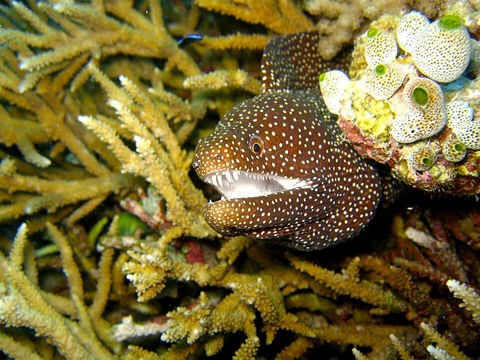
Green moray
Largest tropical Atlantic moray, with green mucus skin.

The green moray (Gymnothorax funebris) is a member of the Muraenidae family. Its range spans the western Atlantic, from Long Island, New York, south to Brazil, including Bermuda and the northern Gulf of Mexico, and it lives at depths up to 40 meters (130 feet). Reaching a maximum length of 2.5 meters (8.2 feet), it holds the title of the largest moray species in the tropical Atlantic and ranks among the biggest moray eels known globally.
The name "green moray" can also refer to the yellow moray, *G. prasinus*. The green moray’s distinctive color comes from a protective mucus layer secreted by specialized goblet cells, similar to other morays. Beneath this mucus, the eel’s skin is a darker shade, as seen in preserved specimens.
These eels are rarely eaten because they can cause ciguatera fish poisoning. While the green moray is not considered endangered, moray eels in general are poorly studied and often undercounted by standard visual surveys. The IUCN rates the green moray as least concern, with no major threats aside from occasional capture for public aquariums.
**Feeding behavior** Stomach content studies of green morays have found fish and crabs. Many moray eels hunt cooperatively with other fish; for example, Brazilian snapper (*Lutjanus alexandrei*) appear to recruit green morays while foraging in mangrove areas.
**Movement patterns** A 2021 study used acoustic transmitters to track 16 green morays in the mangrove estuary of Salt River Bay, St. Croix. Most were nocturnal: ten were detected more often at night, three during the day, and three were too elusive for reliable analysis. The majority had a home range averaging 5.8 hectares (14 acres), with no link between an eel’s size and its range. Two individuals had broader ranges without a clear center of activity, and one moved to an adjacent bay during the study.
Six eels left the survey area, heading toward offshore reefs and rocky submarine canyons. Each of these movements occurred over a single night in winter or spring, though they were preceded by wider exploration of their home bay. The migrating eels were significantly larger (though not necessarily more mature) than those that stayed.
Quick Facts
- Taxon
- Gymnothorax funebris
Facts from the source article.
Lore & Background
The common name 'green moray' is also sometimes used to refer to the yellow moray, G. prasinus. Its green colour comes from a protective layer of mucus secreted by its specialized goblet cells, much like other species of morays. Underneath this mucus layer, the green moray eel is a darker color as can be seen in preserved specimens.
Green morays are typically not eaten and can cause ciguatera fish poisoning. Though the green moray is not considered endangered, moray eels in general are understudied and often undercounted by traditional visual surveys. The green moray is rated as least concern by the IUCN, with no notable threats beyond occasional capture for public aquaria.
Fish and crabs have been reported as gut contents in green morays. Many moray eels cooperate with other fish during hunting, and Brazilian snapper (Lutjanus alexandrei) appear to recruit green morays while foraging among mangroves.
Reader's Guide
A 2021 survey used acoustic transmitters to track 16 green morays in the mangrove estuary of Salt River Bay, St. Croix. Green morays of this area appear to be mostly nocturnal; 10 were detected more often at night, three in the day, and three were too elusive to analyze reliably. Most eels had a home range averaging 5.8 hectares (14 acres), with no correlation between an eel's size and range. Two had broader ranges without a clear center of activity, and one moved to an adjacent bay during study. Six eels moved towards offshore reefs and rocky submarine canyons, exiting the survey area. Each eel's movement took place over a single night in winter or spring, though it was preceded by some broader exploration of their bay of residence. The eels that migrated were significantly larger (but not necessarily more mature) than those which did not. These findings highlight the species' complex movement patterns and the importance of mangrove habitats, though the green moray remains understudied overall.
Did You Know?
- The green moray's green color comes from a protective mucus layer, not its skin.
- It is the largest moray species of the tropical Atlantic, reaching up to 2.5 m.
- A 2021 study found that migrating green morays were significantly larger than non-migrants.
More in Moray Eels 1-24
Spotted an error? Know more?
Reader corrections go straight into our review queue. Suggest an edit · How this site is sourced