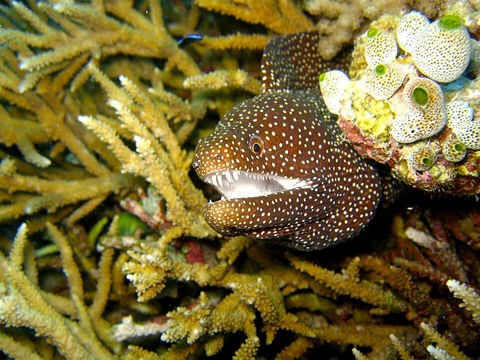
Giant moray
Largest moray eel by body mass, found in Indo-Pacific reefs.

The giant moray (Gymnothorax javanicus) is a marine fish belonging to the moray eel family Muraenidae. It holds the title of the heaviest moray eel species, although the slender giant moray surpasses it in length.
True to its name, this eel grows quite large, reaching just over 3 meters (10 feet) in length and weighing up to 30 kilograms (66 pounds). Its body is elongated and brown. Young individuals are tan with large black spots, while adults develop fine black speckles that transition into leopard-like markings behind the head.
This species is found across the Indo-Pacific, from the eastern coast of Africa and the Red Sea to the Pitcairn Islands, Hawaii, and Polynesia. Its range extends north to southern Japan and south to New Caledonia, Fiji, and the Austral Islands. It inhabits lagoons and the outer slopes of coral reefs, hiding in crevices during the day at depths between 1 and 50 meters.
The giant moray is a nocturnal carnivore that hunts within the reef. It is known to cooperate with the roving coral grouper (*Plectropomus pessuliferus*). The eel’s hunting in the reef can flush prey upward, where the grouper catches them; conversely, the grouper’s hunting above the reef can drive prey into hiding, where the moray ambushes them. Its diet consists mainly of fish, with occasional crustaceans. In the Red Sea, it has been identified as a natural predator of the lionfish (*Pterois miles*). Adults have few natural predators but may compete with reef-dwelling sharks for food. Cleaner wrasses are often seen cleaning the inside of its mouth. Research shows that *Gymnothorax javanicus* has a very small optic tectum, suggesting it relies more on smell than sight to hunt.
This species can pose a hazard to humans. As a top predator, it can accumulate dangerous levels of ciguatera toxins through biomagnification. Eating its flesh, especially the liver, may cause illness, coma, or death. While it is not usually aggressive, it may bite if threatened, cornered, or near food.
Quick Facts
- Taxon
- Gymnothorax javanicus
Facts from the source article.
Lore & Background
The giant moray is a large, elongated eel reaching up to a little over 3 m in length and 30 kg in weight. Its body is brownish; juveniles are tan with large black spots, while adults have black specks that become leopard-like spots behind the head. It lives in lagoons and on outer coral reef slopes, sheltering in crevices between 1 and 50 meters deep during the day. The species is widespread across the Indo-Pacific, from the eastern coast of Africa and the Red Sea to the Pitcairn group, Hawaiian Islands, Polynesia, southern Japan, New Caledonia, Fiji, and the Austral Islands.
Reader's Guide
The giant moray is a carnivorous, nocturnal hunter that primarily feeds on fish and occasionally crustaceans. It has been identified as a natural predator of the lionfish (Pterois miles) in its native Red Sea habitat. Notably, it engages in cooperative hunting with the roving coral grouper (Plectropomus pessuliferus): the eel hunting within the reef may scare prey upward for the grouper, while the grouper hunting above may drive prey into the reef where the moray ambushes them. A mature giant moray has few natural predators but may compete for food with reef-dwelling sharks. Cleaner wrasses are commonly found cleaning the interior of its mouth. The species has very small optic tectum volumes, indicating it primarily hunts by smell rather than vision. It may be hazardous to people: it can bite if threatened, cornered, or near food, though it is not usually aggressive. As a top predator, it can biomagnify ciguatera toxins; eating the eel, especially the liver, can cause illness, coma, or death.
Did You Know?
- The giant moray is the largest moray eel by body mass, but the slender giant moray is the largest in body length.
- It cooperatively hunts with the roving coral grouper, with each species flushing prey toward the other.
- It has very small optic tectum volumes, indicating it hunts primarily by smell rather than vision.
- Eating the liver of a giant moray can cause illness, coma, or death due to biomagnified ciguatera toxins.
More in Moray Eels 1-24
Spotted an error? Know more?
Reader corrections go straight into our review queue. Suggest an edit · How this site is sourced