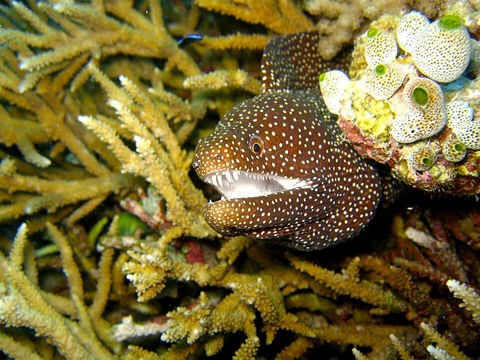
Geometric moray
A pale moray eel with black dots on its greyish head.

The geometric moray (Gymnothorax griseus) belongs to the moray eel family Muraenidae. It inhabits the western Indian Ocean, living at depths down to 40 meters, and reaches a maximum length of 65 centimeters. A notable feature is its infestation by the isopod parasite *Ichthyoxenus puhi*. Its coloration ranges from pale purple and white to brownish, with a greyish head marked by distinct lines of black dots.
In terms of classification, the moray family splits into two subfamilies: the snakemorays (Uropterygiinae) and the typical morays (Muraeninae). The geometric moray falls into the latter because its dorsal fin extends over parts of the body where snakemorays lack one. Within the subfamily, it sits in the genus *Gymnothorax*, which contains more than half of all moray species.
Its closest relative is the white-eyed moray (*Gymnothorax thyrsoideus*), which shares white eyes but is absent from most of the geometric moray’s range. The next closest relative is Castle’s moray (*Gymnothorax castlei*), which has a nearly identical spot pattern and sometimes dots along the lateral line, a feature also occasionally seen in *G. griseus*. More distant relatives include the false and Arabian false brown morays (*Gymnothorax pseudoherrei* and *G. arabicus*) and the mottled moray (*Echidna delicauta*).
Quick Facts
- Taxon
- Gymnothorax griseus
Facts from the source article.
Lore & Background
The geometric moray is classified within the subfamily Muraeninae (typical morays) due to having a dorsal fin in parts of the body where snakemorays (subfamily Uropterygiinae) would not. Within the subfamily, it belongs to the genus Gymnothorax, which contains over half of the species in the family. The fish is generally pale purple, white or brownish in colour, with a greyish head with distinct lines of black dots.
Reader's Guide
The geometric moray is significant as a member of the genus Gymnothorax, which contains over half of all moray species. Its closest relative is the white-eyed moray (Gymnothorax thyrsoideus), which shares white eyes and is not found in most places where G. griseus occurs. The next closest relative is Castle's moray (Gymnothorax castlei), which shares an almost identical pattern of spots and sometimes has dots on the lateral line (a feature G. griseus also sometimes has). More distant relatives include the False and Arabian false brown morays (Gymnothorax pseudoherrei and G. arabicus, respectively) and the Mottled moray (Echidna delicauta). The species is also notable for being parasitized by the isopod Ichthyoxenus puhi.
Did You Know?
- The geometric moray is parasitized by the isopod Ichthyoxenus puhi.
- The fish is generally pale purple, white or brownish with a greyish head and distinct lines of black dots.
- It is found throughout the western Indian Ocean at depths to 40 m.
More in Moray Eels 1-24
Spotted an error? Know more?
Reader corrections go straight into our review queue. Suggest an edit · How this site is sourced