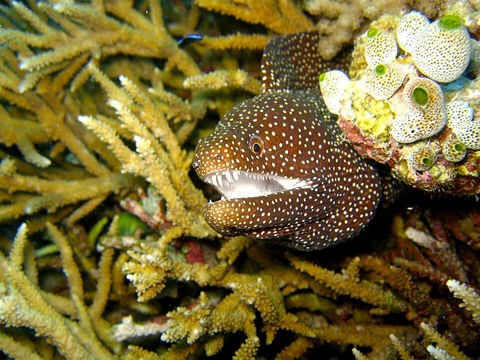
California moray
The only moray eel found off California.

The California moray, scientifically known as *Gymnothorax mordax*, belongs to the Muraenidae family. Its range in the eastern Pacific stretches from just north of Santa Barbara down to Santa Maria Bay in Baja California. This eel is the only moray species found off California and is one of the few subtropical morays. Its typical home is among boulders or cobbles in waters up to 40 meters (130 feet) deep. Adults can reach roughly 5 feet (1.52 meters) in length and may live for 22 to 26 years or more. As with all morays, it lacks pelvic and pectoral fins as well as gill covers.
These morays are frequently seen on rocky reefs around southern California’s islands, especially Catalina Island in the Channel Islands, and other Pacific islands. Their geographic range runs from Point Conception, California, to Magdalena Bay in Baja California. Juveniles inhabit tide pools, while adults move to deeper water. Adult California morays show strong site fidelity, staying in the same general area for their entire lives.
A notable mutualistic relationship exists between the California moray and the red rock shrimp. These cleaner shrimp gather in large numbers on the moray, removing parasites from its skin and even entering its mouth cavity and stomach to feed on parasites there.
The California moray is mainly piscivorous, with a particular taste for kelp bass (*Paralabrax clathratus*). However, it is an opportunistic predator and will also eat octopuses, lobsters, other California morays, and red rock shrimp.
As an apex predator on the reef, the California moray faces few natural predators and little competition for prey. It is thought to hunt at night, as it is elusive during the day. Unlike many fish that use suction feeding with expandable skulls, morays have fused skulls that prevent this. Instead, the California moray, like other morays, uses a specialized set of pharyngeal jaws—miniature, mobile versions of the oral jaws—to transport prey from its mouth into its throat. It also has depressible teeth in the roof of its mouth that fold upward as prey is swallowed. Although the moray’s bite force ranges from 32 to 467 Newtons, it does not prefer certain food types based on that force. Prey manipulation behaviors, including consumption and transportation, do not change with prey type, but the time spent on these behaviors increases as prey gets larger.
Quick Facts
- Taxon
- Gymnothorax mordax
Facts from the source article.
Lore & Background
California morays are a common sight on rocky reefs surrounding islands in southern California, notably Catalina Island in the California Channel Islands, and other islands in the Pacific. Their geographic distribution extends from Point Conception, California to Magdalena Bay, Baja California. Juveniles can live in tide pools while adults live in deeper waters. Adult California morays have high site fidelity, remaining in the same general location throughout their adult lives.
The California moray has a distinct mutualistic symbiotic relationship with red rock shrimp, where the cleaner shrimp clean the moray. The red rock shrimp aggregate in large populations on the moray, helping kill parasites within the mouth cavity and have been found to reach the stomach to feed on parasites. The California moray is thought to be primarily piscivorous, specializing in the kelp bass, Paralabrax clathratus, but is an opportunistic predator whose diet also includes octopuses, lobsters, other California morays, and red rock shrimp.
The California moray is the apex predator in its reef habitat, with few natural predators and no intense competition for prey. They are thought to be nocturnal hunters due to their elusiveness in the daytime. Like other morays, they have a special set of pharyngeal jaws that allow prey to be transported from their mouths into their throats, along with a set of depressible teeth in the roof of their mouths that fold upward as prey is swallowed. Bite force varies from 32 N to 467 N, but morays do not exhibit a preference for certain food types based on relative bite force.
Reader's Guide
The California moray is notable as the only moray eel species found off California and one of the few subtropical morays. Its distribution is tied to warm-water events: the species is believed to mate and spawn in the warm waters off the coast of Baja Mexico, with larvae transported northward to California during winter or El Niño Southern Oscillation events. At least one study has proposed that this species is non-reproductive in the most northern parts of its range due to cold water temperatures preventing gonadal development. A study using otoliths from Catalina Island individuals, cross-referenced with the Oceanic Niño Index, revealed that the majority of individuals likely arrived on Catalina Island only due to an El Niño Southern Oscillation event, with larvae drifting north via the northward-flowing Davidson Current.
Human attacks are very rare but possible when venturing near them; California morays are not venomous but can cause deep puncture wounds with their bite, which can become infected. The species is classified by the IUCN Red List as least concern, is not commercially fished, but faces threats from pollution and habitat degradation. Within Marine Protected Areas, California morays were found to be longer, older, heavier, had higher body condition, and were found in greater abundance. However, too great an abundance was also connected to higher frequencies of cannibalism, the presence of disease, and lower growth rates.
Did You Know?
- The California moray is the only species of moray eel found off California.
- They have a mutualistic symbiotic relationship with red rock shrimp, which clean them and kill parasites inside their mouth and stomach.
- Their pharyngeal jaws are more mobile than those of other fishes and help transport prey into the throat.
- Most individuals on Catalina Island likely arrived only due to an El Niño Southern Oscillation event.
More in Moray Eels 1-24
Spotted an error? Know more?
Reader corrections go straight into our review queue. Suggest an edit · How this site is sourced