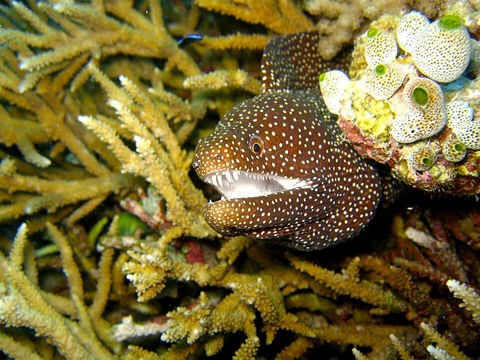
Blackcheek moray eel
A solitary, territorial moray with a black cheek patch.

The blackcheek moray eel, also called the masked moray (Gymnothorax breedeni), is a marine fish belonging to the Muraenidae family. It gets its name from a large, irregular black patch that starts at the eye and extends to the corner of the mouth. The body is brown with many small, dark speckles, and both the gill opening and anal opening are black. This eel can grow up to 100 cm long, though most seen are smaller.
It is found across the tropical Indo-Pacific, from the eastern coast of Africa to Pacific islands like Polynesia, but not Hawaii. It is especially common on Maldives reefs. The blackcheek moray lives in clear seaward reefs near oceanic islands, favoring porous coral rock, reef walls, and steep slopes with holes. It often shelters in rubble and dead coral debris on outer slopes between 4 and 40 meters deep.
This moray is solitary and highly territorial, likely to bite anything that enters its space. It hunts at night, feeding on fish and octopuses, and shares its habitat with cleaner shrimps and Anthias fish.
Quick Facts
- Taxon
- Gymnothorax breedeni
Facts from the source article.
Lore & Background
The blackcheek moray eel is widespread throughout the tropical waters of the Indo-Pacific area, from the eastern coast of Africa to oceanic islands of the Pacific Ocean like Polynesia, though it is not found in Hawaii. It is a very common moray on the Maldives reefs. This species occurs in clear seaward reefs of oceanic islands, especially in porous coral rock and in reef walls and steep slopes with holes. It prefers reefs composed of rubble and debris of dead coral, where it finds shelter, often on outer slopes between 4 and 40 meters deep.
The blackcheek moray is a medium-sized fish that can reach a maximum length of 100 cm, though observed individuals are often smaller. Its background body color is brown speckled with a relatively high density of darker spots. It is easily identifiable by the large irregular black patch mark starting from the eye and finishing in the corner of the mouth. Additionally, its anal orifice and gills aperture are black. The species is rather solitary and very territorial, likely to bite any foreign body entering its vigilance area. It lives in association with cleaner shrimps and the Anthias, and feeds on fish and octopuses at night, when it comes out of its lair.
Reader's Guide
The blackcheek moray eel holds significance as a common and recognizable species on Indo-Pacific reefs, particularly in the Maldives, where it is frequently observed. Its distinctive black cheek patch makes it easily identifiable among morays. The species is notable for its solitary and territorial behavior, which includes a readiness to bite intruders, and for its nocturnal hunting of fish and octopuses. Its association with cleaner shrimps and Anthias highlights its role in reef ecosystems. The species' preference for rubble and dead coral debris underscores its dependence on specific reef habitats, and its occurrence on outer slopes between 4 and 40 meters deep defines its ecological niche. As a medium-sized moray reaching up to 100 cm, it contributes to the diversity of predatory fish in tropical waters. Its widespread distribution across the Indo-Pacific, excluding Hawaii, marks its range and commonality in the region.
Did You Know?
- The blackcheek moray eel is also known as the masked moray.
- Its large irregular black patch mark starts from the eye and finishes in the corner of the mouth.
More in Moray Eels 1-24
Spotted an error? Know more?
Reader corrections go straight into our review queue. Suggest an edit · How this site is sourced