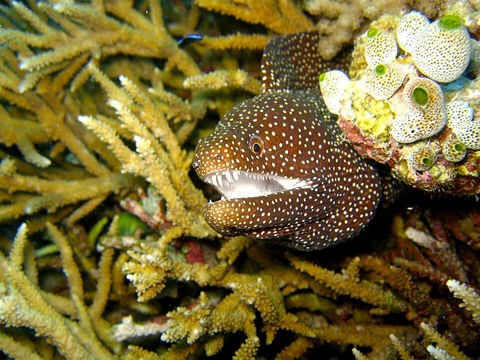
Abbott's moray eel
The most common moray eel in the Hawaiian Islands.

Abbott's moray eel (Gymnothorax eurostus), also called the stout moray or salt and pepper moray, belongs to the family Muraenidae. It is the most common moray eel in the Hawaiian Islands and has an antitropical distribution across the Indo-Pacific. This species grows up to 60 cm long and has 120 to 123 vertebrae. It lacks pectoral fins, and its skin is coated with mucus secreted by goblet cells in the epidermis. Coloration varies: it may be reddish brown with yellow spots, or tan to brown with pale spots that sometimes have darker spots on top. The eel’s range is linked to water temperature, occurring in the Indo-Pacific between latitudes 16° and 32° north and south. It is found in Hawaii, Johnston Island, Easter Island, the Austral Islands, Lord Howe Island, Heron Island, Marcus Island, Taiwan, the Ryukyu Islands, Japan, Bazaruto Island, and Mozambique. It lives in coastal reef habitats such as crevices, caves, and under rocky ledges, from shallow waters down to 74 m, but is most often seen at depths of 3 to 5 m. A voracious nocturnal carnivore, it primarily feeds on reef fish. The parasite *Lironeca puhi* commonly infects Abbott’s moray eel, affecting 15 to 70% of the population. Infected eels usually host one female and one male *Lironeca* in a single gill chamber (either left or right).
Quick Facts
- Genus
- Gymnothorax
- Species
- eurostus
Facts from the source article.
Lore & Background
Abbott's moray eel reaches up to 60 cm and contains around 120 to 123 vertebrae. It lacks pectoral fins, and its skin is protected by a mucus layer released by goblet cells in the epidermis. The color is variable, ranging from reddish brown with yellow spots throughout the body, to tan or brown coloring with pale spots that may have darker spots over them. The distribution of Abbott's moray eel is temperature related, as it is found in the Indo-Pacific between latitudes 16 and 32 degrees north and south. It lives in coastal reef habitats in spaces like crevices, caves, and under rocky ledges, and can be found in shallow waters down to a depth of 74 m, but is most frequently found at depths of 3 to 5 m.
Reader's Guide
Abbott's moray eel is a voracious nocturnal carnivore, feeding mostly on reef fishes. A common parasite of this species is Lironeca puhi, with around 15 to 70% of the eel population being infected. An infected Abbott's moray eel will typically have both a female and male Lironeca in a single, left or right gill chamber. As the most common moray eel in the Hawaiian Islands, it plays a significant role in the reef ecosystem. Its antitropical distribution—found in both northern and southern temperate latitudes but absent from the tropics—highlights its temperature-related range. The species is also known from the eastern Pacific Ocean from Costa Rica to Easter Island, and its presence across many islands and coastal regions of the Indo-Pacific underscores its adaptability to reef habitats.
Did You Know?
- Abbott's moray eel is also called the stout moray and the salt and pepper moray.
- The parasite Lironeca puhi infects 15 to 70% of the Abbott's moray eel population.
More in Moray Eels 1-24
Spotted an error? Know more?
Reader corrections go straight into our review queue. Suggest an edit · How this site is sourced