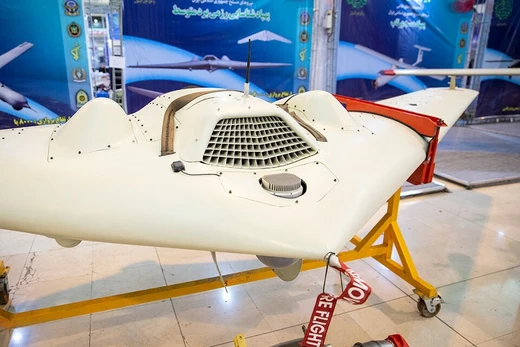
Tupolev Voron
Soviet supersonic reconnaissance drone based on recovered Lockheed D-21.

The Tupolev Voron (Russian: Ворон; English: Raven) was a planned supersonic unmanned reconnaissance aircraft developed by the Soviet Union under the company Tupolev. It was largely based on or designed to compete with the Lockheed D-21, following the recovery and analysis of a crashed D-21 in the Soviet Union.
Quick Facts
- Aircraft Type
- High-altitude and high speed reconnaissance drone
- National Origin
- Soviet Union
- Design Group
- Tupolev
- Number Built
- 0
- Developed From
- Lockheed D-21
Facts from the source article.
Lore & Background
The Voron project began after the remains of a Lockheed D-21, which had crashed in the Soviet Union following a failed mission over the People's Republic of China in 1969, were recovered and analyzed by the Soviet aircraft industry. The Council of Ministers of the Soviet Union commissioned the Tupolev OKB to rebuild the D-21 using Soviet materials, engines and equipment. Work was carried out at the MMZ Opyt facility near Moscow, which had prior experience with the drones Jastreb-1, Jastreb-2, Reys and Strizh. The project was headed by Alexei Tupolev, son of Andrei Tupolev.
The Voron was planned as a reconnaissance platform intended to contribute to overall strategic reconnaissance alongside other airborne and ground-based tools. The autopilot was to guide the aircraft along a pre-programmed route using an inertial navigation system. The only payload was a high-resolution camera attached to the underside. The drone was designed for a single mission; after completion, a reusable section containing the reconnaissance equipment would separate and glide down on a parachute, similar to the Jastreb-1. Launch was primarily from a Tupolev Tu-95 strategic bomber, which could carry one Voron held partially inside an opened bomb bay, unlike the B-52 which could carry two D-21s under its wings. A ground-based launch using a trailer with a large booster rocket was also planned but rejected due to shorter deployment range. Some sources state the Voron used an RD-012 engine with 1350 kgf thrust; others mention a 3Ts4 (RD-07K) engine from OKB-670, which also used the relatively well-preserved Marquardt RJ43-MA-11 engine from the D-21.
Reader's Guide
The Tupolev Voron never progressed beyond the planning stage, as the Soviet government came to believe that reconnaissance satellites would be more effective than drones. Despite not being built, the project yielded valuable insights and useful materials for future supersonic missiles. The Voron represents a direct Soviet response to American drone technology, specifically the Lockheed D-21, and illustrates the Cold War dynamic of reverse-engineering captured equipment. Its design reflected the Soviet approach to strategic reconnaissance, relying on a single-use platform launched from a bomber and recovering only the reconnaissance module. The project also explored alternative launch methods, including a ground-based booster, though this was abandoned. The Voron's legacy lies in the technical knowledge gained during its development, which informed later Soviet missile programs, rather than in operational service.
Did You Know?
- The Voron was based on or designed to compete with the Lockheed D-21, whose remains were recovered after it crashed in the Soviet Union in 1969.
- The project was headed by Alexei Tupolev, son of the famous aircraft designer Andrei Tupolev.
- The Voron was intended to be launched from a Tupolev Tu-95 bomber, carrying one drone partially inside an opened bomb bay.
- Some sources dispute whether the Voron used an RD-012 engine or a 3Ts4 (RD-07K) engine from OKB-670.
More in Military Drones of Asia, Europe and the Americas 1-24
Spotted an error? Know more?
Reader corrections go straight into our review queue. Suggest an edit · How this site is sourced