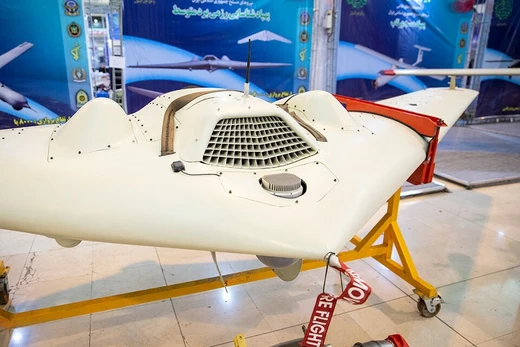
Fuji TACOM
Air-launched Japanese UAV for technology evaluation and potential multirole missions.

The Fuji TACOM (short for the Japanese phrase meaning "multi-role small UAV") is an air-launched drone built by Fuji Heavy Industries, now known as Subaru Corporation. It was first imagined in 1995 as a testbed for technologies that could support an air-launched unmanned aircraft for the Japan Air Self-Defense Force. While the TACOM was not built for a particular job, it could have handled tasks like intelligence gathering, surveillance, target acquisition, reconnaissance, electronic warfare, serving as a decoy, or acting as an aerial target.
The Technical Research and Development Institute started the TACOM program in 1995 to see if an air-launched multirole UAV system was feasible, based on JASDF needs at the time. Fuji Heavy Industries won the contract that same year. From 1995 to 1998, the company designed and built six drones, a ground control station, ground support equipment, and conversion kits so the F-4EJ could carry and control the UAV (with help from Mitsubishi Heavy Industries). Ground and flight tests ran from 1997 to 2001, carried out by the TRDI and JASDF. Ground tests covered mechanical and electrical checks, ground vibration, and recovery tests. Flight tests focused on the drone’s compatibility with the F-4EJ, captive flight testing, and evaluation of four key technologies: a high-speed stealthy shape, wing expansion, GPS/ADS hybrid navigation, and autonomous target tracking. On May 7, 1999, the TACOM made its first fully autonomous flight. The program ended in 2001 after 22 flights on the F-4EJ and five independent flights.
In 2004, a new UAV program called the "Unmanned Aerial Research System" began, building on lessons from the earlier project. It ran from 2004 to 2011, with a total investment of 10.3 billion yen. This follow-on program put more emphasis on autonomous flight, guidance technology for takeoff and landing, data transmission, and video technology for high-resolution images and footage. As a result, the drone was enlarged and slightly modified to support this research. One change was making it compatible with a new mothership, the F-15J. Captive flight tests took off from Gifu Air Field to areas off Japan’s coast, while autonomous flight tests were conducted from Iwo Jima.
The TACOM is built as a high-speed, low-observable air-launched drone.
Quick Facts
- Aircraft Type
- Air launched unmanned aerial vehicle
- National Origin
- Japan
- Manufacturer
- Subaru Corporation
- Number Built
- 6
- Construction Date
- 1995-1998
- Retired
- 2011
- First Flight
- May 7, 1999
Facts from the source article.
Lore & Background
The Technical Research and Development Institute (TRDI) initiated the TACOM program in 1995 to study the feasibility of an air-launched multirole UAV system based on JASDF requirements. Fuji Heavy Industries was awarded the contract that same year. Between 1995 and 1998, FHI designed and manufactured six UAVs, a ground control station, ground support equipment, and conversion kits for the F-4EJ to carry and command the UAV, with assistance from Mitsubishi Heavy Industries. Ground and flight tests were conducted between 1997 and 2001 by TRDI and JASDF. Ground tests included mechanical and electrical checks, ground vibration, and recovery tests. Flight tests focused on the UAV's compatibility with the F-4EJ, captive flight tests, and evaluation of four key technologies: high-speed stealthy configuration, wing expansion, GPS/ADS hybrid navigation, and autonomous target tracking. On May 7, 1999, the TACOM UAV carried out its first fully autonomous flight. The program ended in 2001 with a total of 22 F-4EJ flights and five independent flights.
In 2004, a follow-on program called the 'Unmanned Aerial Research System' was initiated based on experience from the previous project, conducted between 2004 and 2011 with an investment of 10.3 billion yen. This program further emphasized autonomous flight, guidance technology for autonomous landing, data transmission, and video technology for high-resolution images and videos. The drone was enlarged and slightly modified, including compatibility with its new mothership, the F-15J. Captive flight tests were conducted from Gifu Air Field to designated areas off the coast of Japan, and autonomous flight tests were conducted from Iwo Jima.
The TACOM UAV is designed as a high-speed, low observable air-launched drone with a foldable delta wing, a single air intake above the fuselage, and a single turbofan engine. Due to its small folding wings, the UAV is controlled only by its stabilizers and features ventral fins for lateral and directional stability. Radar cross-section reduction features include a curved intake S-duct and a small number of edge orientations. Dimensions were designed for carriage by an F-4EJ. Avionics include a Mission Management Computer and IR sensor in the forward fuselage, and two data link antennas in the nose and rear. The drone uses airbags and a parachute for deceleration and safe landing. After the second program, modifications included a traffic collision avoidance system, an Air Traffic Control transponder, cameras and sensors housed underneath the fuselage, and compatibility with the F-15J.
Reader's Guide
The Fuji TACOM program served primarily as a technology demonstrator for air-launched UAV capabilities within the Japan Air Self-Defense Force. Its significance lies in the development and validation of four key technologies: high-speed stealthy configuration, wing expansion, GPS/ADS hybrid navigation, and autonomous target tracking. These technologies were tested through captive and autonomous flights between 1997 and 2001, culminating in the first fully autonomous flight in 1999. The program's legacy continued with the follow-on 'Unmanned Aerial Research System' from 2004 to 2011, which built upon TACOM experience to advance autonomous flight, guidance for autonomous landing, data transmission, and high-resolution imaging. This second phase involved enlarging and modifying the drone, including compatibility with the F-15J mothership, and represented a significant investment of 10.3 billion yen. The TACOM thus established a foundation for Japanese air-launched UAV research, influencing subsequent unmanned systems development for the JASDF.
Did You Know?
- The TACOM UAV was conceived in 1995 as a technology test platform for an air-launched UAV for the Japan Air Self-Defense Force.
- It performed its first fully autonomous flight on May 7, 1999.
- A follow-on program from 2004 to 2011 invested 10.3 billion yen and made the drone compatible with the F-15J.
Frequently Asked Questions
What is the Fuji TACOM?
The Fuji TACOM is a Japanese air-launched unmanned aerial vehicle whose name abbreviates a phrase meaning 'multi-role small UAV.' It was developed as a technology testbed to evaluate systems that could eventually support an operational air-launched drone for the Japan Air Self-Defense Force.
Who manufactured the Fuji TACOM?
Fuji Heavy Industries, the company that later rebranded as Subaru Corporation, built the drone. The program ran from 1995 through 2001 under the Technical Research and Development Institute.
What missions could the Fuji TACOM perform?
Although it was never assigned a single dedicated role, the TACOM was designed to be flexible enough to handle intelligence collection, surveillance, target acquisition, reconnaissance, electronic warfare, decoy operations, or serving as an aerial target for training.
When did the Fuji TACOM achieve its first autonomous flight?
The drone completed its first fully autonomous flight on May 7, 1999. It was originally designed to be launched from an F-4EJ fighter, with later plans extending compatibility to the F-15J.
How many Fuji TACOM airframes were produced?
A total of six UAVs were built during the program's 1995–2001 run. Each was powered by a single turbofan engine.
More in Military Drones of Asia, Europe and the Americas 1-24
Spotted an error? Know more?
Reader corrections go straight into our review queue. Suggest an edit · How this site is sourced